Pete’s Gear: Pete Townshend’s Signature Series & Endorsements
A listing of signature series, endorsements or name placement by Pete for guitars, amplifiers and accessories. This is undoubtedly a partial list. If you have additions, please contact Whotabs.
Guitars
Gibson Les Paul Artist Series – Pete Townshend Deluxe Gold Top ’76 (2016)

Les Paul Artist Series Pete Townshend Deluxe Gold Top ’76 ©Gibson.
In 2016, Gibson introduced another Pete Townshend Gibson Les Paul Deluxe series, based on Pete’s 1976 Gibson Les Paul Deluxe Gold Top that he smashed at the Boston Gardens on 1 April 1976, and is now displayed at the Victoria & Albert Museum, London. This new series follows on the original Pete Townshend Signature Gibson Les Paul Deluxe series of three in 2005.
The guitar features the typical modifications of Pete’s prototype 1975/76-era three-pickup Les Paul Deluxes, with an added DiMarzio Super Distortion pickup in the middle position with black surround, one added toggle control for the middle pickup, though without the Letraset numbering and additional phase toggle switch that came with the final set of 1975/76-era three-pickup Les Paul Deluxes. And unlike the originals, this guitar features an extra fretboard inlay on the first fret, and the body weight relief via seven body holes, a feature not introduced by Gibson until the 1980s. A final “feature” is a “Break Here” sticker on the back of the neck at the eighth fret.
Gibson’s description:
Original ’70s construction techniques bring to life this ’76 Les Paul Deluxe Goldtop, based on a guitar originally played by Pete Townshend on stage and now displayed in London’s Victoria & Albert Museum. Pete’s beloved DiMarzio Super Distortion humbucker joins two Mini-Humbuckers for modded tone. Limited to 150 units only!

Click to view larger version. Oberhausen, Germany, 10 Sept. 2016, Pete playing PT Signature Gibson Les Paul Deluxe for Won’t Get Fooled Again.
On 10 Sept. 2016, in Oberhausen, Germany, Pete used a modified Gibson Artist Series Pete Townshend Les Paul Deluxe Goldtop for the first half of Won’t Get Fooled Again only. The guitar featured three pickups, the added toggle control, extra fretboard inlay on the first fret, and had no Letraset sticker, as well as an additional volume control for an added piezo pickup. The last known stage use of a Les Paul Deluxe was 28 Dec. 1979, for the Hammersmith Odeon “Kampuchea” show.
Specs
Body & Hardware
- Two-piece maple top, cream binding
- Seven-piece sandwiched mahogany body with walnut stripe
- Chrome hardware
- Wireless ABR bridge
- Custom thumb-wheel straplocks, standard chrome jackplate
Neck & Headstock:
- Three-piece mahogany neck with volute
- 22-fret rosewood fingerboard
- Acrylic trapezoid inlays
- Single-ply cream binding
- 24¾″ scale length, 1 11/16″ nut width
- Kluson-style chrome tuners
Electronics & Strings
- Mini-humbuckers (R, T) and DiMarzio Dual Sound (M)
- Controls: Lead volume, rhythm volume, master tone, middle pickup blend, standard three-way selector switch, one mini-toggle (taps DiMarzio)
- Vintage Reissue .009 strings
Includes standard hard shell case, no COA.
gibson.com/Products/Electric-Guitars/2016/USA/Les-Paul-Artist-Series-Pete-Townshend-Deluxe-Gol.aspxFender Custom Shop Limited Edition Pete Townshend Stratocaster® (2016)

Fender Custom Shop Limited Edition Pete Townshend Stratocaster® (© Fender Custom Shop)
In July 2016, the Fender Custom Shop has announced a Pete Townshend model in Torino Red based on Pete’s use of the Eric Clapton Signature model dating back to 1989.
Fender Custom Shop description:
Known for his pummeling guitar work with The Who, Pete Townshend introduced a new sonic and visual vocabulary to rock ‘n’ roll with his masterful playing. The Fender Custom Shop is proud to present the Limited Edition Pete Townshend Stratocaster to players and fans.
One of Townshend’s hallmarks as a songwriter is his use of intertwined electric and acoustic guitar sounds. At his request, Fender incorporated a method for him to easily access both voices without switching guitars. A two-post Fishman™ Powerbridge tremolo bridge provides a palette of acoustic and hybrid acoustic/electric tones for Townshend to easily access as dictated by his needs. The Townshend Tribute Stratocaster uses three Lace Sensor Gold™ single-coil pickups for noise-free performance inspired by classic, crisp, bell-like Fender tone, boosted by an onboard Fender preamp.
Designed to meet Townshend’s wide-ranging needs while performing his classic catalog, this instrument is the perfect palette for guitarists who need both acoustic and electric sounds without switching instruments. Blending modern musical technology with Fender’s timeless guitar design, the Limited Edition Pete Townshend Stratocaster is perfect for players who need a flexible guitar that will easily stand up to a few windmilled chords while sounding great all night long.
Details:
- Body: Two-piece alder in Torino Red
- Neck: 21-fret 25½″ (9.5″ radius) one-piece maple in soft ‘V’ shape; Micro-Tilt neck adjustment.
- Pickups: Three Gold Lace Sensors.
- Controls: Master Vol.; Tone/Master TBX Tone Control; Tone 2/Master Active Mid Boost (0-25dB); EMG Power Bridge Preamp Volume; five-position switch.
- Bridge: Fishman VIB-101 Power Bridge
- Electronics: 25dB Active Mid Boost; TBX Tone Control; EMG Power Bridge Preamp
- Tuners: Sperzel locking tuners

Click to view larger version. Ca. 2016, Pete at his studio promoting the Fender Custom Shop Limited Edition Pete Townshend Stratocaster®, with, from left, Gretch Chet Atkins, Fender Vibro-King, Fender Acoustic SFX and Fender Eric Clapton Stratocaster.
Rickenbacker 1993Plus 12-String Electric Guitar Fireglo

Rickenbacker 1993Plus 12-String Electric Guitar Fireglo ©Rickenbacker.
Though not a signature item, Pete was involved in Rickenbacker’s model 1993Plus, introduced in 2015.
Rickenbacker:
Pete Townshend asked for an update of his beloved Model 1993 guitar and Rickenbacker was happy to oblige. The result is the 1993Plus, enhanced with a 1/8″ (3.1 mm) wider neck, Caribbean rosewood fingerboard and more stable two-piece neck design fitted with a round heel for comfort.
This classic 12-string design comes standard with three vintage reissue pickups, stereo output, trapeze tailpiece, vintage knobs and f-hole. Double body binding and pearlescent inlays add a refined touch. X-bracing in the body helps to bring out the full, rich and warm sounds these instruments are known for. The 1993Plus also features Rickenbacker’s master variable tone control. This fifth knob allows you to fine tune the EQ between the bass and treble pickups, in a variety of ways and with some unique characteristics.
The haunting, melodic chorus characteristics of Rickenbacker 12-strings continue to benefit from evolution. The original 1993 design was once exclusive to the British distributor Rose Morris in the sixties.
Details
- Double cutaway, semi-hollow double bound maple body with nitrocellulose lacquer finish.
- Set neck in maple with 24.75″ scale with nitrocellulose lacquer finish.
- Carribbean rosewood fretboard with 10″ radius; 21 medium jumbo frets with triangle pearlescent inlays; 2.10″ (53.5mm) nut.
- 1.75″ nut; deluxe vintage tuners.
- Three Vintage single-coil Toaster Top pickups with stereo/mono output.
- Treble volume, bass volume; treble tone, bass tone controls; mix knob; three-way pickup switch.
- Trapeze tailpiece; six-way split-saddle bridge.
RRP: £3,770
http://www.rickenbacker.com/model.asp?model=1993PlusGibson 50th Anniversary Pete Townshend SG Electric Guitar (2011)

Gibson 50th Anniversary Pete Townshend SG Electric Guitar ©Gibson.

Gibson 50th Anniversary Pete Townshend SG “WHO” case ©Gibson.
In 2011, Gibson issued a 50th Anniversary Pete Townshend SG Special in Alpine White to commemorate the 50th anniversary of the Gibson SG and Pete’s later use of Polaris White Gibson SG Specials.
Gibson description:
To celebrate the Golden Anniversary of the instrument behind the Live at Leeds-era Who performances and recordings, Gibson USA releases the 50th Anniversary Pete Townshend SG. Rendered with all the period-correct details of an early ’60s Les Paul/SG Special, with Townshend’s preferred hardware complement, this model represents the early ’60s SG Special with a smaller pre-’65 pickguard (5-ply B/W/B/W/B) that Townshend used for the first British Quadrophenia shows in late 1972 and early ’73, before switching to a Gibson Les Paul Deluxe for the remainder of the ’70s.
Details:
- Solid Mahogany body with Alpine White (often referred to as “Polaris White” in the early ’60s) nitrocellulose finish.
- Slim-taper, fast ’60s-style neck profile.
- Dual Gibson USA P-90 single-coil “soap bar” pickups.
- Wraparound bridge with compensated “lightning bar” saddle bridge.
- High-quality Mini Grover™ kidney button tuners.
- 50th Anniversary headstock logo.
- Gibson USA hardshell case with silver block-letter WHO stencil.
MSRP: $2,129
www2.gibson.com/Products/Electric-Guitars/SG/Gibson-USA/50th-Anniversary-Pete-Townshend-SG.aspxPete Townshend Signature Gibson Les Paul Deluxe Cherry Sunburst (2005)

Pete Townshend Les Paul Deluxe Cherry Sunburst ©Gibson.
In November 2005, Gibson released the third (in series of three) Signature Gibson Les Paul Deluxes, based on Pete’s #9 1976 Gibson Les Paul Deluxe, in Heritage Cherry Sunburst finish. All specs are otherwise identical to the Wine Red Pete Townshend Signature Gibson Les Paul Deluxe.
Gibson Custom’s description:
In the 1970s, Pete Townshend made the Les Paul Deluxe his weapon of choice for The Who’s live shows. The new Townshend Signature Deluxe recreates all the quirky aspects of Pete’s #9 Deluxe, including the pancake body, neck volute, and extra toggle switches to control the added middle pickup.
Limited Edition of 75
Specs
Body & Hardware
- Three-piece maple top
- Mahogany/poplar back
- Single-ply cream binding on top
- Bullion Gold finish
- Chrome hardware
- Nashville TOM bridge, stopbar tailpiece
- *Custom endpins, metal jackplate
Neck & Headstock:
- Three-piece maple neck with volute
- 22-fret rosewood fingerboard
- Pearloid trapezoid inlays
- Single-ply cream binding
- Pete Townshend neck profile
- 24¾″ scale length, 1 11/16″ nut width
- Kidney bean tuners
Electronics & Strings
- Mini-humbuckers (R, T) and DiMarzio Dual Sound (M)
- Controls: Three volume, one master tone, three-way selector switch, two mini-toggles (one taps DiMarzio, other puts it out of phase)
- Vintage Reissue .010 strings
Includes Custom Shop case w/silk-screened signature, Pete Townshend COA, custom care kit.
gibsoncustom.com/flash/products/signature/townshend9/PeteTownshend9.htmlPete Townshend Signature Gibson Les Paul Deluxe Goldtop (2005)

Pete Townshend Les Paul Deluxe Goldtop ©Gibson.
In late 2005, Gibson will ship the second (in series of three) Signature Gibson Les Paul Deluxes, based on Pete’s #3 1976 Gibson Les Paul Deluxe, in gold top finish. All specs are otherwise identical to the Wine Red Pete Townshend Signature Gibson Les Paul Deluxe.
Gibson Custom’s description:
In the 1970s, Pete Townshend made the Les Paul Deluxe his weapon of choice for The Who’s live shows. The new Townshend Signature Deluxe recreates all the quirky aspects of Pete’s #3 Deluxe, including the pancake body, neck volute, and extra toggle switches to control the added middle pickup.
Limited Edition of 75
Specs
Body & Hardware
- Three-piece maple top
- Mahogany/poplar back
- Single-ply cream binding on top
- Bullion Gold finish
- Chrome hardware
- Nashville TOM bridge, stopbar tailpiece
- *Custom endpins, metal jackplate
Neck & Headstock:
- Three-piece maple neck with volute
- 22-fret rosewood fingerboard
- Pearloid trapezoid inlays
- Single-ply cream binding
- Pete Townshend neck profile
- 24¾″ scale length, 1 11/16″ nut width
- Kidney bean tuners
Electronics & Strings
- Mini-humbuckers (R, T) and DiMarzio Dual Sound (M)
- Controls: Three volume, one master tone, three-way selector switch, two mini-toggles (one taps DiMarzio, other puts it out of phase)
- Vintage Reissue .010 strings
Includes Custom Shop case w/silk-screened signature, Pete Townshend COA, custom care kit.

Pete Townshend Signature Gibson Les Paul Deluxe (2005)

Pete Townshend Les Paul Deluxe ©Gibson.
In March 2005, Gibson has introduced the long-rumoured Signature Gibson Les Paul Deluxe, based on Pete’s #1 1976 Gibson Les Paul Deluxe, as seen in The Kids Are Alright. Reportedly listed at U.S.$8,236.
Gibson Custom’s description:
In the 1970s, Pete Townshend made the Les Paul Deluxe his weapon of choice for The Who’s live shows. The new Townshend Signature Deluxe recreates all the quirky aspects of Pete’s #1 Deluxe, including the pancake body, neck volute, and extra toggle switches to control the added middle pickup.
Limited Edition of 75
Specs
Body & Hardware
- Three-piece maple top
- Mahogany/poplar back
- Single-ply cream binding on top
- Wine Red finish
- Chrome hardware
- Nashville TOM bridge, stopbar tailpiece
- *Custom endpins, metal jackplate
Neck & Headstock:
- Three-piece maple neck with volute
- 22-fret rosewood fingerboard
- Pearloid trapezoid inlays [Note: inlay on first fret is not based on PT’s original Les Paul Deluxe models.]
- Single-ply cream binding
- Pete Townshend neck profile
- 24¾″ scale length, 1 11/16″ nut width
- Kidney bean tuners
Electronics & Strings
- Mini-humbuckers (R, T) and DiMarzio Dual Sound (M)
- Controls: Three volume, one master tone, three-way selector switch, two mini-toggles (one taps DiMarzio, other puts it out of phase)
- Vintage Reissue .010 strings
Includes Custom Shop case w/silk-screened signature, Pete Townshend COA, custom care kit.
gibsoncustom.com/flash/products/signature/townshend/PeteTownshend.html
Click to view larger version. Gibson Les Paul Deluxe reissue control diagram. ©Gibson. Courtesy Jim Evanoff.

Click to view larger version. Gibson Les Paul Deluxe reissue wiring diagram. ©Gibson. Courtesy Jim Evanoff.
Pete Townshend Gibson SJ-200 Limited (2004)


In February 2004, Gibson introduced a Pete Townshend SJ-200 Limited acoustic guitar in commemoration of Pete’s 1968 Gibson J-200 used for writing and recording throughout his career beginning with Tommy, namely Pinball Wizard.
According to Gibson Montana, 150 Pete Townshend-personally signed (on the interior serial number label) guitars were produced, with remaining guitars not featuring Pete’s actual signature (just the mother-of-pearl fretboard inlay). (Thanks to Dave Kleinwaks.)
Gibson Montana and rock icon Pete Townshend have recreated the 1960s J-200 that he used to pen such classic hits as “Pinball Wizard” from The Who’s 1969 rock opera Tommy and “Won’t Get Fooled Again.”
The Townshend SJ-200 Limited has a spruce top with a flamed maple body, Madagascar rosewood fingerboard is augmented with a solid Moustache bridge for added volume and mother of pearl crown inlays and “P. Townshend” signature on the fingerboard.
Available in Antique Natural and Vintage Sunburst. Features: Sitka Spruce top, Flamed Maple back and sides; Flamed Maple slim profile (specially selected by Pete) 14/20 25½″ neck with Madagascar rosewood fingerboard and mother-of-pearl Crown inlays and a Pete Townshend signature; 1960s-style Madagascar rosewood 1960s-style moustache bridge with mother-of-pearl inlays (Note: No Tune-o-matic metal adjustable bridge, as the 1968 Gibson J-200 featured.); gold “Kidney Bean” Grover tuners; Fishman electronics.
Full details and specification are available at Gibson.com.
Additional photos: Harmony Central.
Pete Townshend Gibson Signature SG (2000)


Limited edition (250 units made):
Mahogany body, Satin Mahogany Red finish; Mahogany neck, Rosewood fingerboard, 22 frets/Dot inlay; Scale/Nut Width 24¾″ scale, /1 11/16″ width at nut; Cream binding on fingerboard; Compensated wrap-around bridge and tailpiece; Chrome hardware, Dual P-90 pickups; Two volume controls, two tone controls, three-way selector switch; strung with Gibson Brite Wires .009–.042. Signature and issue number decal on back of headstock; “tour worn” faded cherry finish. Comes with: customized Anvil Flight Case, protective cloth cover, signed certificate of authenticity, hardshell Custom Shop SG case.
£2,950, with portion of proceeds to benefit Double ‘O’ Charity
Non-limited edition:
Mahogany body, Satin Mahogany Red finish; Mahogany neck, Rosewood fingerboard, 22 frets/Dot inlay; Scale/Nut Width 24¾″scale, /1 11/16″ width at nut; Cream binding on fingerboard; Compensated wrap-around bridge and tailpiece; Chrome hardware, Dual P-90 pickups; Two volume controls, two tone controls, three-way selector switch; strung with Gibson Brite Wires .009–.042
gibson.com/products/gibson/sg/townshendsg.htmlCourtesy Martin Forsbom

Click to view larger version

Click to view larger version

Click to view larger version
Photos of Gibson Pete Townshend Signature SG 77/250, courtesy Justin Harris (thehiwattsband.com (archived)).


Takamine FP360SC (1996)

Click to view larger version
takamine.comPete Townshend. One of the many important guitarists Who’s chosen Takamine for the best onstage acoustic/electric performance. The FP360SC is also available non-cutaway (FP360S). Try one at your Takamine dealer today.
Pete Townshend Limited Edition Rickenbacker 1997PT (1987)


Click to view larger version
In 1987, Rickenbacker released a limited edition Pete Townshend Rickenbacker, based on the the six-string Rose Morris Co. LTD Rickenbacker 1998 model Pete used extensively in 1965 and 1966. This reissue was limited to 250 guitars.
The handmade instrument features Rickenbacker’s hand-shaped slim “fast action” neck from the 1960s; violin sound hole; 21 frets; small headstock; three vintage pickups; Rosewood fingerboard; semi-hollow body and neck made from solid Maple; plus, Rickenbacker’s exclusive dual truss rod system. The necks are hand-shaped by the same craftsmen that built the originals in the ’60s.
The list price was $1,225 with a custom hardshell case at $129. 250 individually numbered guitars were manufactured.

PT Rick, courtesy Mike P. (classiccase.co.uk).
“I’m quite surprised now that Rickenbacker are happy to have me sponsor an instrument which is so tied up with an anarchic part of my career. It’s the only guitar I’ve ever sponsored … and I’ve done it partly out of guilt.”
Also see:
In May 2000, Pete auctioned no. 1 of 250 of this guitar for £9,000 for charity.
Schecter PT/Saturn (1984)


Click to view larger version U.S. (left) and U.K. (right) versions of ads with Pete’s guitar.
Originally issued with no name, later named the “Saturn,” and subsequently renamed the “PT.” Later versions are of considerably different design than the original issue. (NB: Not endorsed by Pete.)
- Cream-bound Alder body.
- 25½″ scale bolt-on rock maple neck with either maple or rosewood fingerboard, 22 extra-jumbo frets, 16″ radius and Schecter’s 6-in-line headstock.
- Two Schecter ‘SuperRock’ tapped humbuckers pickups with master volume and tone/tap controls.
- Sperzel locking tuners and choice of hardware color.
- Available in Gloss Black and Vintage Gold top.
Gibson Guitars (ca. 1974)

Click to view larger version
Generic endorsement for Gibson guitars.
gibson.comPeople who play Gibson
When you need to get there, you need something better. That’s why the best guitarists play Gibson. Every Gibson guitar is made from the best materials. Every Gibson guitar has more handwork and craftsmanship put into it. That’s why every Gibson guitar takes three months to make. And that’s why you play better when you play Gibson
See Gibson at your Gibson/Star dealer.
Distributed by Henri Selmer & Co. LTD. Braintree, Essex. A Norlin™ Company.
Ovation Guitars (1972)

Click to view larger version. Ovation ad from Rolling Stone, ca. 1972. Courtesy 237Studio Vintage Advertising.
Ovation ad, ca. 1972, which appeared in Rolling Stone magazine.
ovationguitars.comWho Plays Ovation. The Who. Pete Townshend. John Entwistle Play Ovation. “The Incredible Acoustic Electric Guitar”
Amplifiers
Marshall 40th Anniversary JTM45/100 stack (2005/06)

Though not an endorsement or signature item per se, Marshall have released a commemoration of Pete and John’s original JTM45/100 amplifiers and (much like the original reason for doing away with the 8×12s) back-saving 4×12 cabinets (though intended to look like the 8×12s).

Click to view larger version Marshall 40th Anniversary JTM45/100 stack at NAMM 2006, courtesy Mark Herman.
From Marshallamps.com:
Marshall 40th Anniversary JTM45/100
The JTM45/10 Limited Edition run of 250 is an all-valve, 100 Watt head and two 4×12 cabinet setup. It uses two 50 Watt output transformers in its power section, just like the original did in 1965. It was the very first appearance of what has now come to be known as the 100 Watt ‘stack’.
Our goal for this handwired re-issue is both obvious and simple — to make it as identical to the late 1965 originals as possible. To this end the circuit, cosmetics, construction, sound and all-important dynamic characteristics all have to be 100% correct — and they are. We went to incredible lengths to achieve maximum authenticity and are delighted to report that our suppliers were equally as exacting in their tasks.
The speaker cabinets for the Anniversary Stack, 812T40 and 812B40, have been designed to recreate the majestic look of the original 8×12s when stacked. We could, of course, have replicated the 8×12 but in consideration to your back (and your roadies!) we decided that dividing it into two 4×12s was much more sensible! Just like the original 8×12, both cabs are loaded with Celestion’s highly celebrated T652 Alnico Speakers. The angled top cabinet also features a semi-open back, just like the genuine 8×12 reference we took our dimensions from.
Whereever and whenever possible, we have gone back to the original manufacturers for all components to maintain the highest quality and to ensure maximum authenticity.
The specs:
- 2×50w output
- Two channels
- Pre-amp valves: 3xECC83
- Power amp: 4xKT66
U.S. MSRP: $9,000. For more information:
marshallamps.com/product.asp?productCode=JTM45-100Fender (Vibro-King) (2002/2003)


Click to view larger version
2002 and 2003 Fender Frontline catalog.
2002: Pete Townshend blasts for miles and miles through his Vibro-King® and extension cab.
2003: “They do exactly what I need … [like] the massive rigs of the ’60s I used to use. Remember that the first Marshall amps were very close emulations themselves of the Fender amps I first used — and which I asked Jim Marshall to make ‘ten times as loud!’. Today, this rig fills every hall I come across. If I play a stadium, I simply add another rig, but rarely need to turn it above ‘2’. I’ve never ever come close to using my basic setup over half volume. Forget ‘eleven’, these babes go up to fifty-seven. And they are Fender. The real thing. There are very few products Fender has made — even in bad times — which were ugly. This amplifier is so pretty I have one in my living room next to the expensive furniture. It reminds me why I wanted to play guitar in the first place. I thought I looked prettier with a guitar. I do. But with a Fender Strat and a Vibro-King I’m as cool, as irresistible as James Dean.”
— Pete Townshend, November 2002

Fender 2006:
“Sixty and Sixty. We make a good team in years. Congratulations!” Pete Townshend
Hiwatt Amplification – Signature Pete Townshend (2001)

Signature Pete Townshend Hiwatt amp, hiwatt.co.uk (archived)
Hiwatt’s owner in the UK have released a signature Pete Townshend CP103 amplifier, to make Pete’s classic Hiwatt amp available.
Hiwatt description:
CP103: This amp is designed to the same spec as the one extensively used by Pete Townshend of “The Who.” It is based on the ever popular Custom 100 head but with more gain and a more responsive treble and bass control network. This is in addition to four independent pre-amp channels, two Brilliant and two Normal inputs, four individual volume controls and a master volume. There are four × EL34s,
fourfive × Ecc83s, Partridge high grade transformers, a switchable 4, 8 and 16 ohm output impedance and 100 watts output.
The same amplifier is available in the USA under the nameplate Reeves (after Dave Reeves).
- 4 linked inputs rated at normal sensitivity, Volumes 1, 2, 3, 4
- Bass, Treble, Master volume controls
- Four EL34s;
Fourfive ECC83s; Partridge transformers - Switchable 4, 8, 16 ohm impedance
- 100 watts output.
The list price was £999.
hiwatt.co.uk/signature/signaturehiwatts.htm (archived) andreevesamps.com/signature103504.htm
Note: Hiwatt have recently issued a 50-watt version of the Signature amp, the CP-504, with two EL34 power valves, and four ECC83 preamp valves. See reeves.com; hiwatt.com or hiwatt.co.uk.
Hiwatt Signature CP103 photos
Photos of a Hiwatt Signature CP103 amplifier, courtesy Justin Harris (thehiwattsband.com (archived))

Click to view larger version Hiwatt Signature CP103 – front, courtesy Justin Harris.

Click to view larger version Hiwatt Signature CP103 – rear, courtesy Justin Harris.

Click to view larger version Hiwatt Signature CP103 – interior, courtesy Justin Harris.

Click to view larger version Hiwatt Signature CP103 – tagboard, courtesy Justin Harris.

Click to view larger version Hiwatt Signature CP103 – serial plate, courtesy Justin Harris.

Click to view larger version Hiwatt Signature CP103 – caps and bridge rectifier, courtesy Justin Harris.

Click to view larger version. Ca. 2006, Pete playing through one Hiwatt Signature CP103 and Mesa/Boogie 2×12 vertical Studio cabinet, as part of Fender Vibro-King rig.
MESA/Boogie Amplifiers (ca. 1979/1980)


Pete endorsed MESA/Boogie amps in 1979, after using the MESA/Boogie Mark I combo amp beginning in 1976. He actually approached MESA to offer to do the photo shoot.
From April 1980 issue of Sound International article, courtesy Joe G’s site.
I endorse Boogie amps because they’re handmade and a lot of care goes into them and they’re good and the people who make them won’t compromise. At least they haven’t yet. They’re not entirely to my taste; they’re much more complicated than they look and they’re quite hard to get used to. I don’t get them for nothing. I wish I did. I have to put my name on them to get one at all.
Sunn Amplification (1972)
During their 1967 and 1968 North American tours, Pete and John used Sunn gear (following a deal reached with Vox earlier in 1967). As a part of their use, they also provided endorsement for the Sunn gear. In the 1970s, John would return to Sunn gear, and from 1971 to 1972, the Who would use a Sunn PA.
- also see: thewho.org/posters/sunn.jpg, courtesy thewho.org
- also see: whocollection.com Sunn poster, courtesy Brad Rodgers

Click to view larger version
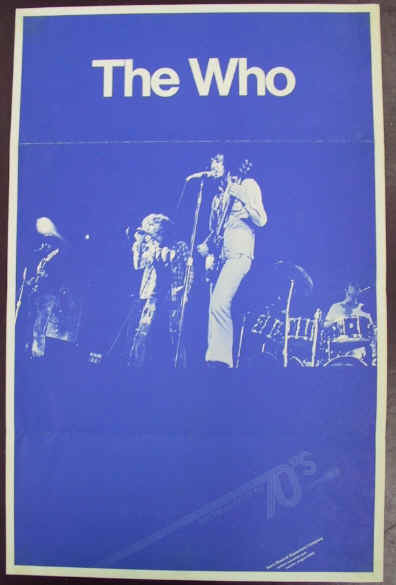
Click to view larger version Courtesy whocollection.com


Click to view larger version Courtesy Martin Forsbom

Click to view larger version Courtesy Mark Herman
Hiwatt Amplification (1969)

Click to view larger version Courtesy Hiwatt Story (dcsbulldog.tripod.com)
Hiwatt Story (dcsbulldog.tripod.com)
Fane (1979)

Fane speakers ad, courtesy Martin Forsbom.
A generic “Who” endorsement of Fane speakers, which were used in Hiwatt amplifiers by John and Pete.
Marshall (1966)

Marshall promo: Who generates the power behind “My Generation.” Courtesy Max the Mod (offline)
Generic Marshall amplification promotion, showing Pete and John’s Marshall JTM45 100 amps and 8×12 cabinet stacks as well as the group’s Marshall 1969 4×12 PA columns.
Who generates the power behind “My Generation”

Click to view larger version. “Go over big with Marshall.” The Who in late 1965 or early 1966 with two Marshall 4×12 model 1969 PA columns at left (same photo as above), and, bottom, from left to right, Marshall 1960A 4×12 cabinet, Marshall 1969 speaker columns and Marshall 1968 Super P.A., courtesy Kurt Schrotenboer.
Miscellaneous and accessories
Aclam Windmiller Preamp (2021)

Pedal image courtesy Aclam Guitars
Aclam Guitars has introduced an effect pedal that recreates the Grampian Reverberation Unit Type 636 S/N: 1138 that Pete used as a saturation tool.
The pedal was developed from an original type 636 preamp unit. (NB: Not endorsed by Pete.)
From Aclam:
aclamguitars.com/thewindmillerpreampThe result is a versatile pedal that can be used as an “always on” preamp with a beautiful color, a booster for solo parts, or a tool to saturate and enhance the amp’s natural overdrive.
- Based on the preamp of the Grampian Reverberation Unit Type 636 S/N: 1138
- Suitable for guitar, bass and keys
- Improved and quieter circuit including true bypass switching
- Hi. Cut and Lo. Cut tone shaping controls for maximum versatility
- Smart Track® Fastening System
- Controls: Gain, Overload, Lo. Cut, Hi. Cut
Audient ASP8024 mixing desk (2010)
Excerpt of article about Pete’s use of the Audient ASP8024 at audient.com/news/audient-makes-life-easier-pete-townshend-my-desk-literally-plug-and-play:
Musician and songwriter Pete Townshend had three requirements of the mixing console for the new multi-functional recording studio he was building: sonically transparent, efficient operation and fast delivery. Audient delivered on all three with its flagship ASP8024 analogue desk.
“I had to have a desk that any engineer would immediately feel comfortable with,” explains Townshend, best known for his forty years as rock guitarist with The Who. “I didn’t want to buy a classic desk, even though I found some nice old ones with patchbays. They would have been tricky to keep properly serviced.”
“Then I remembered how wonderful life was in my private control room at Eel Pie, back when I was mixing The Who’s last album, Endless Wire,” he says. “The desk? An Audient ASP8024.”


Read the full article at audient.com/news/audient-makes-life-easier-pete-townshend-my-desk-literally-plug-and-play.
audient.com/news/audient-makes-life-easier-pete-townshend-my-desk-literally-plug-and-playAkai Pro APC40 Artist (2009)

Click to view larger version Akai Pro ad
Pete has endorsed the Akai Pro APC40 Artist software controller. From the endorsement:
akaipro.com/townshendPete uses Ableton Live and the Akai Professional APC40. He had this to say about the APC40:
“The AKAI Pro APC40 is an incredibly powerful interface for LIVE. LIVE is already an extraordinary composing tool, with big real-time capability that I have never thought I could ever use. I always thought LIVE would be great for deejays and veejays, but they’d need to be masters of MIDI-mapping to be able to make LIVE really fly the way it can when you have the software under your mouse.
But the APC40 makes creating loops and rhythmic scenes, constantly changing and elaborating, so easy. It is intuitive, and everything is right under the fingers. This is going to change Live music based on loops and sample — and of course now LIVE itself is a fully functioning sequencer recording audio as well as MIDI and triggered loops, musicians are going to be able to model sound in the studio to perfection, but then bring exactly the same loops and tracks to life on stage in complete synchronicity with the band — but most important the mood and vibe of the audience.
Astonishing. This simple interface has created the most powerful new tool for the stage and studio that I seen in the last ten years. Deejays are going to go nuts for this — but musicians too, possibly even drummers.
Everything is under the fingers. I will go further. This interface, loaded with drum loops makes you feel like that kid in Santana playing for Carlos Santana at Woodstock in 1969. It’s a revolution, but this time the only drug is the APC40. I am hooked.”
Strobostomp pedal tuner (2005)

Click to view larger version StroboStomp ad
In an ad appearing in Guitar Player magazine, Pete is promoting the Peterson StroboStomp pedal tuner.
strobostomp.comDon’t get fooled again. Hear the difference. With 1/10th cent accuracy, 100% true bypass switching, in a Rock n ’Roll-proof package, Who wouldn’t want one?
petersontuners.com
detempleguitars.com


Click to view larger version.
Ernie Ball (2015)


Click to view larger version Ernie Ball ad, ca. 2015.
Pete has used Ernie Ball strings since as early as 1989, and he is featured in the company’s artists series.
ernieball.jp/artists/pete_townshend.html (archived)JBL (2002)


Click to view larger version JBL ad, ca. 2002. Courtesy Martin Forsbom.
Sponsor of the 2002 Who tour.
jbl.com/jbl-who/ (archived)Today I use JBL speakers everywhere in my life — at home and in the studio. I still have several sets of 4311s, and lots of smaller speakers that I like to use rather than those funny Yamaha things everyone loves. I use big modern JBLs for my cinema set up at home (I use the cinema rig as a test bed for my 5.1 mixes as well).
Fishman Acoustic Amplification (2007)

Click to view larger version (192kb) Fishman trade ad, courtesy Mark Herman.
fishman.comPickups and preamps. Toneshaping. Acoustic Amplifiers.
True Life. True Live.
On stage or at home, Fishman acoustic amplification products deliver the quality, accuracy and beauty or your instrument’s natural sound.
Pete Townshend uses the Fishman Ellipse® pickup & preamp system.
Ellipse Matrix Blend. Ellipse VT. Ellipse Aura new for 2007.
Fishman Powerbridge (1999)

Click to view larger version
fishman.comPete Townshend and the power of Fishman … pure genius. Because when Pete walks on stage, the Fishman Powerbridge™ pickup is the only acoustic he trusts to deliver his music. Loud and clear. From subtle finger-picked passages to crushing windmill power chords. From the opening acoustic chords of Pinball Wizard to the high energy riffs of My Generation. And everything in-between. Give your guitar an infinite palette of sound. Follow Pete’s lead. Play Fishman. And you won’t get fooled again.
The Fishman family of Powerbridge™ Pickups for Strat-style, Tele-style and Tune-O-Matic bridges
Parsons/White String Bender (1992)

Click to view larger version String Bender ad. Courtesy eBay ID jupiterschild31.
Pete appears in an ad with Albert Lee promoting the Parsons/White String Bender. This ad appeared in the September 1992 issue of Guitar Player magazine.
Because Albert Lee & Pete Townshend don’t have three hands … Parsons/White String Bender. Play what you’ve been hearing.
The String Bender (or “B-Bender” — as its known when used for the “B” string) is a modification to the guitar, where a mechanism is inserted into a routed cavity that connects the bridge to the upper strap button. Pushing down on the guitar body at the strap button activates the “bend,” giving a pedal-steel guitar-like effect to the B string.
Pete used the String Bender on the 1982 studio recordings of Eminence Front and One at a Time using his customised Roger Giffin-built Schecter Telecaster-style with B-Bender.
stringbender.comSoundtracs (1984)

Click to view larger version Soundtracs ad, ca. 1984, courtesy WhiteFang’s Who Site.
Who uses Soundtracs? Pete Townshend that’s who
— The only mixer in the 16-track market designed with the musician in mind — either you people at Soundtracs are musicians or you’ve talked to a lot of people. I’d recommend this mixer to anyone — and tell them that I paid full retail for the 16-8-16 I bought!
— Pete Townshend, November 7th, 1984
ARP Synthesizers (1970s)
Pete used ARP synthesizers beginning in 1971 with Lifehouse (which became Who’s Next).

Click to view larger version ARP synthesizer ad, ca. 1975. Courtesy Martin Forsbom.
ARP ad ca. 1975
Pete’s ARP Opera.
You know Pete Townshend. He and his ARP synthesizers produce some of the most incredibly creative music of our time. As a matter of fact, Pete used his ARP’s throughout the soundtrack of the new “Tommy” film.
His creations say plenty. About life. And about his choice of musical instruments. His ARP synthesizers help him express himself exactly the way he wants to. His ARP 2600, for instance, has a patch cord and slider system which makes it a natural for live performance or studio work. You’ll find one in just about every leading rock band in the country.
Who wrote the first ARP opera? None other than Pete Townshend. There are seven different ARP models to suit every musical need and budget, from $995 (suggested list). Now, isn’t it time you discovered all about ARP … the number one hitmaker.
ARP Instruments, Inc. 320 Needham Street, Newton, MA 02164.

Click to view larger version “Pete Townshend with his ARP 2600 Synthesizer” — ARP 2600 synthesizer ad, ca. 1972. Courtesy Ed Intagliata at Cassell’s Music, San Fernando, Calif. cassellsmusic.com.

Click to view larger version (587kb). “Who’s Arp?” ARP synthesizer ad from 23 Nov., 1972, issue of Rolling Stone. Courtesy Martin Forsbom and Bill Keller.
EMS VCS3 Synthesizers (1971)
Pete used an EMS VCS3 (the “Putney”) synthesizer in 1970/71 for Lifehouse (which became Who’s Next), and is referenced in this ad from Rolling Stone in 1971.

Click to view larger version EMS VCS3 synthesizer ad, ca. 1971. Courtesy Bill Keller.
ems-synthi.demon.co.ukthink of a sound...
now make it...The Putney is designed for the exacting standards of electronic music and is really easy to operate.
With absolutely foolproof cordless patching and easy portability, it accepts any guitar or microphone input, and connects directly into your sound system. It contains a full complement of electronic devices — oscillators, reverberation, filters, ring modulators, noise generators, joystick control and many more to produce the whole spectrum of electronic effects. A revolutionary matching keyboard is also available for the Putney.
More VCS3’s have been sold than any other synthesizer in the world and are already used by Blood Sweat and Tears; Pink Floyd; King Crimson; Moody Blues; Peter Paul and Mary; Ringo Starr; Pete Townshend; Third Ear Band; Gentle Fire and the Crazy World of Arthur Brown.
Buy direct from the manufacturers at the incredibly low price of: $785. $285: keyboard.
Electronic Music Studios (London) LTD.
Write or phone for details and free brochure to:
49 Deodar Road
London S.W. 15 England