John Entwistle’s Gear: 1960–1963
Getting started, the first Fender P
First bass guitars
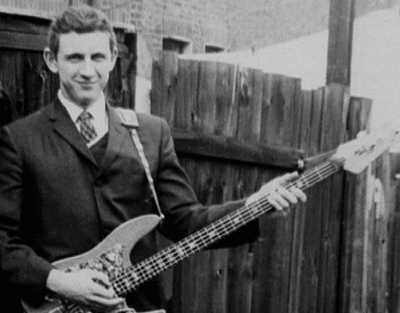
First bass guitars
-
Ca. 1960, self-built on grandmother’s dining table, a Fender Precision copy out of mahogany and painted mauve. John had it fretted like a Hofner bass.
From the November 1975 Guitar Player
Then, when I was about fourteen, I made my own bass. I never played guitar. Everybody I knew played guitar, and everybody needed bass players, and they just weren’t about. When I first started playing in England there were only about four bass guitars on the market, and they were all very cheap. You couldn’t buy a Fender bass or a Gibson. They were all like these very cheap tuxedo basses; I think the most expensive on you could get was a Framus-style bass — a big sort of acoustic thing — and a few Hofners. I had some photographs of Fender basses, and I just looked very closely at the pictures and tried to make one. I wanted a nice long bass, and so I made the neck really long — it ended up about 5′6″ long. When I took it in to be fretted they took the fret measurements off a Hofner violin bass, and it ended up with about 9″ of fingerboard with absolutely no frets on it. It had a drum material for the scratch plate, the control knobs were stuck on with glue, the wire came straight out of the pickup, and it had a square neck as well. It was terrible.
From the April 1995 Bassist
“My first bass was a chronic homemade effort, but I was in a hurry! I had it cut out of a piece of wood and it was in one piece. The guy who made it cut the neck off for me and I had to screw it back on again. It had a pickup made by a company called Royal that looked like a sardine tin with a lead coming straight from it. I didn’t realise that you had to put the lead in the actual body and have a jack plug socket there, and I just had a jack plug on the end of the pickup lead, so it was only about a couple of feet long! I had to sit down to play it through some anonymous amp.
“I’m sure the speaker was smaller than a 10″ and it was a mighty 10 watts. But most of the time during rehearsals I used to play through the rhythm guitarist’s record deck because it sounded better than the amp. That says a lot about the amp, doesn’t it?”
From the October 1974 Guitarist:
-
I was playing trumpet in a dance band, playing at interesting venues like Joe Lyons and social clubs. I was quite interested in the guitar in the band, but the guitarist kept breaking strings. I think he must have tuned it wrong. Anyway, I had a guitar-playing friend who had made his own amp, and he wanted me to join him in a group, playing trumpet. When we got together he was louder than me, so I thought I’d better enquire into this guitar thing! I looked at 6-strings, but I found bass was much easier — mainly because the strings are further apart. There were only two or three you could buy here in those days, Tuxedo, Star and Lucky 7, and they were all too expensive. I wanted a Fender, but they just weren’t available. I think Jet Harris was the only person who had one then.
- So what did you do about that?
-
I had one made up, same sort of shape, but not really very good. It had a great, square-backed neck, just glued on to the body. One day I was playing it, the glue gave out and I had an instant four-string harp!
-
-
Then, built a Fenton-Weill bass at the Fenton factory.
Fenton-Weill, a guitar manufacturer with a factory in Chiswick, made oddly shaped but serviceable guitars. For a fiver (about twelve dollars), Entwistle convinced someone who worked for Fenton-Weill to smuggle out a body for his next instrument. A second factory had put on all the other parts. Peter remembered this bass sounding “pretty good.” John swore it was “diabolical.”
Early amplification
-
Vortexion 50-watt amplifier without tone control with a single 18″ Goodman speaker suspended on a six-inch nail inside an open-backed cabinet, covered with a red, green, turquoise and yellow curtain fabric.
“I had to remove it after a gig, otherwise the band refused to carry the cabinet because of its weight.“
From Guitar Center interview with Pete and John, May 15, 2002:
- GC: You’ve gone through quite a few makes and models of amps over the years. Can you take us through the high points of your amp history.
-
John: I started out with an 18″ speaker, which lived in an open-back cabinet. The rest of the band (we had no roadie at the time) objected to the heaviness of the cabinet with the 18″ inside it. So we had the idea to hang the speaker on a six-inch nail and carry it in a separate cardboard box. Consequently every time I played a low E note the speaker would vibrate off the nail and fall on the floor behind the cabinet. I guess I learned how to play with just my left hand in this way — as I needed the right to hang the damn speaker back on the nail!
1963
As the Detours.
Bass guitar
-
1961 Fender Precision bass guitar
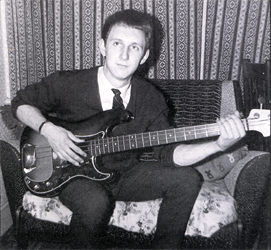
Ca. 1963(?), John with Fender Precision Bass.
In mid-1963, a 1961 Fender Precision, his first proper bass.
- Acquired from Gabby Connolly, Detours co-vocalist, in 1963, for paying off his £50 HP debt.
- Later sold at Roger’s behest, who thought it kept blowing up speakers.
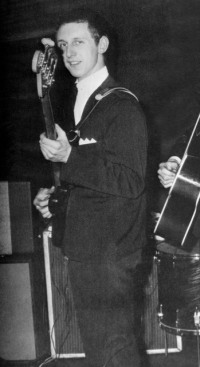
Ca. 1963, as the Detours, John with Fender Precision Bass, in front of the speaker “cabinet” containing one Goodman 18″ speaker hung on a nail, and covered in curtain fabric.
Excerpt from January 1977 interview with John in International Musician and Recording World:
I just don’t like getting rid of any guitars. I bought a Fender bass a long time ago and it was a really nice bass. I had a couple of 15″ speakers and they always seemed to distort, so we figured it must be the bass. I sold the bass for £50! After that, I realised it wasn’t the bass after all and from then, decided I wouldn’t get rid of any guitars.
From the October 1974 Guitarist:
-
The Detours had a new singer and he was also a bass guitarist, but he had some HP troubles. He kept the guitar hidden under his girl friend’s bed. He said I could have it if I paid off his £50 HP debt. It was a Fender Precision. I was around 16 at the time.
- And The Who had started?
-
Yes, only we were called The High Numbers at first. We had an agent and we were quite busy — about five gigs a week around west London. I made a mistake about the Precision. I was ignorant about amps and speakers, and because everything sounded rather weird I got rid of it and got a Rivoli. Later I regretted parting with the Fender, but then the group began to get very popular and I found I could afford better guitars.
Bass Culture:
“After a string of homemade monstrosities, made of mostly stolen parts (the Fenton Weils guitar factory was half a mile from my house) I finally took over the finance payments of a G4 Fender Precision bass. That bass spent the next year propped up at the foot of my bed. It was the last thing I saw at night and the first thing I saw in the morning. Fads change and I partly exchanged it for £50.00 at Marshall’s Music Store for a sunburst Semi-Acoustic Epiphone Rivolvi [sic], which I later partly exchanged for a Rickenbacker.”
Amplification
- Vox AC15, shared with PA. The Detours had two Vox AC-15s, one for Roger and Pete to share, and one for John and the PA.
Resources and Information
Contributors
Thanks to those who have made this page possible:
- Paul Winkler (pw_lists@slinkp.com)
- Brad Rodgers (whocollection.com)
- Max The Mod: westminsterinc.com/who1965/equip.htm (offline).
- Calvin “Sandy” Buckles
Additional Information:
- Brad Rodgers at whocollection.com
- Rock Stars Guitars, rockstarsguitars.com
- Sotheby’s May 2003 auction: sothebys.com
- Björn Eriksson’s Rickenbacker Info: rickbeat.com
- Vintage Guitars Info (Rickenbacker): guitarhq.com/rick.html
- Vintage Guitars Info (Gibson): guitarhq.com/gibson9.html
- Vintage Guitars Info (Epiphone): guitarhq.com/epiphone.html
- Vintage Guitars Info (Danelectro): guitarhq.com/dano.html
- Vintage Guitars Info (Fender Bass): guitarhq.com/fender2.html#pbass
- Max The Mod: westminsterinc.com/who1965/equip.htm (offline)
- Rickenbacker Registration: rickresource.com
- alt.guitar.rickenbacker FAQ: faqs.org/faqs/music/guitars/rickenbacker/
- Dr. Tube’s Schematics: drtube.com/guitamp.htm
- PlexiPalace Vintage Amps Forum: vintageamps.com/plexiboard/viewforum.php?f=24 (archived)
- The Vox Showroom: voxshowroom.com
- The Vox Museum: voxamps.com/museum/acroom/
- Bass Culture, by John Entwistle; forewords by Roger Daltrey and Rick Nielsen. Published 2004 by Sanctuary Publishing
Manufacturer’s Links:
- Rickenbacker: rickenbacker.com
- Fender: fender.com
- Marshall Amplification: marshallamps.com
- Sunn Amplification: sunnamps.com
- Epiphone: epiphone.com
- Gibson USA: gibson.com
- Rotosound Strings: rotosound.com
- The Vox Showroom: voxshowroom.com