John Entwistle’s Gear: 1967–1968
Frankenstein is alive; Sunn, Solid-State, and Sound City amps
Bass guitars – 1967–1968
With the Who’s first North American tours in 1967, John continued to experiment with different bass guitars, eventually settling on Fender Precision basses, and putting together “Frankenstein.”
- 1962 Fender Precision bass
-
Fender Bass VI
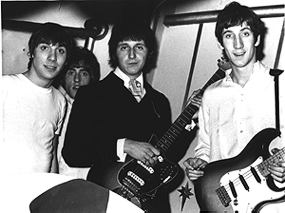
17 May 1967, with Fender Bass VI, backstage at the Stevenage Locarno.
John continued to use a Fender Bass VI six-string bass into 1967, though unknown whether it was a different instrument than the one he used in 1965.
-
Fender Jazz bass (Fiesta Red)
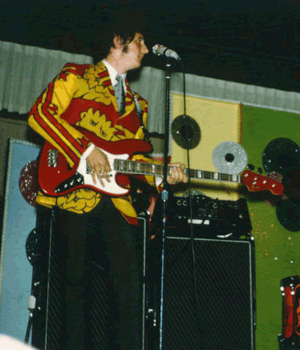
19 July 1967, Salt Lake City, Utah, U.S. tour with 1966 or 1967 Fender Jazz with block fret markers, and U.S. Thomas Organ (Vox) V1143 Super Beatle solid-state amps and cabs.
- Used on first American tour, July/August 1967.
- A 1966 or 67 model, Fiesta(?) Red, on both body and headstock, bound rosewood fretboard with block fret markers.
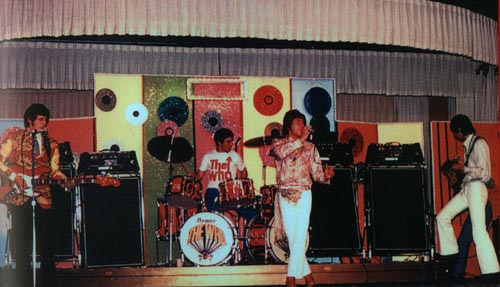
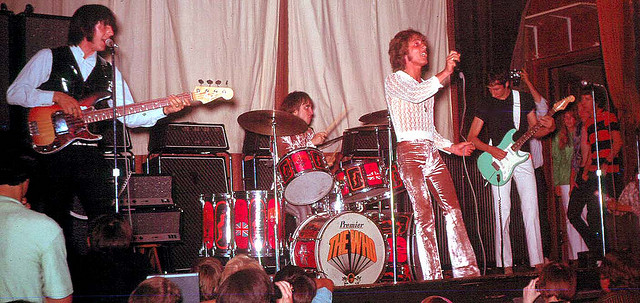
19 July 1967, Salt Lake City, Utah, U.S. tour with Pete and John using U.S. Thomas Organ (Vox) V1143 Super Beatle solid-state amps and cabs. Bass is 1966 or 1967 Fender Jazz with block fret markers.
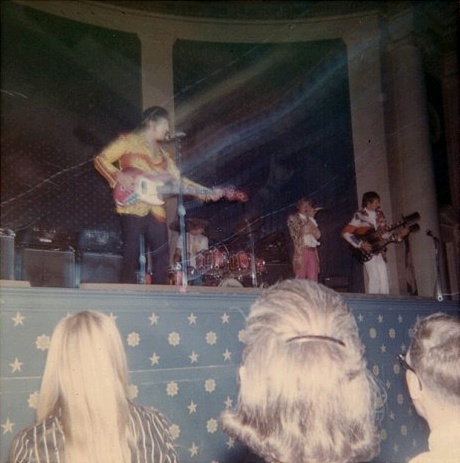
13 Aug. 1967, Constitution Hall, Washington, D.C., with with 1966 or 1967 Fender Jazz with block fret markers, and U.S. Thomas Organ (Vox) V1143 Super Beatle solid-state amps and cabs.
-
Fender Precision Bass (black)
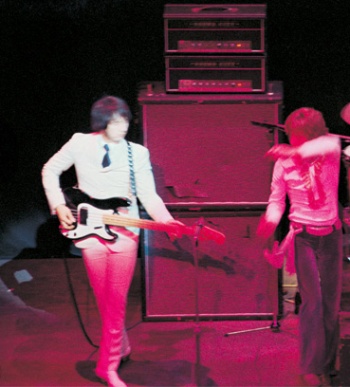
22 Oct. 1967, Saville Theatre, with black Fender Precision, two modified Sound City L100 amps stacked, and two 1982B (extra tall) Marshall 4×12s.
Fender Precision Bass, in black, with maple neck (used August to at least October 1967).
-
Vox Sidewinder IV V272 bass
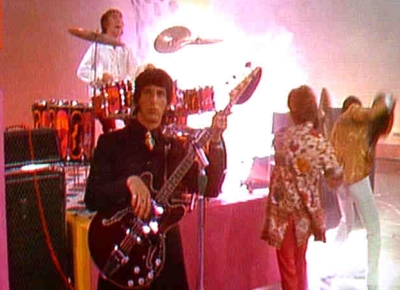
The Smothers Brothers show, 15 Sept. 1967.
Vox Sidewinder IV V272 bass in a burgundy-grain finish, as used on the Smothers Brothers show, 15 Sept. 1967.
According to the Vox Showroom, the Vox Sidewinder IV featured battery-powered on-board special effects: built-in G tuner, distortion booster, treble and bass booster; “double T” bar and adjustable steel truss rod; two Ferro-Sonic pickups; fully adjustable bridge; one volume, two tone controls, three-position pickup selector switch; and jumbo chrome-plated machine heads.
-
Custom “Axe” Jazz bass
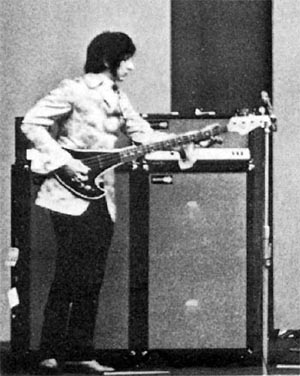
19 Nov. 1967, Hollywood Bowl, Los Angeles, with two Sunn 100S or 200S amplifiers and Sunn 200S 2×15 cabinets. Bass is custom “Axe” bass. Courtesy Mark Herman.
- An amalgam of a Fender Jazz bass rosewood neck and electronics with a custom axe-shaped body with bound black finish.
- Used at least 3–22 Nov. 1967; first known use: Granada Cinema in Kingston-upon-Thames, London, on 3 Nov. 1967.
- Replicas made in the 2000s by NS Custom Guitars.
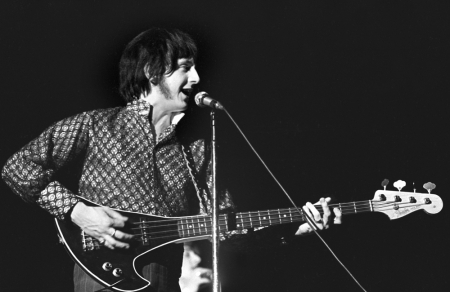
18 Nov. 1967, Cow Palace, San Francisco, with custom “Axe” bass.
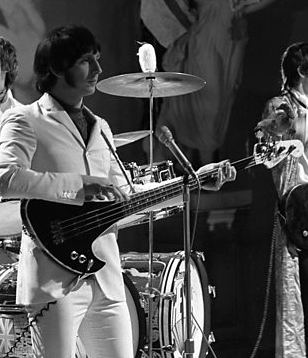
15 Oct. 1967, television performance with the custom “Axe” bass.
-
Custom-made “Spider” bass
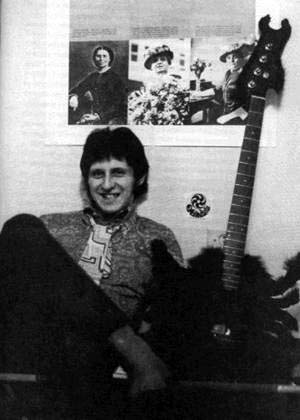
Ca. 1967, backstage with the custom “Boris the Spider” bass.
A custom-made “Boris the Spider” bass.
-
1966 Fender Precision Bass (slab) in Olympic White
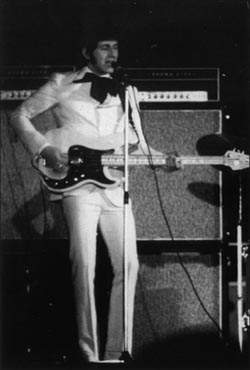
6 May 1967, Stockholm, Sweden, with two modified Sound City L100 amps and two 1982B (extra tall) Marshall 4×12s (tops) and 1982A (straight-front) Marshall 4×12s (bottoms). Bass is the 1966 slab Fender Precision Bass.
John continued to use a 1966 Fender Precision Bass (slab) in Olympic White, with maple neck, into 1967, before it became part of Frankenstein.
-
Fender Precision Bass (sunburst)

17 Aug., 1968, at Phoenix, Arizona, four Sunn 200S 2×15 cabinets stacked vertically, driven by two Sunn 200S amplifiers. Unknown pedal or splitter at far left of stack. Bass is sunburst Fender Precision Bass with rosewood fretboard.
John used a Fender Precision bass in sunburst with rosewood fretboard in 1968, and continued to use this bass at least into 1969.
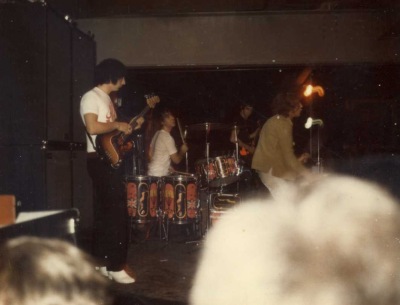
Click to view larger version. 10 Aug. 1968, Jaguar Club, St. Charles, Ill. Bass is sunburst Fender Precision Bass with rosewood fretboard. (Photo: Rick Giles)
For more, see The Who at the Jaguar, 10 Aug. 1968. -
“Frankenstein”
1965 sunburst (refinished in the mid-’70s to Fiesta Red/salmon pink) “Frankenstein” Fender Precision Bass with maple neck.
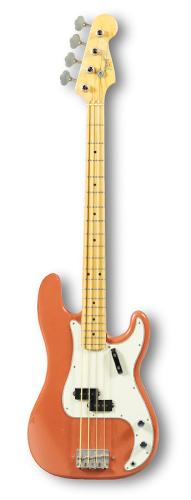
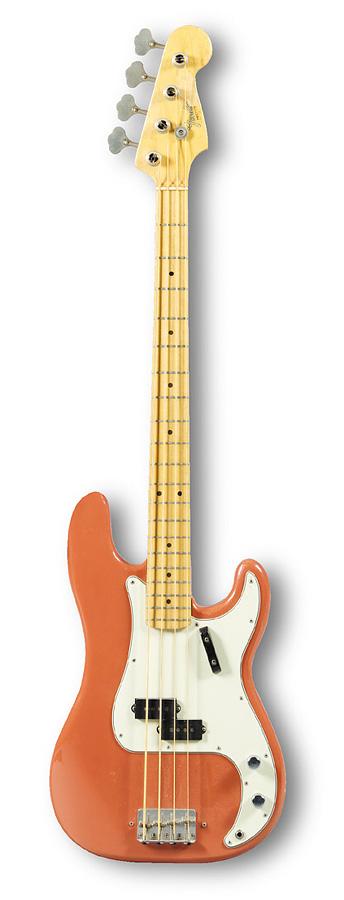
Click to view larger version: The “Frankenstein” 1965 Precision bass (refinished), with new pickguard.
- Assembled from various basses, including the chrome pickup cover from a Fender Jazz Bass; the neck pickups and circuitry from two of John’s three “dead” slab basses.
- Serial no. 13081, stamped on neckplate.
-
Used beginning 1967.
JE: I put this together in San Francisco on a day off part way through a Who tour. It’s the remains of five smashed basses hence the name ‘Frankenstein’. In the mid 70’s it was retired from stage work so I had it refinished from sunburst into its present pink colour. I used this baby from 1967 onwards through ‘Tommy’ and all the tours up to ‘Quadrophenia’...The neck, pickups and circuitry are from a ‘dead’ slab bass, the tailpiece from a Jazz bass, the pickguard from a black P bass and the machine heads from 2 white P basses...Two hours with a Phillips screwdriver and a soldering iron and I was ranting around my hotel room screaming “It’s alive, it’s alive!”
Quote from April 1994 Bassist interview
- Which sound was responsible for that amazing sound on Won’t Get Fooled Again?
-
“That was Frankenstein, which I made from dead parts. I had a day off in San Francisco once and spent it screwing a bass together from five smashed Precisions including a couple of slab ones of which they only made about 20. I took the pickup and scratch plate from one of the slab Precisions, the neck from another, machineheads from a Jazz Bass, the body off a sunburst Precision and the tailpiece from another. The slab Precisions were like white, squared-off Telecasters, with a split pickup, a maple neck, black scratch plate and what looked like blue veins coming through the white paintwork. I don’t know what they used on them but those basses had a sound of their own, really raunchy with more of a growl than a regular Precision. I have about 35 Precisions, all with different colours and from different eras, but I always go back to Frankenstein.
“I used Frankenstein through Hiwatts for the whole of ‘Tommy’, ‘Live At Leeds’ and ‘Who’s Next’ but by ‘Quadrophenia’ and Who By Numbers I was playing Gibson Thunderbirds. I felt I was getting stuck in a rut, using all the treble.
- Sold in Sotheby’s May 2003 auction: estimated £5,000–£7,000; sold for £62,400.
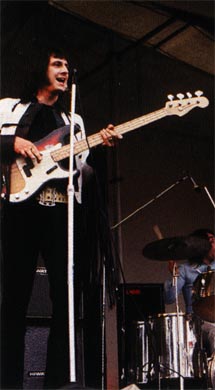
On stage, 30 Aug. 1969, second Isle of Wight festival, with the “Frankenstein” Fender Precision bass.

Amplification – 1967–1968
19 July 1967, Salt Lake City, Utah, U.S. tour with 1966 or 1967 Fender Jazz with block fret markers, and U.S. Thomas Organ (Vox) V1143 Super Beatle solid-state amps and cabs.
From the end of 1966 into 1967, both John Entwistle and Pete Townshend continued their use of Marshall 100-watt JTM100 Super Lead amplifiers or the model 1967 Marshall Major Lead (affectionately called the “Pig”) 200w amps, with 1982 and 1960 Marshall 4×12 speaker cabinets in various configurations, either in traditional stack form, with the amp on top of the cabinets, two amps stacked high, one on top of the other, on top of cabinets, or as a precursor to their future rigs, with the amps on a stand or chair next to the speaker cabinets. Pete early on ran the guitar to a split “Y” cable to power both amplifiers. Later, he used “daisy chain” cabling, where the guitar lead went into the “High Treble” input of channel I amp and out of channel II into the second amp. John would also use a split cable, or occasionally had dual/stereo jacks on his Jazz bass, with each lead going into one amp, one for treble frequencies (treble dimed, bass rolled off), one for bass frequencies (vice versa).
For the Who’s first shows in March/April 1967, and subsequent North American tour starting June 1967, instead of their usual Marshall stacks, John and Pete used U.S.-manufactured U.S. Thomas Organ V1143 “Super Beatle” solid-state amplifiers. The Super Beatle was the made-for-U.S. solid-state version of Vox’s AC-100, which Pete had used in 1965. Thomas Organ owned the rights to distribute Vox in the U.S., though Thomas Organ began designing and building its own “VOX” amplifiers, albeit of inferior quality. The amp line was coined the “Beatle” to take advantage of Beatlemania, though the Beatles did reportedly use the Super Beatle on their last few U.S. concert dates.
The reason for the difference in gear in the 1967 North American shows was that the group could not afford the cost of importing their full gear and, instead, rented or borrowed gear once arriving in the U.S. Because of their financial straits, Chris Stamp, the Who’s manager, signed the group to an exclusive agreement with Vox to use their gear in the States. On the first 1967 U.S. tours, including the March/April 1967 “Murray the K – Music in the Fifth Dimension” shows in New York, and the Monterey Pop festival in June, the Who used rented U.S. Thomas Organ (Vox) V1143 ‘Super Beatle’ 120w solid-state amplifiers and 4×12 (w/two horns) cabinets. The inferior quality of the gear is evident in the 18 June, 1967, Monterey Pop show, where Jimi Hendrix, who had “learned” his gear setup from Pete and the Who, was able to bring his Marshall 4×12s and 100-watt amps, to great effect. So while the Who were renowned in England for the sheer power and volume of their Marshall gear, it was Hendrix (and The Cream) who would ultimately gain notoriety in the USA for “pioneering” the Marshall backline.
Beginning in April 1967, upon returning from the USA, John began using Sound City L100 100-watt amplifiers, first paired with Marshall 4×12s, and later with Sound City 4×12s. Pete began using Sound City amplifiers starting in May 1967. These amps were customised for Pete and John by Dave Reeves of Hylight Electronics, the maker of Hiwatt amplifiers (and who originally worked at Sound City, a division of Dallas Arbiter), presumably to what would be the CP103 specification.
The Sound City amps were used only in the UK/Europe until 1968. Back in North America in June 1967, John and Pete used Vox Super Beatles. The first North American tour, with Herman’s Hermits and the Blues Magoos, began 13 July 1967, where the Who continued to use the Super Beatles. However, on the second day of the tour, 14 July 1967, in Portland, Oregon, the Blues Magoos purchased (and became sponsored by) Sunn amplifiers and a Sunn Coliseum PA.
Mark “Hoss” Amans, roadie for the Blues Magoos, has written that he purchased Sunn amplifiers and Coliseum PA in Tualatin, Oregon, on 14 July 1967, and secured sponsorship by Sunn for the Blues Magoos. Because the Herman’s Hermits were sponsored by Fender and had matching amps, and the Who were sponsored by Vox and had matching Super Beatles, he thought it appropriate that the Blues Magoos also have a matching backline. So as the tour rolled on, it is possible the Who used some of these Sunn amps as they transitioned away from the Super Beatles. The Who and Hermits did use the Sunn Coliseum PA for the tour.
Excerpted from Mark “Hoss” Amans book, Where The Action Was:
When we were in Calgary, the Blues Magoos didn’t have matching equipment on stage. Hermans Hermits were sponsored by Fender, and they had all large Fender-dual showman amplifiers. The Who were sponsored by Vox, and had six Super Beatle Vox amplifiers. This was an amplifier I was well familiar with, because when I was with the Raiders, we were sponsored by Vox, as well. I knew Con and Norm Sundholm, because Norm used to play bass with the Kingsmen, and his brother Con started an amplifier company called Sunn, out of Tualatin, OR, just south of Portland.
So when we got to Portland, OR, to play the second gig of the tour, I called up Norm at the plant and told him my situation with the Blues Magoos. Here we were in the beginning of our tour, and I needed amplifiers and PA, bad. The Who, and The Herman Hermits didn’t even carry a PA with them, and in those days, we always carried our own equipment. We very rarely relied on the house to supply amps or PA systems. Keep in mind that this was long before the huge rental systems came into play.
So I took Mike Esposito with me and went to the Sunn factory. We went inside and told them exactly what we needed, and the guys really came through for us and sponsored The Blues Magoos with all Sunn equipment. We had all of the amplifiers for all of the instruments that we needed, and I told them that I wanted a Sunn Coliseum PA system which was customized with two horns on top of each speaker cabinet and two bottoms to a side. So that’s four horns to a side, and two bottoms to a side. And to this day, I still love that system.
I got back to The Coliseum with all of the gear in plenty of time to start the show. Even though though The Blues Magoos were better known at the time than The Who, the guys volunteered to open the show, and they let The Who play second, and The Hermits headlined. So I set up all of the Sunn amplifiers and PA, brand new, right out of the cardboard box. Looked very impressive.
The tour manager, Ed McAdams, used to handle a lot of the Dick Clark tours, and he knew me well. He put me in charge of all three of the road crews, because of my past experience. So unloading the truck, we had all of the Super Beatle amps, all of the Fenders, and all of the new Sunn gear from Portland. Also, all three groups used the Sunn Coliseum PA system, and they all liked it a lot. So I had to teach other roadies and cross-train them on all of the gear on stage. I was also in charge of the stage set up, all of the lighting, the sounds, and backstage security.
In the middle of the tour, The Who had to break away on a couple of off days and go to Tennessee to record a song called “I Can See For Miles”. They had damaged their amplifiers so bad because on their ending song called “My Generation”, they would kick the drum kits over, jam the guitars into the speaker cabinets of the Vox Super Beatle amps, knock the amps over, and break the guitars and throw them into the audience.
They also played so loud that one night I was I was watching standing off on stage left next to Peter Townsend [sic], and I looked down behind him between him and the amps and I saw a brass screw coming out of the deck. The vibrations from the amps were so strong that it loosened the screw and came all the way out of the stage and fell over.
They asked us if they could use our Sunn amps to record the song, “I Can See For Miles”, and The Blues Magoos said, “Sure, go ahead.” So I can say my Sunn amps are the amps that are on that song.
When the tour was over, they left all of their broken gear with the Blues Magoos, and we put it in the garage of our band house. They didn’t want to take it back to England with them. During the tour I had called Warren T. Hampton at Vox, who was the artist relations manager, and told him these guys were destroying their equipment. He didn’t know exactly what to say and I described to him how they were jamming their guitar necks into the grill cloths and speakers and kicking over the amps.
In August 1967, Pete and John began using two Sunn 100S 60-watt amplifiers (featuring KT88 valves) powering two or four JBL-loaded 2×15 Sunn cabinets. The first documented use of Sunn amps is 23 Aug. 1967, where they were used along with the Super Beatles. It’s possible these Sunn 100S amps were purchased on 15 or 16 Aug. 1967, during a two-day break in Nashville.
John and Pete also used blackface Fender Showman amplifiers and Fender 2×15 cabinets on the North American tour in August–September 1967. It is likely that these amps were borrowed from tour headliners Herman’s Hermits. The Hermits were sponsored by Fender, and as the Who were transitioning from Vox Super Beatles to Sunn in while on the tour in 1967, it is likely that these Fender Showman amps were borrowed from the Hermits during the tour.
Bobby Pridden has indicated the group purchased additional Sunn gear, including a Sunn PA, from Manny’s in New York, around the 25 Nov., 1967, Village Theatre date in New York, and prior to the 29 Nov., 1967, date in Scotch Plains, New Jersey. As a part of their use, the Who also provided endorsement for the Sunn gear.
Returning to the U.K. in October 1967, both John and Pete continued using Sound City.
For the 1968 Australia/New Zealand tour, the Who took various Marshall and Sunn gear, though were unable to source replacements for the Sunn speakers.
For the first 1968 North American tour, from February to April 1968, John and Pete used their Sound City gear for the first time in U.S. and Cananda, including the Grande Ballroom, Detroit, 9 March, the Opera House, Peoria, Illinois, 10 March, and the Fillmore East, New York, 4 April. However, for the the second 1968 North American tour, beginning with the Shrine Auditorium in Los Angeles on 28 June, both had switched back to Sunn.
For the 9–14 July, 1968, shows, Pete used Sunn Orion solid-state amps. until 14 July 1968, while John remained with the Sunn 100S and 200S amps.
During the Cleveland Musicarnival show on 14 July, 1968, Pete’s and Roger’s passports (and clothes) were stolen from the dressing room. The following day, on 15 July, The Who headed to Kingston, Ontario, Canada. Per the Concert File, en route in Toronto, customs officials demanded a $20,000 bond to release the band’s equipment. James McCormick, the promoter, chartered two aircraft to fetch The Who and entourage from Toronto after the customs had been satisfied. However, the Sunn equipment stayed behind. In Kingston, the promoter supplied instruments and equipment from a local source.
It has been assumed the abandoned Sunn gear was the Sunn 100S, etc., not the Orions, since the 100S was no longer seen in Pete’s setup. However, given that the Orions were used up to 14 July, it is possible it was some of the “16” Orion units, along with the original Sunn 100S amps that were left in Toronto.
After two more Canadian dates, the Who returned to the USA, Providence, Rhode Island, on 18 July, and had Sound City gear shipped over from the UK, with the first known North American date at The Dome, Virginia Beach, Virginia, 20 July 1968, where John used a combination of Sound City amps and speaker cabinets with Sunn speaker cabinets.
However, by August 1968, while Pete remained with Sound City, John had switched permanently to Sunn for the remainder of the tour.
Back in the U.K. for the duration of 1968, both John and Pete used Hiwatt-badged Sound City amplifiers, which began their full transition to Hiwatt.
Selected quotes
All quotes and references are copyright their original owners and are included for reference only.
From July 1967 Beat Instrumental article:
Sounds I Like – By Britain’s top Bassmen
John Entwistle
I’m using a Fender Telecaster bass on stage although I have a six-string and also a Precision, which I have modified—It’s finished in fur. Amps are two Sound City 100 watt units with 16×12″ speakers by Marshall. I like a “twang” sound, like [Duane] Eddy has but more bassy of course, with lots of bass and treble. I buy Rotosound wire-wound string for the twang I was talking about and I like a load of speakers in my set-up rather than a few large ones. I’ve been through the lot, 15″, 18″ but I found that they just flapped. It’s taken me six years to get the sound I want. It was four years before I could afford the gear that would give it to me. Now I think other groups are catching on the sound I use. I might be using reverb in the future.
From Guitar Player, October 1967
Excerpts from an interview with John Entwistle and Pete Townshend conducted 18 June, 1967, in San Francisco, just prior to the Who’s appearance at the Monterey Pop Festival.
- GP: What is your amp volume setting on a ratio of ten?
Entwhistle [sic]: Five or six, full treble. I use two amps: full treble and full base. The cabinets are split, so the treble comes out on top of the amp. I set my guitar about two-thirds on, and then at the end I turn it full up.
- GP: What about amps?
Entwhistle: Sound City, they’re an English amp. We both use sixteen twelve-inch speakers and two two-hundred watt amps. That way we get a nice even sound.
Townsend [sic]: We use Vox in the States . . . Super Beatles, four altogether.
- GP: Picks and strings?
Entwhistle: We both use Herco heavy-gauge nylon picks. And I use Roto-Sound heavy-gauge wirewound strings; they’re only available in England.
Amplifier details
-
Marshall 1959 JTM100 Super Lead amplifiers, Marshall 1967 Major Lead (The “Pig”) amplifiers, and Marshall 4×12 speaker cabinets
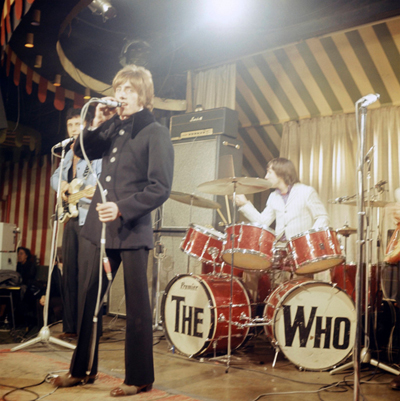
2 March 1967, at the Marquee Club, Wardour Street, with one Marshall JTM45 100 100w amplifier and one Marshall 1959 JTM100 Super Lead amplifier. Speaker stacks are 1982B cabinets.
John Entwistle continued his use of Marshall 100-watt amplifiers, with 1982 and 1960 Marshall 4×12 speaker cabinets in various configurations, connected via a split cable, until March 1967, when he switched to Sound City upon return from the USA in April 1967.
Setups: Two Marshall 1959 JTM100 Super Lead amplifiers, or one Marshall 1967 Major Lead (The “Pig”) 200-watt amplifier, into Marshall 1960A (angled front) and 1960B (straight front) or 1982A (angled front) and 1982B (straight front) 4×12 speaker cabinets.
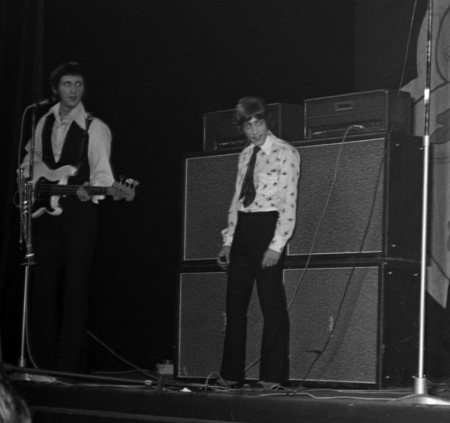
29 Jan. 1967, playing through a block logo Marshall 1959 JTM100 Super Lead and block logo Marshall JTM45 100 Super P.A. (right), connected via Y-cable, and driving four Marshall 1982B (extra tall) 4×12 speaker cabinets set sideways. Bass is the refinished 1962 Fender Precision bass.
-
U.S. Thomas Organ (Vox) V1143 Super Beatles (North America only)
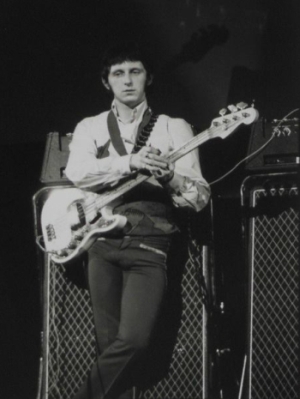
Click to view larger version. Ca. March/April 1967, Murray The K shows, with Vox U.S. Thomas Organ V1143 Super Beatles.
- U.S. Thomas Organ (Vox) V1143 Super Beatle solid-state amps and cabs (U.S./Canada 1967 tours only).
- Used on 1967 North American tours and acquired through Vox deal signed in States by Chris Stamp.
-
Features
- V1143 amplifier:
- 120 watts, solid state, Field Effect Transistors (FET)
- Three channels, with myriad effects, including reverb, tremolo, fuzz, mid-range boost.
- V4141 speaker cabinet:
- Four Vox Bulldog 12″ heavy-duty speakers and two 25w high-frequency horns, with two crossovers.
- Chrome-plated roller stand, with swivel lock.
- V1143 amplifier:
19 July 1967, Salt Lake City, Utah, U.S. tour with Pete and John using U.S. Thomas Organ (Vox) V1143 Super Beatle solid-state amps and cabs. Bass is 1966 or 1967 Fender Jazz with block fret markers.
19 July 1967, Salt Lake City, Utah, U.S. tour with 1966 or 1967 Fender Jazz with block fret markers, and U.S. Thomas Organ (Vox) V1143 Super Beatle solid-state amps and cabs.
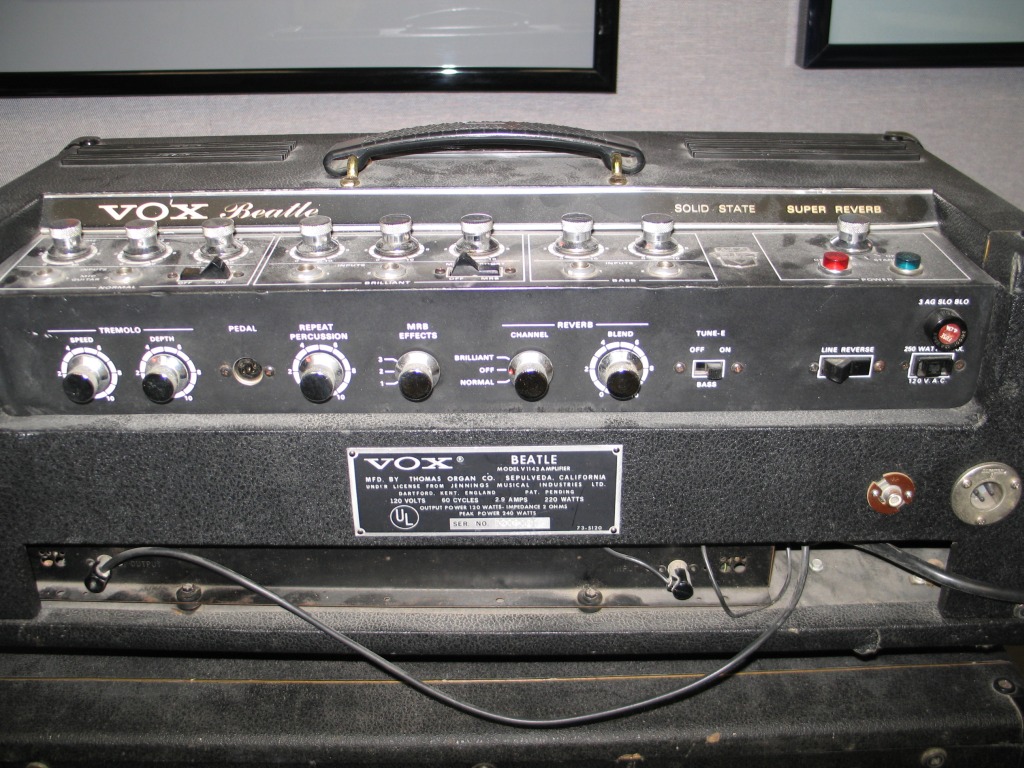
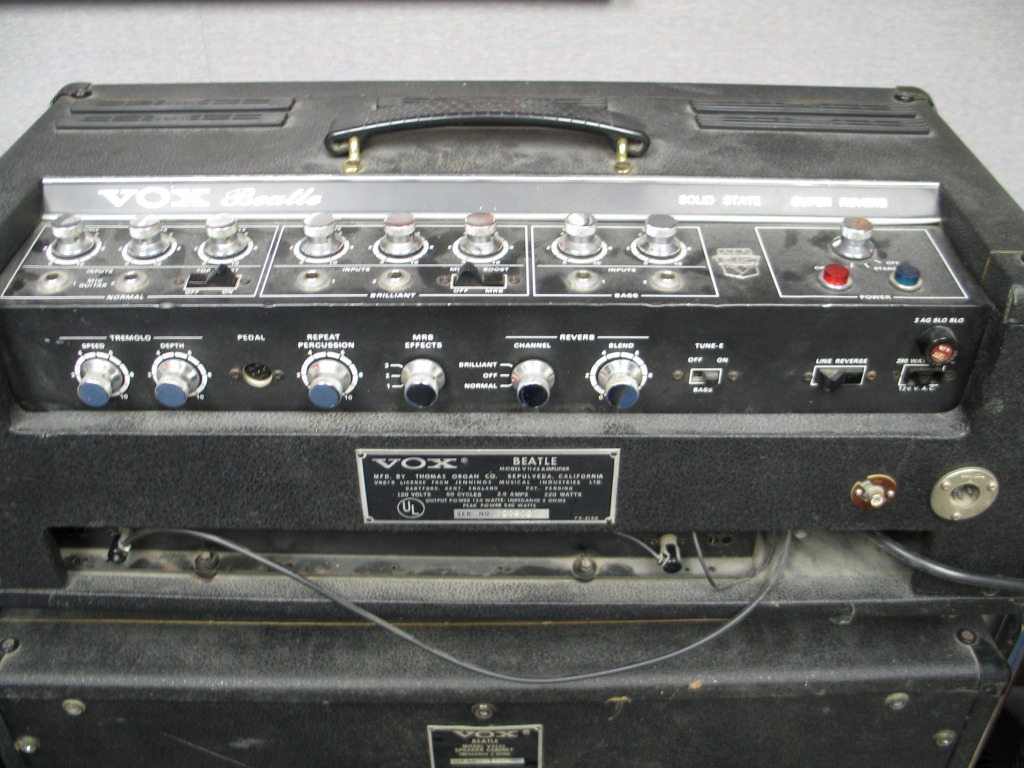
Vox U.S. Thomas Organ V1143 Super Beatle amp, owned by Brad Rodgers
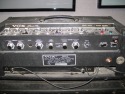
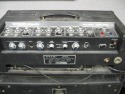
Brad Rodgers owns the following Vox U.S. Thomas Organ V1143 Super Beatle. It was reportedly left with Murray the K following their shows in March/April 1967. Vox Beatle amplifier model V1143, serial no. 1290020, and Vox Beatle Speaker Cabinet, model V4141, serial no. 195274. Images courtesy whocollection.com.


-
Sound City L100 amplifiers with Marshall or Sound City 4×12 speaker cabinets
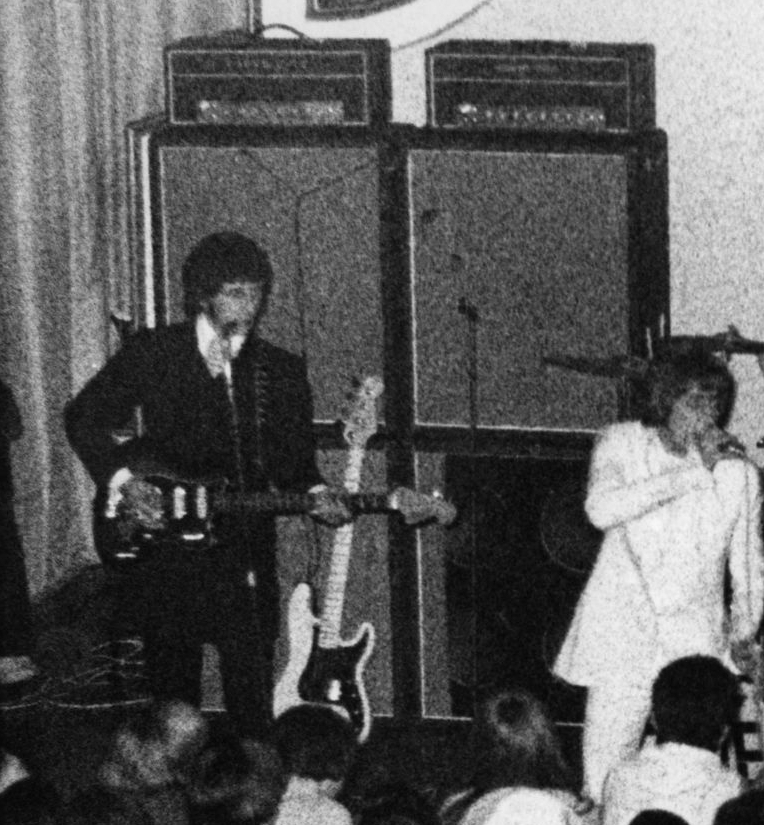
6 May 1967, Stockholm, Sweden, with two modified Sound City L100 amps and two 1982B (extra tall) Marshall 4×12s (tops) and 1982A (straight-front) Marshall 4×12s (bottoms). Bass is the 1966 slab Fender Precision Bass.
Beginning in April 1967, upon returning from the USA, John began using Sound City L100 100-watt amplifiers, first paired with Marshall 4×12s, and later with Sound City 4×12s. Pete began using Sound City amplifiers starting in May 1967.
These amps were customised for Pete and John by Dave Reeves of Hylight Electronics, the maker of Hiwatt amplifiers (and who originally worked at Sound City, a division of Dallas Arbiter), presumably to what would be the CP103 specification.
Customised Sound City L100 specs
The controls on the customised L100s were identical to the CP103 control layout. From left to right, the controls:
- Four inputs
- Volumes 1, 2, 3, 4,
- Treble
- Bass
- Master Volume
- Standby
- Mains
For more information on Sound City, see Pete’s Sound City/Hiwatt.
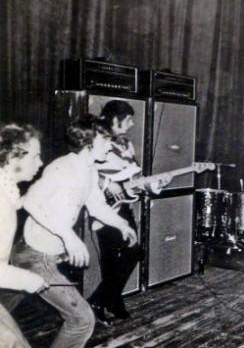
9 April 1967, Wuppertal, Germany, with two modified Sound City L100 amps and two 1982B (extra tall) Marshall 4×12s (tops) and 1982A (straight-front) Marshall 4×12s (bottoms) with badges still in tact. Bass is the 1966 slab Fender Precision Bass.
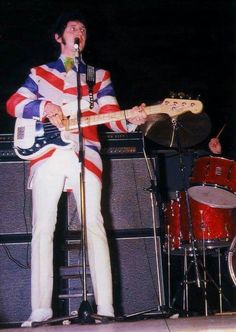
13 April 1967, Munich, Germany, with two modified Sound City L100 amps, with Y-cable, and four 1982B Marshall 4×12s without badges. Bass is the 1966 slab Fender Precision Bass.
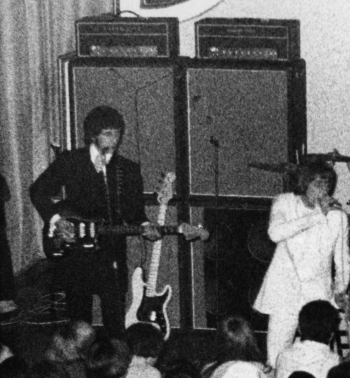
Click to view larger version. 17 May 1967, at the Locarno Ballroom, Stevenage, playing a Fender Bass VI, with the 1966 slab Fender Precision bass as spare. Amplifiers are two Sound City L100 connected by Y-cable, driving two 1982B (extra tall) Marshall 4×12s (tops) and 1982A (straight-front) Marshall 4×12s (bottoms).
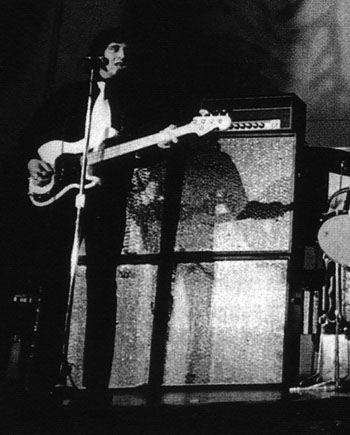
Ca. 1967, with two modified Sound City L100 amps and four Sound City 4×12s. Bass is the 1966 slab Fender Precision Bass.
22 Oct. 1967, Saville Theatre, with black Fender Precision, two modified Sound City L100 amps stacked, and two 1982B (extra tall) Marshall 4×12s.
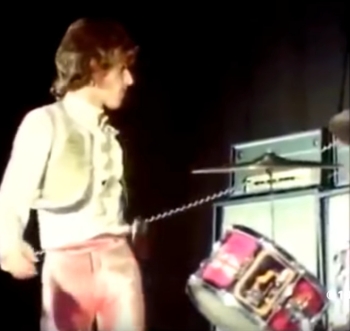
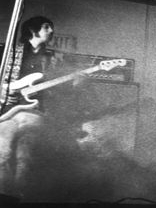
10 March 1968, Peoria Opera House, Illinois, with two Sound City amps unknown cabs.
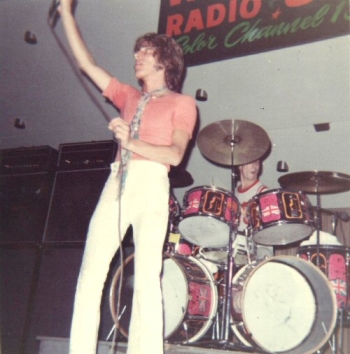
Click to view larger version. 20 July 1968, Virginia Dome, John using two Sound City L100 amps stacked on Sound City and Sunn cabinets.
-
Fender Showman amps and cabs (1967 North America only)
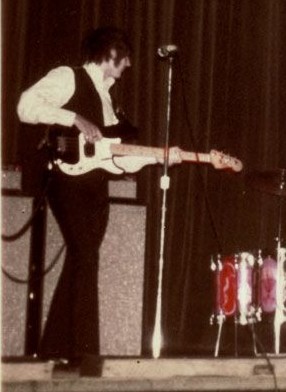
25 Aug. 1967, Kiel Opera House, St. Louis, Mo., with Fender Showman amps with 2×15 cabinets, likely borrowed from the Herman’s Hermits. Photo courtesy Paula Wills, stlbook.com.
Both John and Pete used blackface Fender Showman amplifiers and Fender 2×15 cabinets on the North American tour in August–September 1967.
It is likely that these amps were borrowed from headliners Herman’s Hermits on the first American tour in 1967. The Hermits were sponsored by Fender, and as the Who were transitioning from Vox Super Beatles to Sunn in while on the tour in 1967, it is likely that these Fender Showman amps were borrowed from the Hermits during the tour.
-
Sunn 100S or Sunn 200S amplifiers and Sunn 200S 2×15 speaker cabinets (North America only)
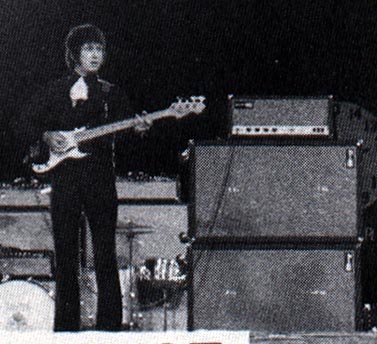
23 Aug., 1967, Atwood Stadium, Flint, Michigan, John’s and Pete’s first known use of Sunn amplifiers. One Sunn 100S amplifier and two Sunn 200S 2×15 cabinets. Herman’s Hermits’ Fender gear set up behind John.
Beginning in August 1967, John and Pete used Sunn amplifiers, the brand John would use for much of the rest of his career with the Who.
Following the Vox Super Beatles for the first North American concerts, the Sunn amps’ first known use was 23 Aug. 1967, Flint, Michigan, possibly purchased 15 or 16 Aug. 1967 in Nashville.
Both John and Pete used one or two Sunn 100S amplifiers with two or Sunn 200S 2×15 cabinets.
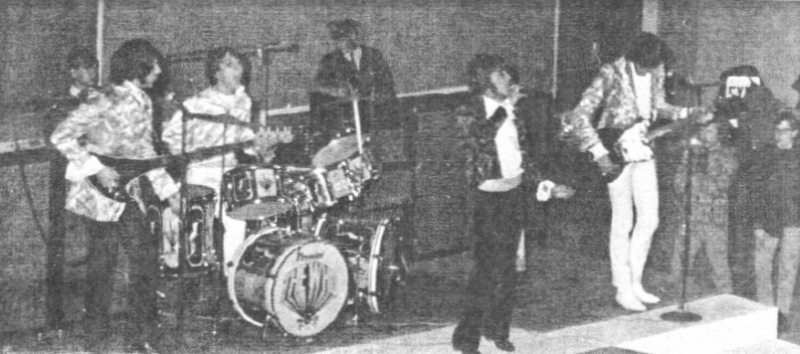
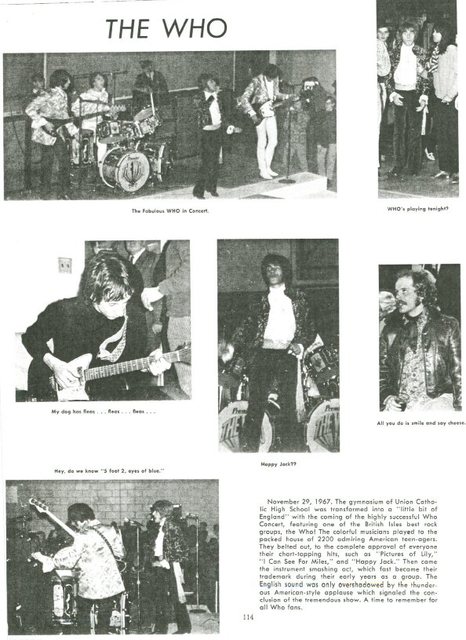
Additional amps were purchased from Manny’s Music in New York on or about 27 Nov., 1967, and first used on 29 Nov., 1967, at Union Catholic High School Gymnasium in Scotch Plains, New Jersey.
In 1968, John was using two Sunn 200S amplifiers, with four Sunn 200S 2×15 cabinets.
For at least the July 8–14 dates of the second 1968 North American tour, Pete used a Sunn Orion solid state preamp and Sunn Orion 2×15 cabs, and though it is unlikely John used the Sunn Orion gear.
Due to their passports being stolen during the Cleveland Musicarnival show on 14 July, some Sunn gear was abandoned at Canadian customs on 15 July 1968.
Sunn 100S amplifier features:
- 60 watts
- Controls (left to right): two inputs, Volume, Treble, Bass and Contour controls, rocker switches for Power, Standby and Polarity
- Two KT88 power valves
- Dynaco transformer
- GZ34 rectifier
- 7025 preamp and 6AN8 phase inverter
Sunn 200S amplifier features:
- 60 watts
- Controls (left to right): two inputs, Low Boost, High Boost, Volume, Treble, Bass controls, rocker switches for Power, Standby and Polarity
- Two KT88 power valves
- Dynaco transformer
- GZ34 rectifier
- 7025 preamp and 6AN8 phase inverter
Speaker cabinets:
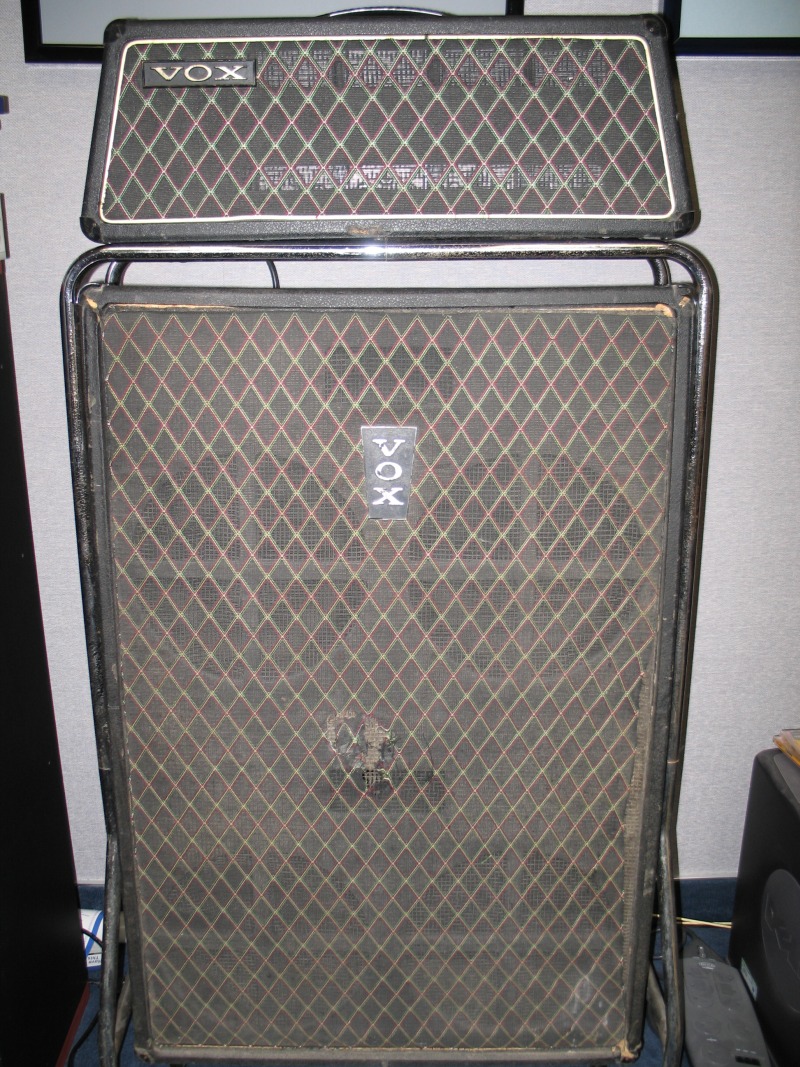
- Most all photographic evidence indicates both Pete and John used the Sunn 200S 2×15 rear-loaded folded-horn enclosures, which would have two JBL D140 15″ speakers. Pete also appears to have occasionally used the Sunn 100S cabinet, which was the same size but featured one JBL D130 15″ speaker and one JBL LE100S midrange driver with high-frequency acoustic lens/horn. Both the 100s and 200s cabinets were 42″ high × 24″ wide × 15″ deep.
For more information on Sunn, see Pete’s Sunn Amplifiers.
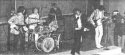
Click to view larger versions. 29 Nov., 1967, at Union Catholic High School in Scotch Plains, New Jersey. Courtesy The Who Concert Guide. (h/t Dave Goessling.)
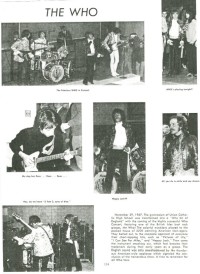
Click to view larger version. Collage of 29 Nov., 1967, at Union Catholic High School in Scotch Plains, New Jersey. (h/t Dave Goessling.)
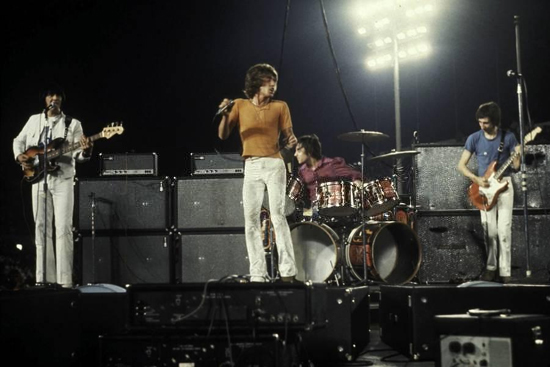
19 Nov. 1967, Hollywood Bowl, Los Angeles, with two Sunn 100S or 200S amplifiers and Sunn 200S 2×15 cabinets. Bass is custom “Axe” bass. Courtesy Mark Herman.
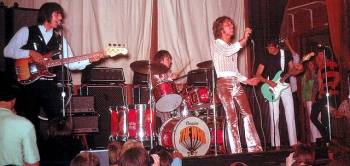
Click to view larger version. 13 July 1968, Grande Ballroom.
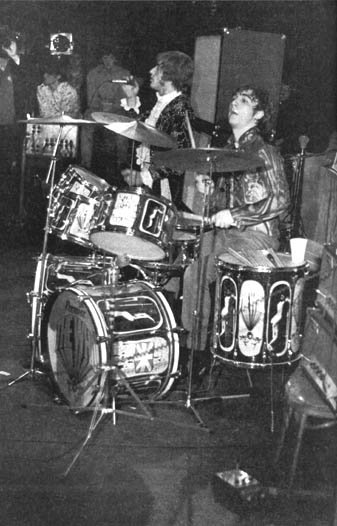
Ca. 1968, two Sunn 100S amplifiers visible at far right. John’s Sunn 2×15 cabinet stacks visible in background.
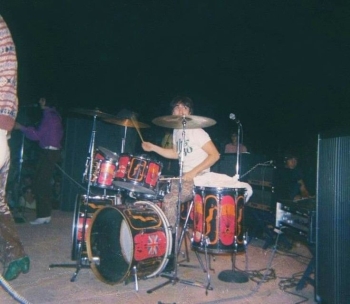
Click to view larger version. 14 July 1968, Musicarnival, Ohio, with Pete’s Sunn Orion detail. John’s Sunn 100S (top) and 200s (bottom) visible behind Keith.
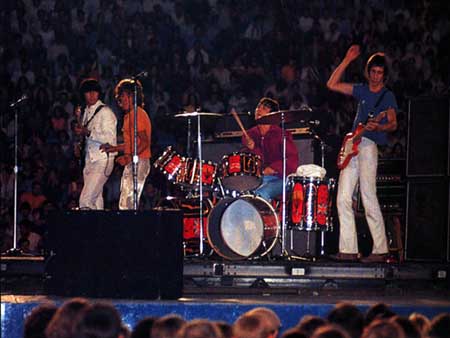
2 Aug. 1968, at the Singer Bowl, New York, with two Sunn 200S amplifiers and two Sunn 200S 2×15 cabinets. Bass is sunburst Fender Precision Bass with rosewood fretboard.
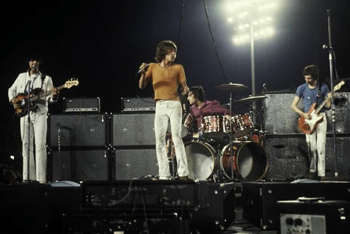
Click to view larger version. 2 Aug. 1968, at the Singer Bowl, New York, with two Sunn 200S amplifiers and two Sunn 200S 2×15 cabinets. Bass is sunburst Fender Precision Bass with rosewood fretboard.
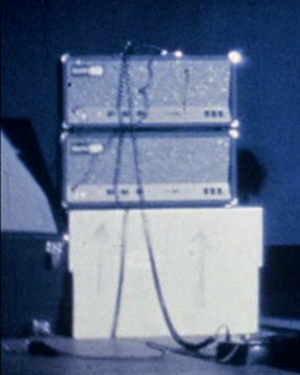
6 Aug., 1968, Music Hall, Boston, closeup of John’s two stacked Sunn 200S amplifiers, with unknown pedal or splitter on stage.
Click to view larger version. 10 Aug. 1968, Jaguar Club, St. Charles, Ill. Bass is sunburst Fender Precision Bass with rosewood fretboard. (Photo: Rick Giles)
For more, see The Who at the Jaguar, 10 Aug. 1968.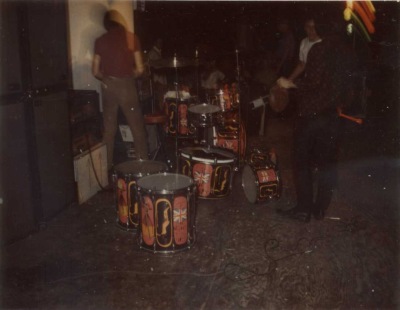
Click to view larger version. 10 Aug. 1968, Jaguar Club, St. Charles, Ill., stage-side view, post-show. (Photo: Rick Giles)
For more, see The Who at the Jaguar, 10 Aug. 1968.
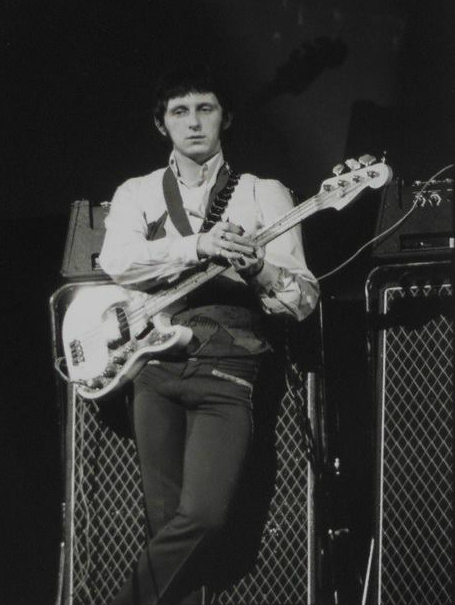
17 Aug., 1968, at Phoenix, Arizona, four Sunn 200S 2×15 cabinets stacked vertically, driven by two Sunn 200S amplifiers. Unknown pedal or splitter at far left of stack. Bass is sunburst Fender Precision Bass with rosewood fretboard.

Resources and Information
Contributors
Thanks to those who have made this page possible:
- Paul Winkler (pw_lists@slinkp.com)
- Brad Rodgers (whocollection.com)
- Jesse Pollack (Quarryman88@yahoo.com)
- Jake Kety
Additional Information:
- Brad Rodgers at whocollection.com
- Rock Stars Guitars, rockstarsguitars.com
- Sotheby’s May 2003 auction: sothebys.com
- Vintage Guitars Info: guitarhq.com/fender2.html#pbass
- Dr. Tube’s Schematics: drtube.com/guitamp.htm
- The Hiwatt Story, dcsbulldog.tripod.com
- Mark Huss’ Hiwatt Legacy: hiwatt.org
- PlexiPalace Vintage Amps Forum: vintageamps.com/plexiboard/viewforum.php?f=3
- Unofficial Sunn Equipment: sunn.ampage.org/site/museum/ (archived)
- Includes “museum,” schematics and history.
- The Sunn Shack: richbriere.com/The_Sunn_Shack.htm (archived)
- Bass Culture, by John Entwistle; forewords by Roger Daltrey and Rick Nielsen. Published 2004 by Sanctuary Publishing
- Sound City history & info: soundcitysite.com
Manufacturer’s Links:
- Hiwatt USA (owned by Fernandes Guitars): hiwatt.com
- Hiwatt U.K. (owned by Music Ground): hiwatt.co.uk
- Fender: fender.com
- Marshall Amplification: marshallamps.com
- Sunn Amplification: sunnamps.com
- Rotosound Strings: rotosound.com