John Entwistle’s Gear: 1975–1985
Overview of John Entwistle’s bass gear, from 1975 to 1982 (and The Who’s 1985 reunion), with Alembic bass guitars and continued use of Sunn amplifiers.
1975–1976
Bass guitars – 1975–1976
-
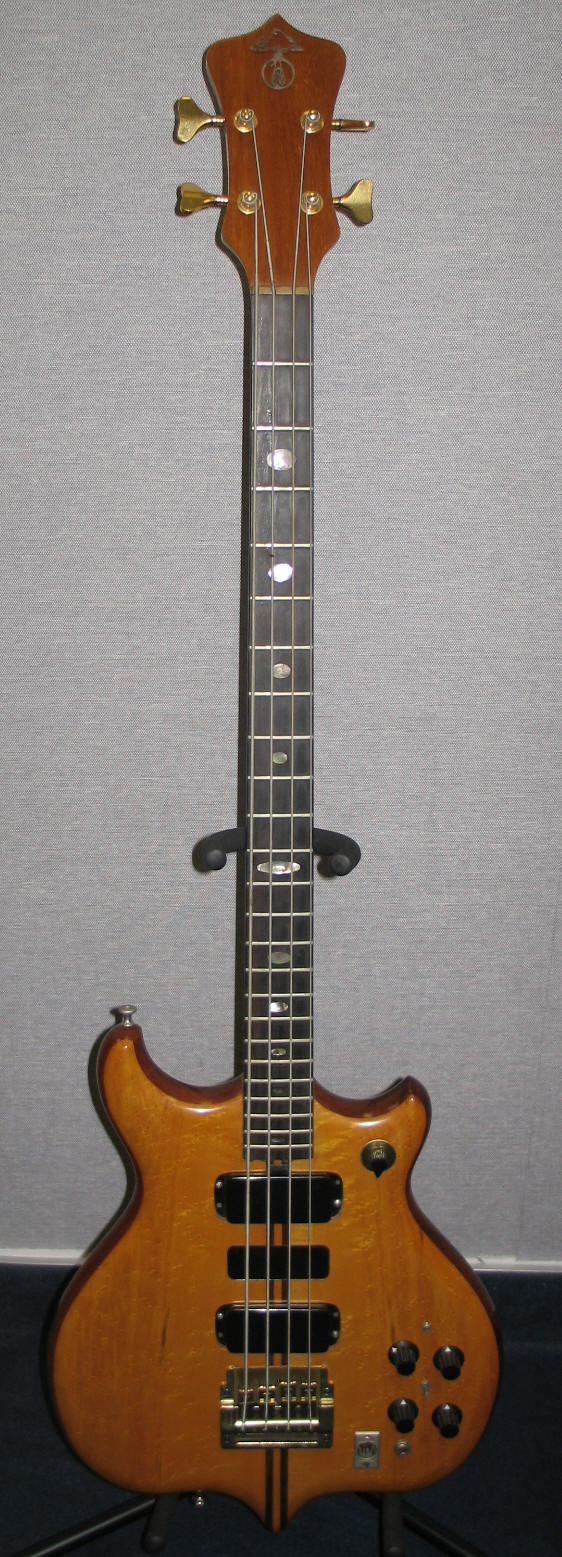
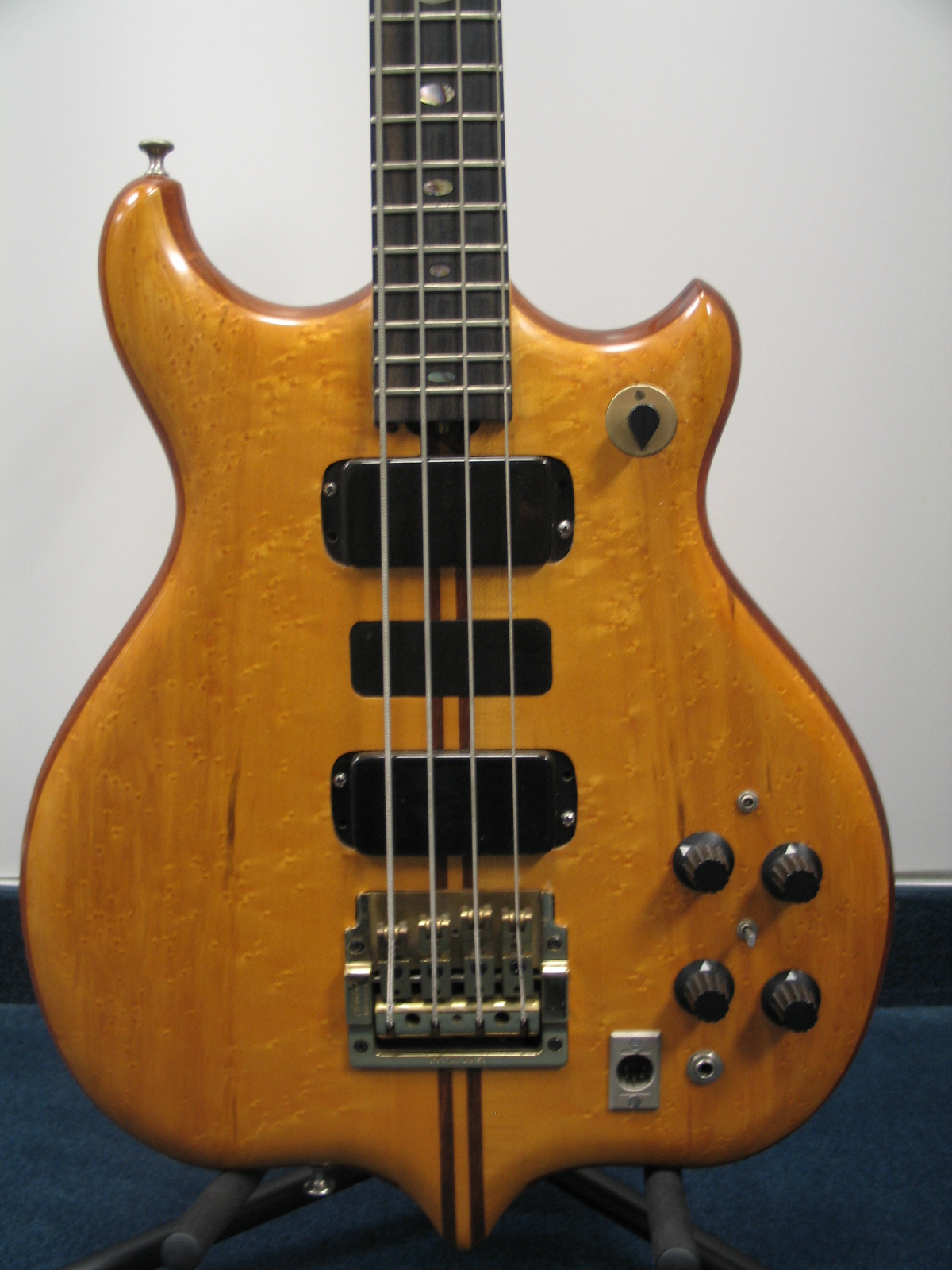
Alembic Series I bass guitars
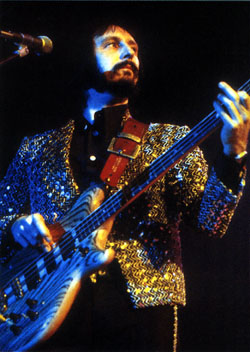
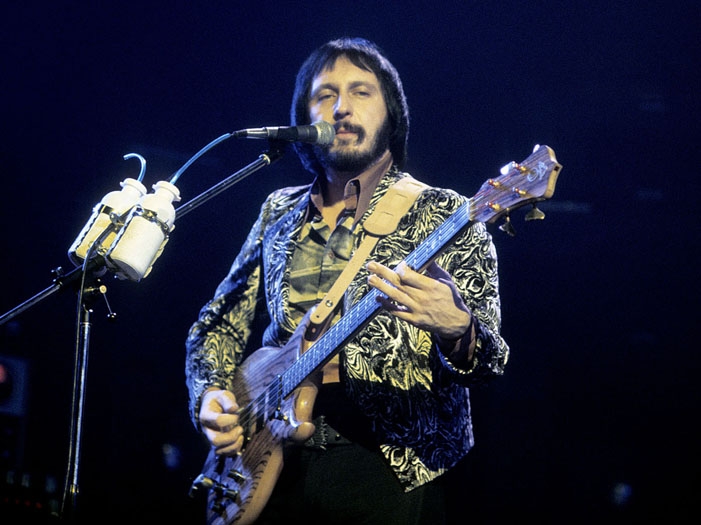
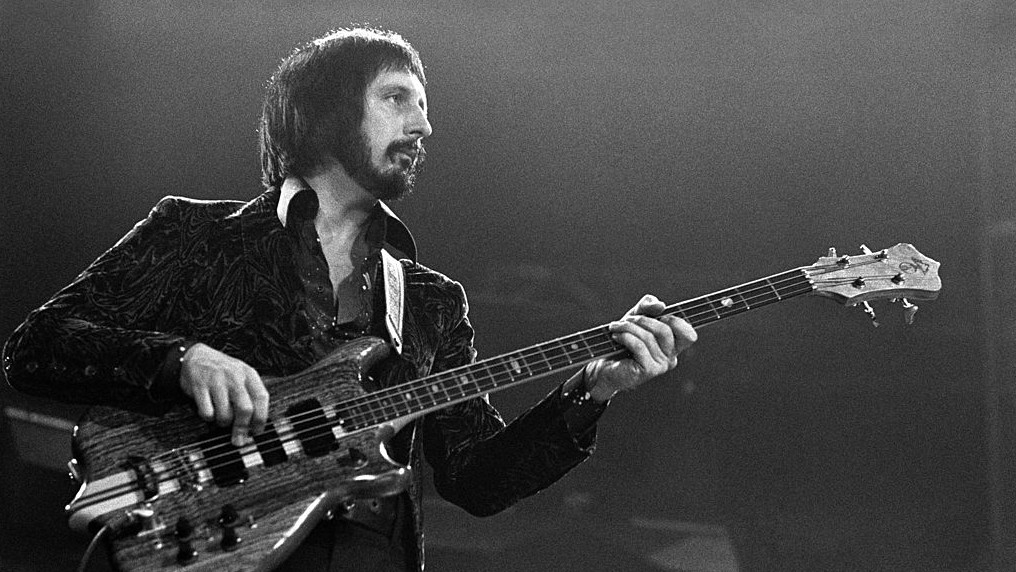
Ca. 1975, with Alembic Series I bass in zebra wood.
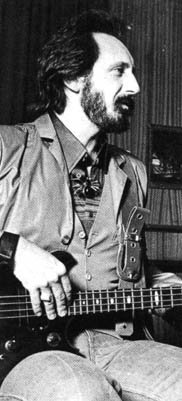
John’s first Alembic bass guitars, made in Santa Rosa, California, which he used as his primary instruments from October 1975 to October 1976, when they were replaced with the “Explorer”-style Alembics.
General specs
- Body:
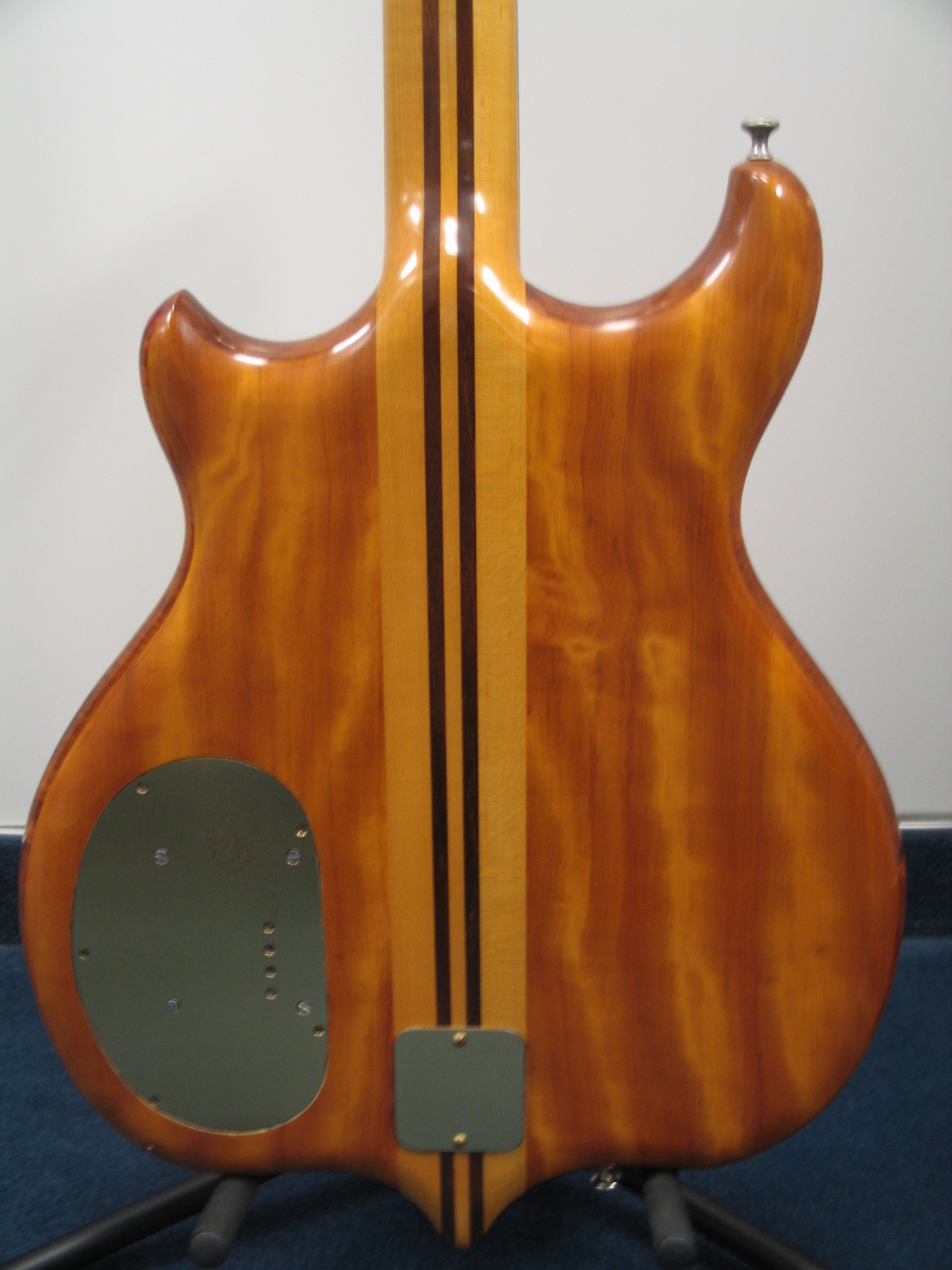
- neck-through-body construction, mahogany body with various (maple, walnut, etc.) wood tops/accents
- Neck:
- five-piece maple and walnut laminate 34″-scale neck, ebony 26-fret fingerboard with oval mother of pearl inlays and LED side markers, 1.625″ nut, peghead with walnut facing and silver Alembic logo
- Electronics:
- two single-coil pickups plus a hum-canceling pickup in the middle, two volume/two tone controls with active low pass-filter controls, three-way rotary selector switch, two mini-toggle switches, standard jack and five-pin cannon connector
- Hardware:
- gold-plated Schaller bridge/tailpiece with four adjustable saddles
John (about the first one): Bought from Fred Walecki whilst holidaying in L.A.… I had it re-wired back to stereo by Peter Cook. He brought it along to a Who rehearsal when he’d finished — I plugged it in and it blew my mind. I jetted to San Francisco 3 days before the tour started and bought three more!
From the August 1989 Guitar Player
He happened upon a second-hand Alembic in a Los Angeles music store. “Someone had wired it incorrectly, so I gave it to my guitar tech, Pete Cook, to fix. Right before we were to leave for a U.S. tour, he brought it to a rehearsal, where I tried it and was, of course, blown away. I flew over early to order three more basses from Alembic, who eventually built me the Explorer-shaped models.”
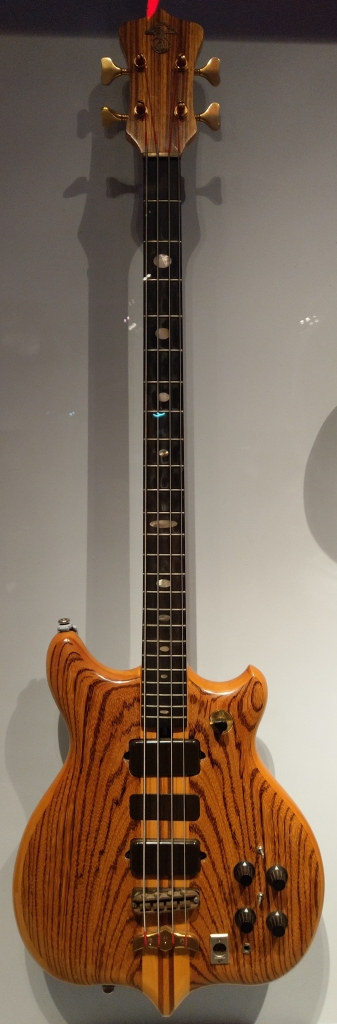
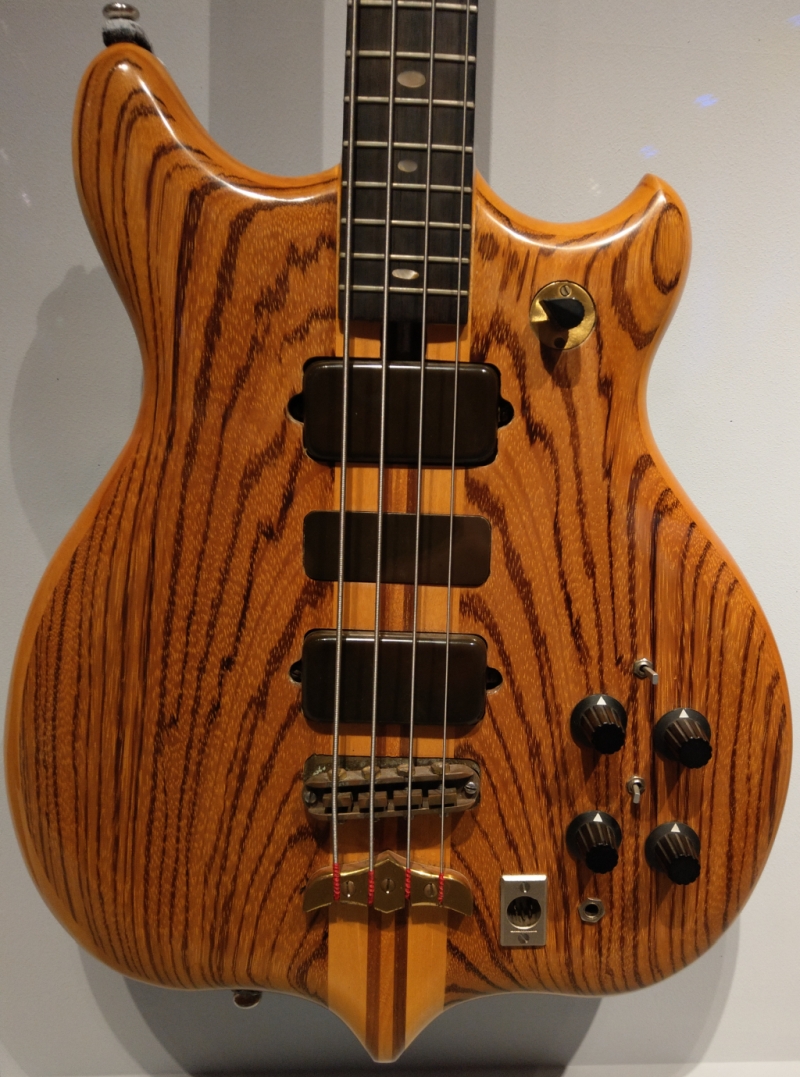
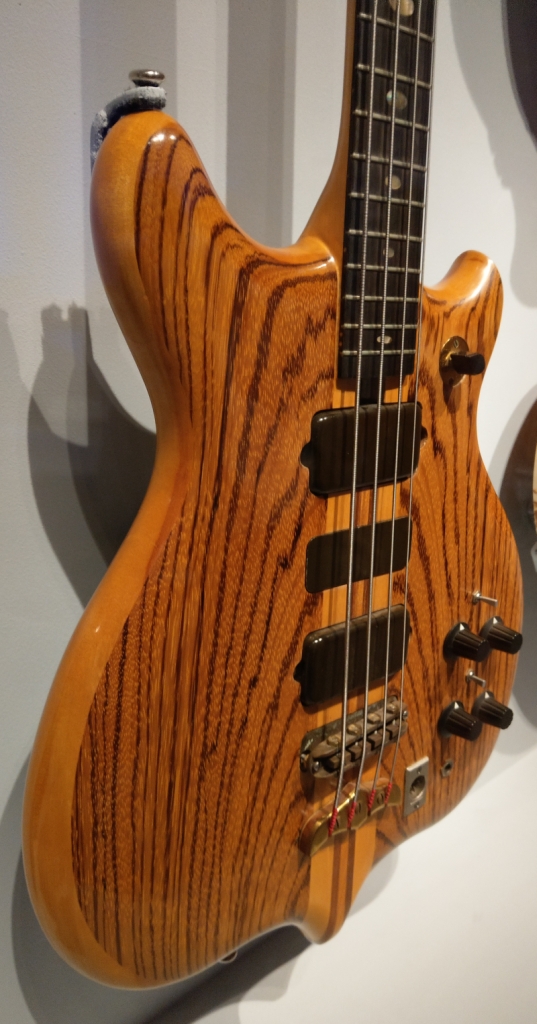
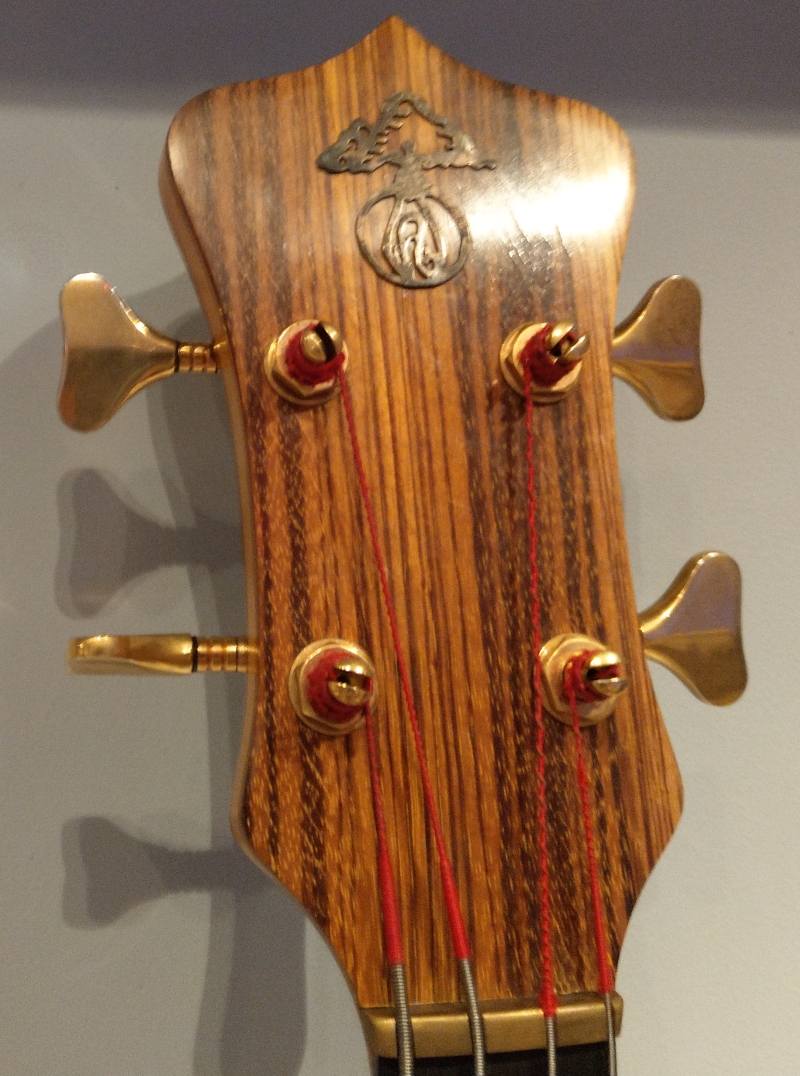
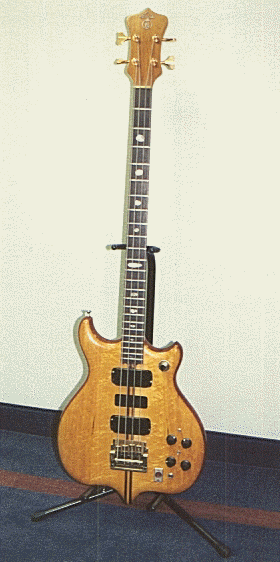
1974 Alembic Series I bass – zebra wood
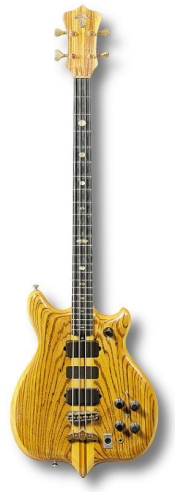
Click to view larger version. Alembic Series I in zebrawood. ©Sotheby’s
- John’s first Alembic bass, natural finish zebra wood.
- Indistinct serial number (74-A011) impressed to top edge of headstock.
- Purchased from Fred Walecki’s Westwood Music in L.A.
- Rewired back to stereo by John’s luthier/guitar maker Peter Cook.
- First known stage use, 3 Oct. 1975, New Bingley Hall.
- Sold in Sotheby’s 2003 auction; Estimated £2,000–£3,000; sold for £13,200.
- Collection of David Swartz.
- On display through October 2019 at the Play It Loud Exhibition at the Metropolitan Museum of Art in New York.
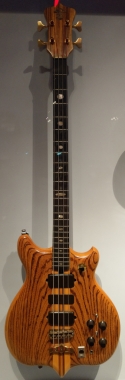
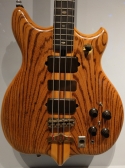
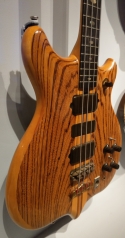
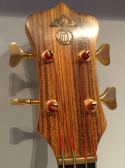
Click to view larger versions. 1974 Alembic Series I in zebra wood.
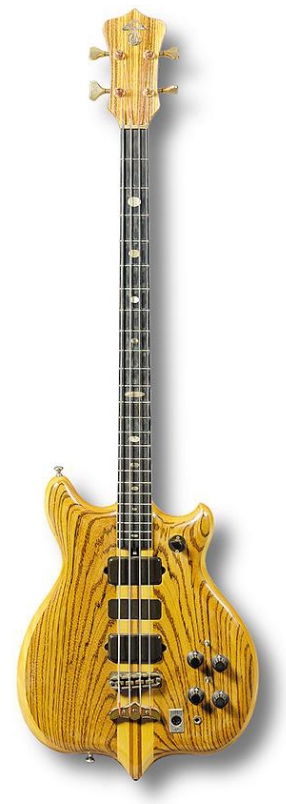
1976 Alembic Series I bass – natural finish
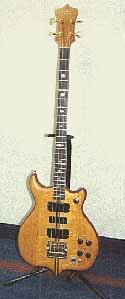
Click to view larger version. Alembic Series I bass, courtesy Brad Rodgers, whocollection.com.
- John’s second Alembic, natural maple finish with maple and walnut laminate neck
- Serial number 76-A046
- First sold in 1988 by John in Sotheby’s auction (Rock ‘n’ Roll Memorabilia 1956–1984 – The Property of John Entwistle, Sotheby’s, London, 7th April, 1988).
- Sold again in Christie’s 2012 auction. Estimated £10,000–£15,000; Realised: £10,000.
- Owned by Brad Rodgers; on display at the Rock & Roll Hall of Fame in Cleveland, Ohio, from 1998–2007.
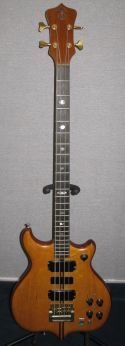
Click image to view larger version. John’s second Alembic, 1974 Alembic Series 1, courtesy Brad Rodgers, whocollection.com.
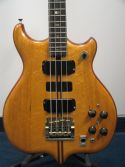
Click image to view larger version. (729kb) John’s second Alembic, 1974 Alembic Series 1, courtesy Brad Rodgers, whocollection.com.
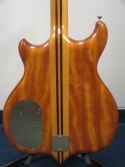
Click image to view larger version. 688kb) John’s second Alembic, 1974 Alembic Series 1, courtesy Brad Rodgers, whocollection.com.
John used at least four additional Alembic Series I basses on stage with The Who, including a dark finish, two heavilty quilted natural finish, and a Series I Omega, some of which are pictured below.
Stage use of the Alembic Series I
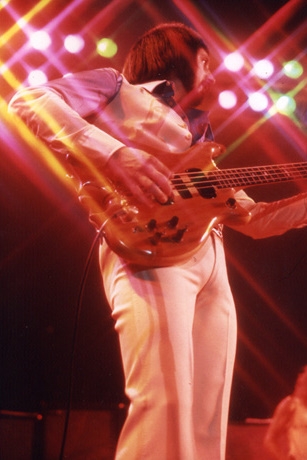
Ca. 1975, with Alembic Series I Omega bass with flame-figured top.
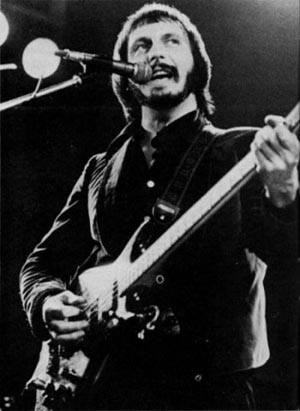
On stage with Alembic.
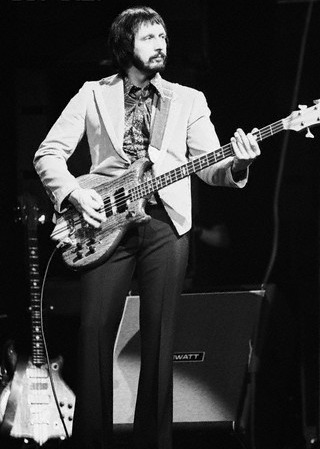
On stage with Alembic Series I and spare.
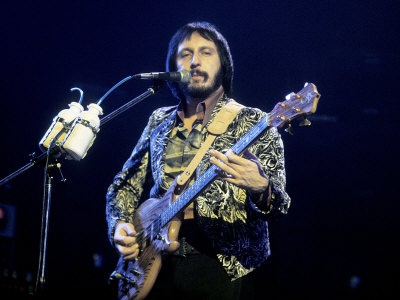
Click to view larger version. Ca. 1975, on stage with Alembic Series I with zebra wood top.
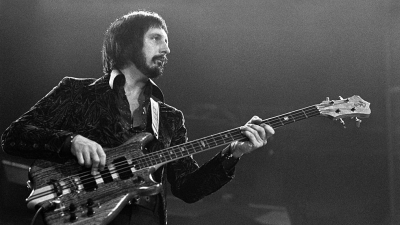
Click to view larger version. Ca. 1975, on stage with Alembic Series I with flame-figured top.
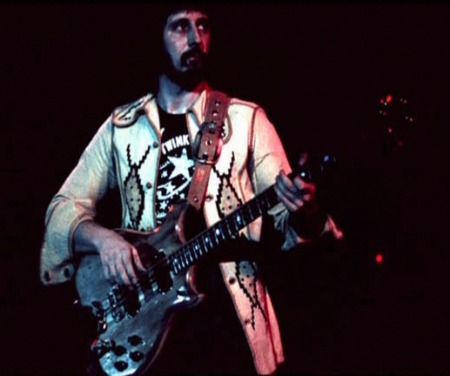
On stage with Alembic Series I Omega with flame-figured top.
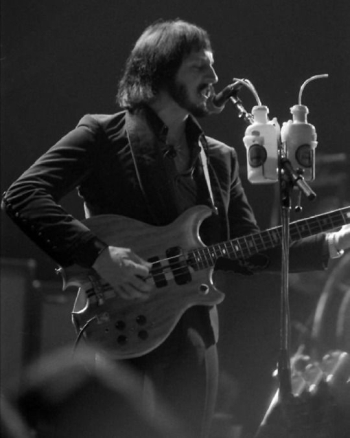
On stage with Alembic Series I Omega with flame-figured top.
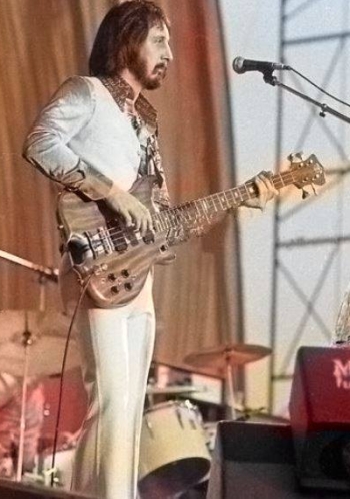
21 March 1976, Anaheim, California, on stage with Alembic Series I Omega with flame-figured top.
-
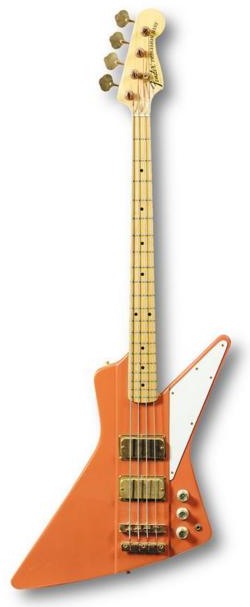
Fender “Explorer-Bird”
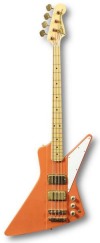
Fender “Explorer-Bird”
- Gibson Explorer-style body with Fender Precision Bass maple necks and machine heads; gold-plated hardware, two volume controls/one tone control.
- Approximately six in total custom-made by luthier Peter Cook, in white (later given to Pete) and orange/red.
- Used in studio only, 1975 and 1978.
- As seen in the Who Are You segment of The Kids Are Alright film, 1978.
- Orange/red one sold in Sotheby’s May 2003 auction. Estimated £2,000–£3,000; sold for £12,000.
- Currently owned by Dave Schools of the band Widespread Panic. He bought it from the Sotheby’s May 2003 auction of John’s estate. See article on relix (archived) and photo of Schools.
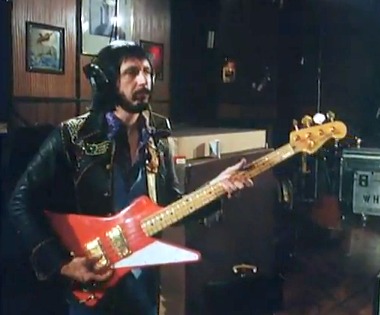
9 May 1978, Ramport, with Fender “Explorer-Bird” bass.
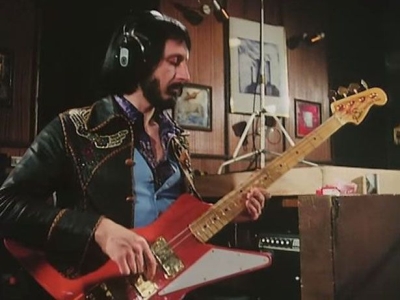
9 May 1978, Ramport, with Fender “Explorer-Bird” and Mesa Boogie amplifier.
-
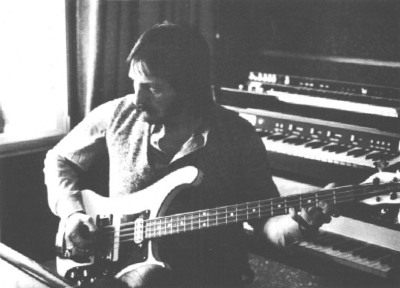
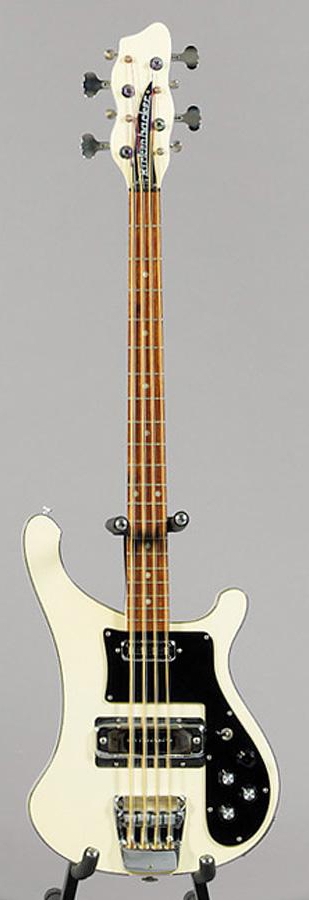
1973 white Rickenbacker 4001 prototype 8-string bass
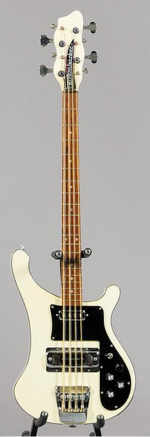
Click to view larger version. © Sotheby’s
- Used in studio only: Success Story, 1975.
- Serial no. MH2553.
- Reverse (low string/high string) setup.
- Wavy headstock, with four-a-side machineheads.
- Cream finish with chequered binding; through neck with rosewood fingerboard, dot markers.
- One of two; other one bought by Chris Squire.
- Sold in Sotheby’s May 2003 auction. Estimated £1,500–£1,800; sold for £4,560.
-
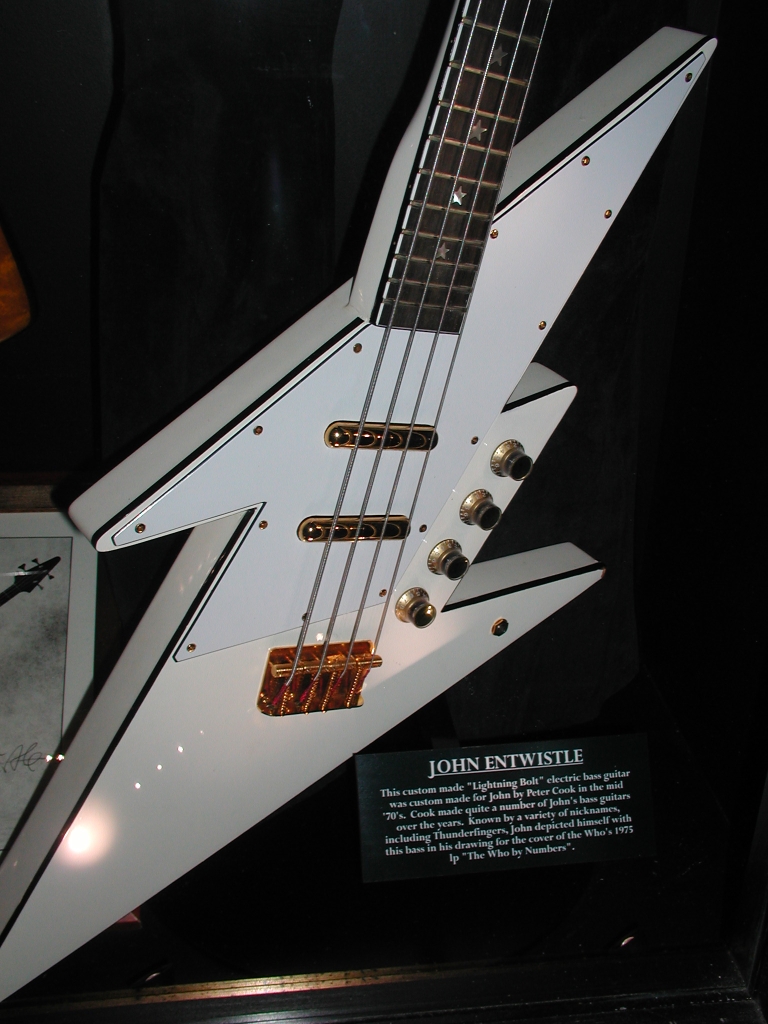
Custom Peter Cook “Lightning Bolt” bass
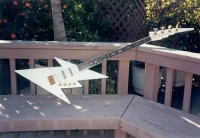
Click to view larger version Custom “Lightning Bolt” bass, made by Peter Cook. Courtesy Rock Stars Guitars.
- Requested by John and designed and built by luthier Peter Cook.
- Featured on The Who By Numbers album cover drawing.
- Dan Electro lipstick-type pickups.
- Star-shaped fret marker inlays.
- Gold hardware.
- Used on many tracks
- On display at Hard Rock Café, New York.
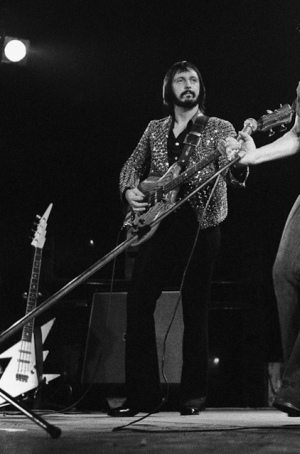
Ca. 1975, with Alembic Series 1 bass in zebra wood. Peter Cook “Lightning Bolt” bass visible on stand at left.
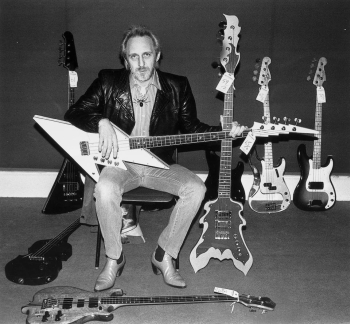
-
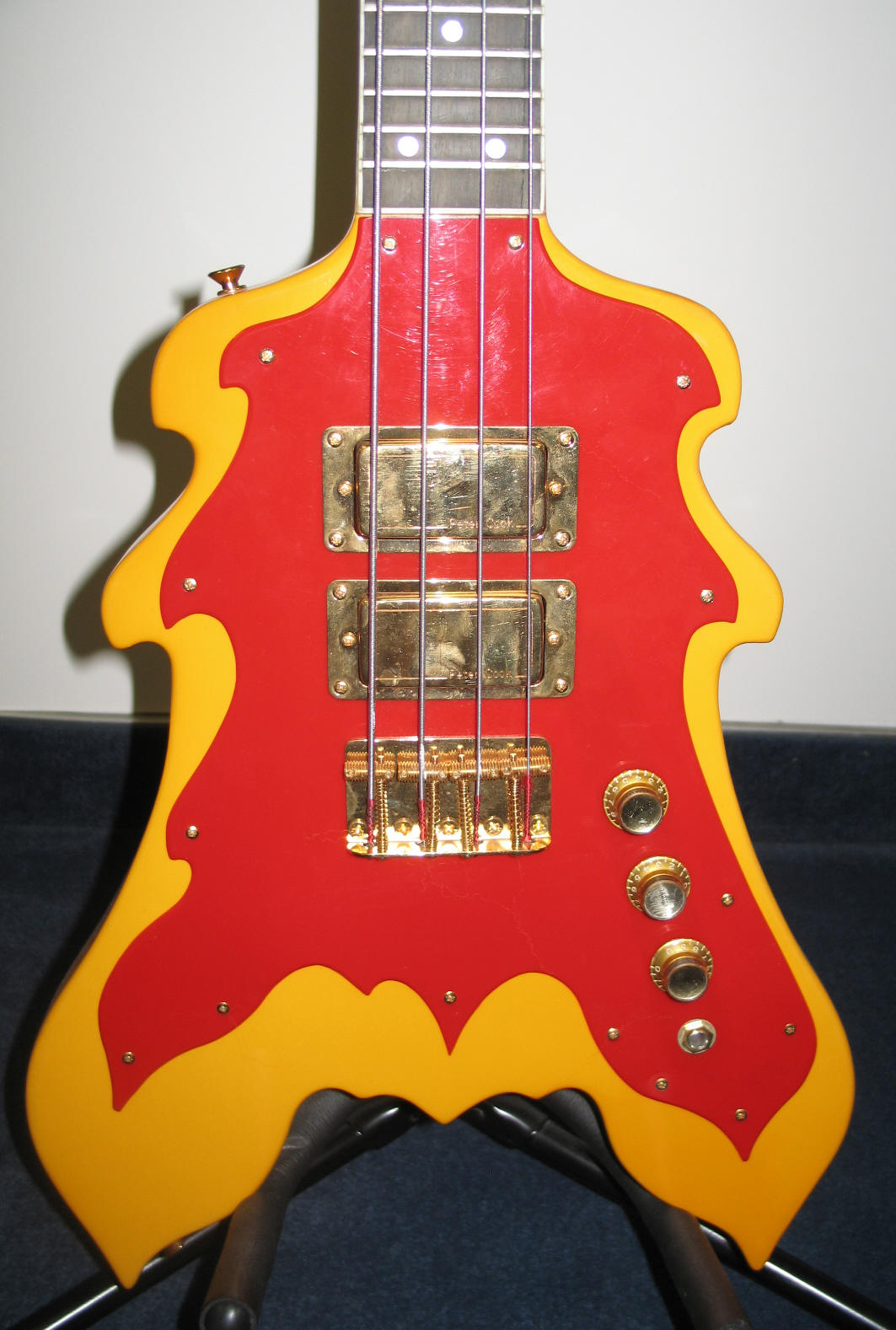
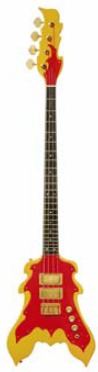
Custom Peter Cook “Flame” bass
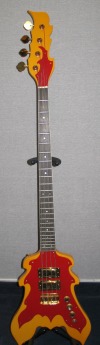
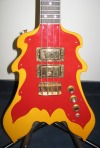
Click to view larger versions Custom “Flame” bass, made by Peter Cook. Courtesy Brad Rodgers, whocollection. com.
Sold by John at auction in April 1988. It was the highest-priced bass of all the ones that John sold, fetching approximately $33,000. John stated in the catalog that this was used on the U.K. Television show Top of the Pops in the early 1970s.
Currently owned by Brad Rodgers, see whocollection.com.
- Designed and built by luthier Peter Cook.
- Yellow and red finish, flame-shaped body, and flame-shaped red plastic pickguard.
- Gold hardware.
- Bound neck with 24-fret rosewood fingerboard, dot inlays.
- Flame-shaped headstock with red plastic truss rod cover.
- Two Peter Cook-built pickups, three controls, gold bridge baseplate with four adjustable saddles.
Also see auction notice, below.
-
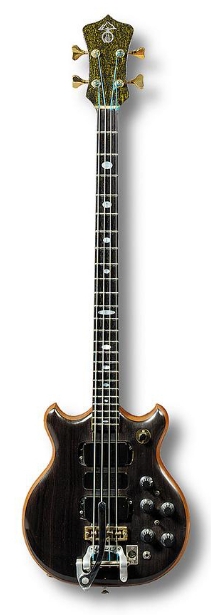
Alembic Baby Bass with Bigsby
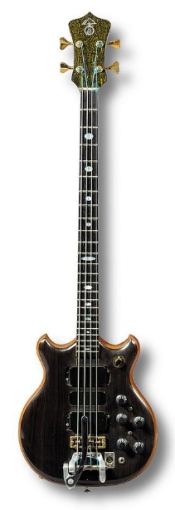
Click to view larger version. © Sotheby’s
Alembic Baby Bass in ebony finish fitted with Bigsby reverse tremolo.
- Used in the studio on the bridge of 905 and Dancing Master.
- Features: Fitted with upside-down Bigsby, body with graphite through-neck, active electronics and LEDs to fingerboard, oval markers.
- Sold in Sotheby’s auction, 13 May 2003. Estimated £1,500–£2,000; sold for £4,560.


Amplification: 1975
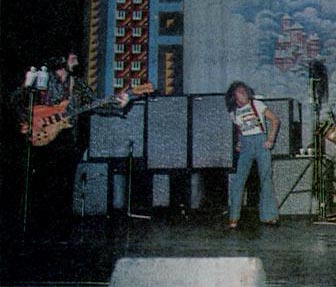
Ca. 1975, Sunn rig, with amplifiers moved to side-stage rack: two Sunn 4×12 speaker cabs (outside top), two Sunn 312 3×12 speaker cabs (inside top), two Sunn 1×18 speaker cabs (outside bottom), two Sunn W 1×18 reflex bins (inside bottom). Bass is 1974 Alembic in zebra wood.
In 1975, John’s amplifier rig switched to a rack-based setup, with the amplifiers separated and moved to a side-stage rack. The signal from the Alembics via five-pin (Cannon) output to an Alembic IN-1 input module, into Alembic two-channel F2-B preamps, which was then sent to Sunn Coliseum Slave power amps. John’s speaker configuration remained largely the same as the 1974 setup, though the Sunn W bins now had the badges on the horn bells, and the Sunn 3×12 speaker cabinets moved to the center of the setup, while the Sunn 4×12 speaker cabinets moved to the outside on top of the Sunn 1×18 speaker cabinets, with filler boxes to balance the setup due to the differing heights of the bottom row cabinets/bins.
John used this setup from October 1975 until August 1976.
- Alembic IN-1 input module
- Amplifiers
- Four Alembic F2-B preamps
- Four Crown DC 300 power amplifiers or Sunn Coliseum Slave power amplifiers
- Speakers
- Two Sunn 4×12 speaker cabs
- Two Sunn 3×12 speaker cabs
- Two Sunn 1×18 speaker cabs
- Two Sunn W 1×18 reflex bins
Amplifier specs
Alembic IN-2 Input Module

Alembic IN-2 input module
Features a power supply function for Alembic instruments; Mult Box, each of the two stereo channels has four phone jack outputs; Direct Box, a transformer-coupled low-impedance output via the three-pin Cannon balanced outputs, with phase reversal switches; Mode Switch, supporting stereo, reverse stereo, A+B mono A or B mono.
Alembic F2-B stereo preamp
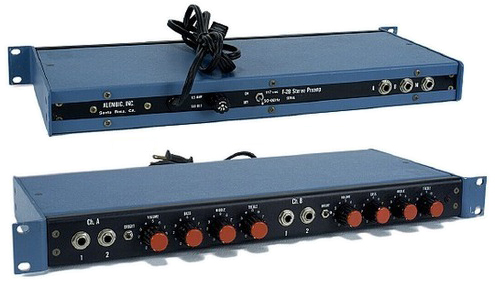
Click to view larger version. Generic Alembic F2-B preamp.
- Front panel:
- two independent preamp/tone control sections: Channel A input 1/2, bright switch, volume, bass, middle, treble controls; Channel B input 1/2, bright switch, volume, bass, middle, treble controls.
- Rear panel:
- power, channel A out, channel B out, mono out.
- Valves:
- One 12AX7 per channel.
Sunn Coliseum Slave (black/red model)
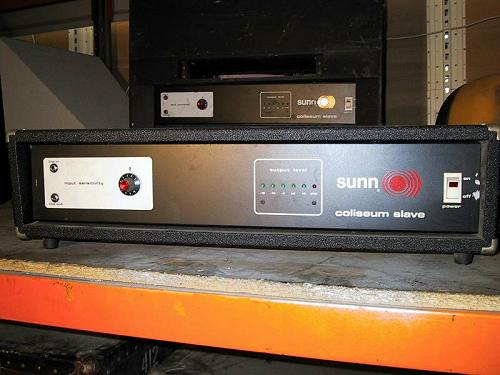
Click to view larger version. Sunn Coliseum Slave, courtesy rockstarsguitars.com.
- Front panel:
- Line in jack/line out jack, input sensitivity control (0–10), output level meter (−18, −12, −6, ±0, +6, clip), power switch.
- Rear panel:
- Circuit breaker, two speaker jacks.
- Power:
- solid state, 320 RMS (880 watts peak) in a 2 ohm load.
Selected quotes
All quotes and references are copyright their original owners and are included for reference only.
From the November 1977 Guitar Player (read an excerpt of the article):
About two years ago, while one of the “Fenderbirds” was being repaired, John happened to pick up a stock Alembic for a rehearsal. He liked it so much that he ordered several — unmodified except for their extremely low actions.
Excerpt from January 1977 interview with John in International Musician and Recording World:
- How did you come to start using [Alembics]?
Well, I’d heard about Jack Cassady using one and I’d seen photographs of them and Rick Turner from Alembic ’phoned me up one day — he’d heard I was in New York — and he brought along a bass for me to try out. It was a short-scale, but it felt quite nice and so I asked him if he could make me one to my specifications. He sent me an estimate and a description of what he was going to make me but I never followed it through — in fact, I lost the bit of paper! Later, I was on holiday in Los Angeles and I found a guitar shop that sold nice old guitars. The guy asked me if I’d be interested in a second-hand Alembic. I tried it out and I really liked it, so I bought it just for the collection and never really bothered with it. We had a rehearsal one day and I had five basses made with an Explorer body and Thunderbird pick-ups and Fender necks — I’d had them made up for the next bout of touring. I was getting all the necks straightened at the time, so just for a laugh, I brought along the Alembic and plugged it in. The sound was really amazing, so I changed over to Alembic — the five Explorers never got used.
- How different was the sound?
Well, it’s got a ... whole frequency sweep on it. You can get any sounds you like, just by varying the switches and by turning the tone controls backwards and forwards. it’s also about three times as loud as a normal bass. It’s a lot clearer — in fact, it’s very hard to get it to sound dirty. You have to wind it right up. It’s also got this feedback effect — when you have all the frequency switches right down in their lowest positions, you get this sort of signing sound.
- Are you after a very clean sound?
Yeah, I sort of pioneered the trebly bass sound, the piano sound, and I use an awful lot of treble. The Alembic’s got such an amazing amount of treble — it’s almost ear-piercing. But you don’t lose the bottom. A Fender is perfect for treble, but there’s no bottom and Gibson is perfect for bottom but there’s no treble. The Alembic has both, and it’s much louder. And also when I get bored with playing trebly, I want a bass sound that really cuts through — not just a boomy sound.
- Tell me about the Alembic’s “lightshow.”
Well, at the side of the guitar neck, you’ve usually got small marker dots. On the Alembic they’re red lights instead — L.E.D.’s. Mind you, you have to plug the guitar into a power supply. That supplies power for the lights as well. It also works on battery but the lights are connected directly to the mains power supply.
- What do you play through?
I use two stereo Stramp pre-amps and four big Sunn slave amps. They go through two 3 × 12″s in big PA-type cabinets, two standard pressurised 4 × 12″s, two pressurised 18″s and two 18″s in PA-type cabs again. So I’ve got some of the cabinets pushing the sound right out, and others which are just for the stage. It’s all miked through the PA as well. The guitar, I have about two-fifths up and amps are on number five — of course, the pre-amps are virtually right up, so I’m using about half volume.
- You don’t suffer any loss of tone with the guitar down?
No, because the Alembic has individual pick-up pre-sets on the back, so if you wind them up, you don’t lose anything on the volume control. There’s also a dummy pick-up in the middle and two controls to eliminate hum and buzz, so I never get any buzzes or anything.
- Do you still experiment with other basses?
I fiddle around with different ones. Gibson are trying to make me something similar using the same tone circuitry as the Alembic. They’re getting together with Moog to work something out. They made a prototype which they were going to put Alembic electronics in, but we managed to convince them it was going to be senseless to make me twelve Gibson guitars all with Alembic stuff on. There’s one thing about Alembic — it can be hard to vary the controls while you’re playing because there are so many, so it would be nice if, when they did the Gibson one, they could give me some floor controls so I can either control it from the guitar or the floor.
- When you record in the studio, how loud do you play?
Up to now, I’ve been playing very quietly because it was the only way I could get a clean sound. Consequently, as I’m playing quietly I get a very bassy sound — a normal sort of bass sound which I don’t like. But now, with the Alembic, I’m probably going to be able to play a lot louder in the studio — and more trebly. I’ll be playing through two cabinets and there’ll be a separate sound coming out of each one. It’ll be more or less a stage sound that I try to put on recording, unless the number merits a normal bass sound.
Photo gallery
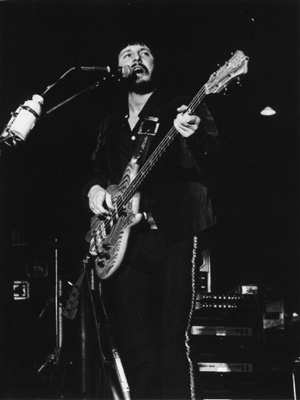
Ca. October 1975, with Alembic Series 1 bass in zebra wood. Alembic/Sunn Coliseum Slave amplifier rack visible at right. Peter Cook “Lightning Bolt” bass (courtesy Rock Stars Guitars) headstock/neck visible on stand at left (as seen on cover of The Who By Numbers).
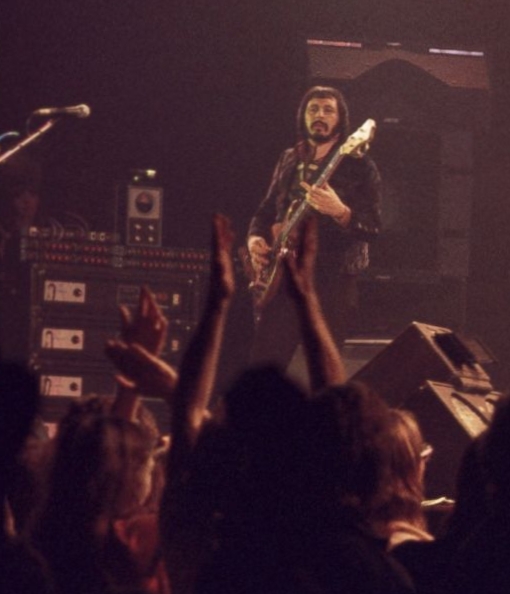
Click to view larger version. 26 Nov. 1975, with Alembic Series 1 bass in zebra wood. Amp rack comprises Alembic IN-1 input module, four Alembic F-2B preamps and four Sunn Coliseum Slave power amplifiers, topped by Conn Strobotuner.
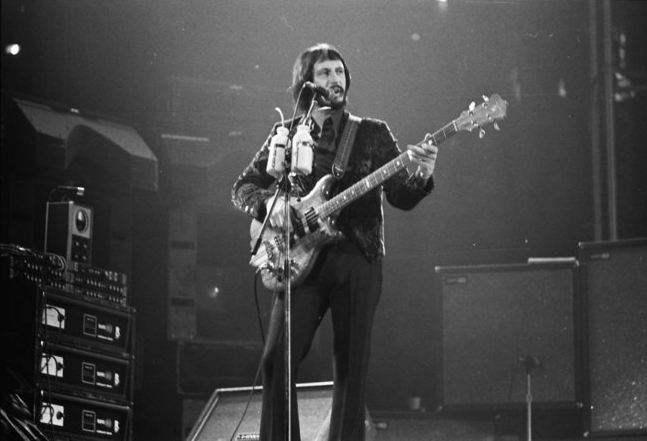
Click to view larger version. Ca. 1975, with Alembic Series 1 bass with flame-figured top. Amp rack comprises Alembic IN-1 input module, four Alembic F-2B preamps and four Sunn Coliseum Slave power amplifiers, topped by Conn Strobotuner.
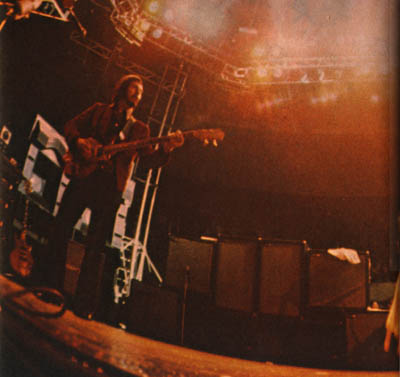
Ca. 1975, Sunn rig (with amplifier rack barely visible at far left): two Sunn 4×12 speaker cabs (outside top), two Sunn 312 3×12 speaker cabs (inside top), two Sunn 1×18 speaker cabs (outside bottom), two Sunn W 1×18 reflex bins (inside bottom).
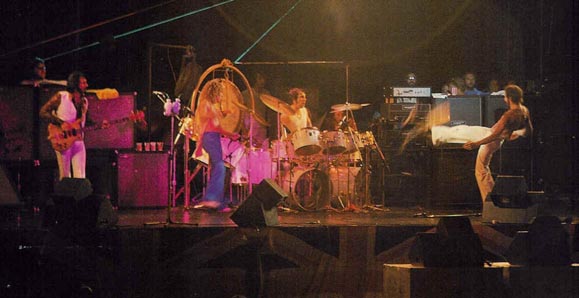
Ca. 1976, with Alembic bass and Sunn rig. Courtesy whocollection.com.
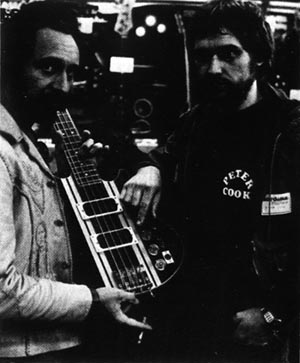
John with guitar maker/luthier Peter Cook and an Axis bass.
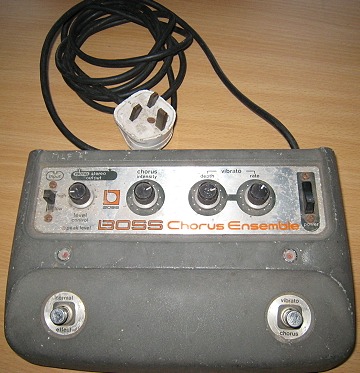
Boss CE-1 Chorus Ensemble pedal, used on stage mid-’70s, courtesy Rock Stars Guitars.
1976–1985
Bass guitars
-
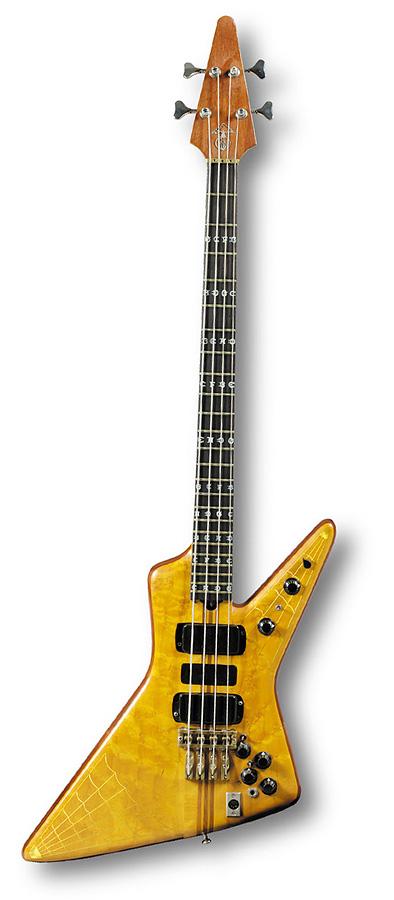
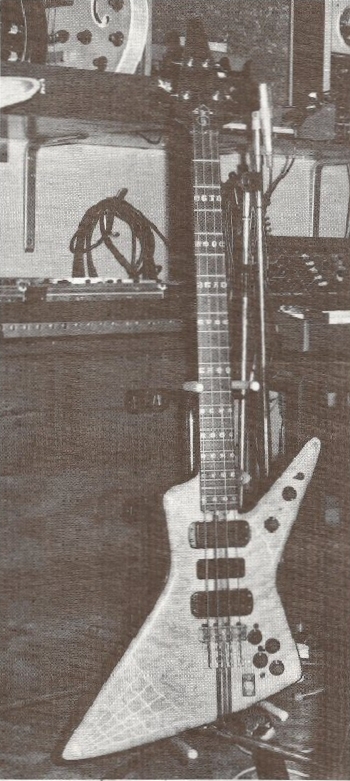
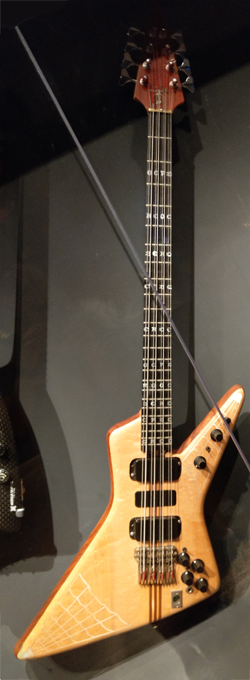
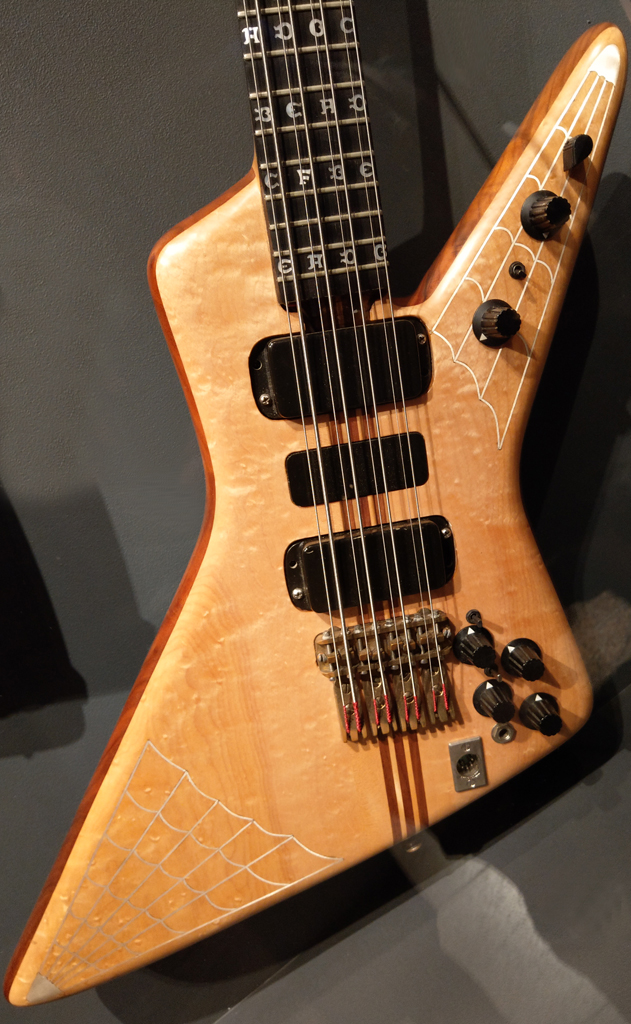
Alembic Explorer bass
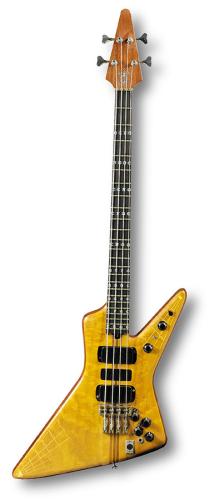
Click to view larger version. One of the three four-string Alembic Explorers.
John worked with Alembic to design these basses. There were at least two of this model made, plus a “V”-shaped headstock model and an 8-string. Starting with the final leg of the 1976 North American tour on 6 Oct. in Phoenix, Arizona, “No. 1” became John’s main stage bass guitar through 1982, with its last use at Live Aid in 1985.
“Alembic took two years to make the three basses for me. The other 4-string is in a Hard Rock somewhere. I sold it as its punishment for going wrong at the beginning of Live Aid.”
John sold the main instrument to the Hard Rock Café. The four-string model pictured at right sold in the 13 May 2003 Sotheby’s auction in London for £50,400.
Alembic subsequently released a retail version of the “A”-shaped headstock model, renaming it the “Exploiter.”
Features
- Bird’s eye maple body featuring:
- Through-walnut neck.
- Spider’s web wire sterling-silver inlay, which later appeared to be brass as the instrument’s lacquer yellowed with age.
- Graphite-reinforced neck of laminated walnut and maple.
- Fingerboard with music-note inlays in mother-of-pearl Gothic script.
- LED markers on the top edge.
- Two master volume controls with a selector switch to choose from the presets, active low pass-filter controls.
- Five-pin (Cannon) and standard jack connectors. Standard Alembic electronics.
Alembic Explorer details
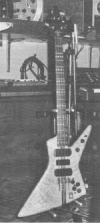
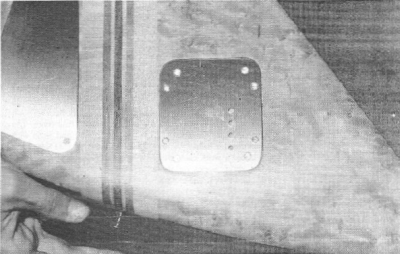
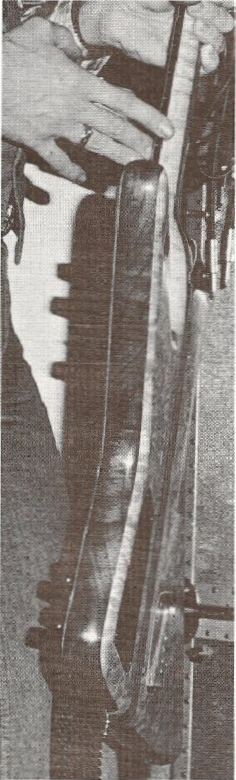
Click to view larger version Alembic 4-string bass.
Click to view larger version Alembic rear adjustment screws.
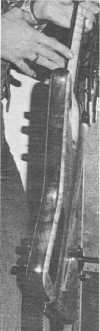
Click to view larger version Alembic 4-string bass, side view.
See more Alembic Explorer photos below.
- Bird’s eye maple body featuring:
-
1980 Alembic Explorer four-string with a “Vee”-shaped headstock
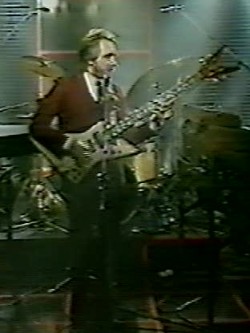
1983 Gastank television performance with the Alembic with “V”-shaped headstock. (See clip of this performance on YouTube.
- As seen on the cover of Too Late The Hero
- Not used on stage with The Who (see photo at right for 1983 television appearance performing with this bass guitar. h/t Wil Bogantz)
- Serial no. 80-1742, impressed to body end of fingerboard.
- “Weighs a ton.”
- Sold in Sotheby’s auction, 13 May 2003. Estimated £2,500–£3,000; sold for £15,000.
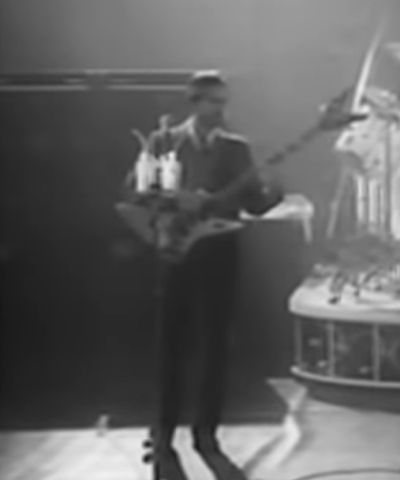
1981 video for Another Tricky Day with the Alembic with “V”-shaped headstock.
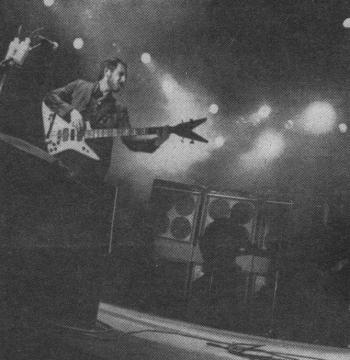
-
Alembic Explorer 8-string
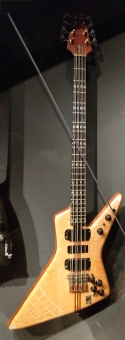
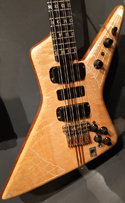
- As used on Trick of the Light and You.
- Identical “Explorer”-shaped body as above, with “A”-shaped headstock.
- Same specs and electronics as above.
- Used on stage ca. 1979 for Trick of the Light.
- Serial no. “MINE”
- Owned by David Swartz.
- On display through October 2019 at the Play It Loud Exhibition at the Metropolitan Museum of Art in New York.
John:
“I wrote a lot of songs on this one. The bass was so loud on stage The Who and their road crew used to vacate my side of the stage whenever I played it. The neck was so difficult to control I finally had Alembic make me one with a graphite neck.”
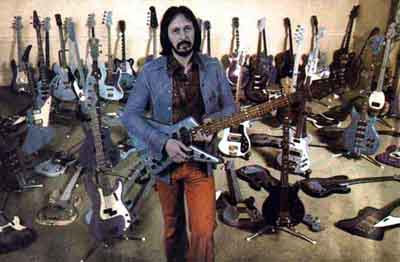
Click to view larger version Alembic 8-string bass.
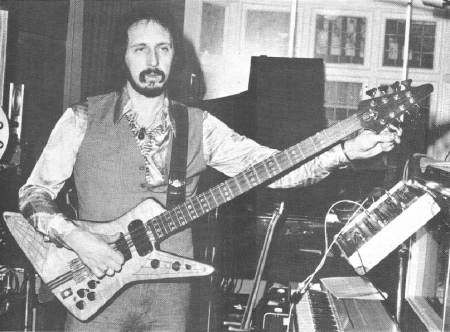
Alembic 8-string bass
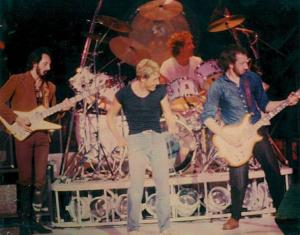
Click to view larger version. Ca. 1979, performing Trick of the Light, with John on 8-string Alembic Explorer and Pete playing 4-string Alembic Series I.
-
Alembic V Bass
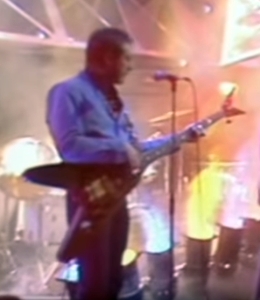
1981 Top of the Pops television performance with the Alembic “V” bass. (See clip of this performance on YouTube.
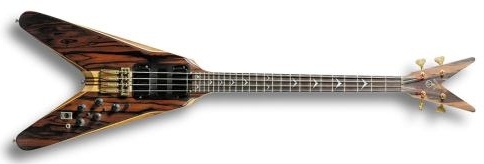
- Ca. 1980, serial no. 801743
- Used on Top of the Pops, 1981.
- Featured in Bass Culture, page 108.
- Sold in Sotheby’s May 2003 auction. Estimated £2,000–£3,000; sold for £3,840.
John:
“Too heavy to get off the ground but good for catching snakes.”
-
Hamer Quad Standard 12-string bass
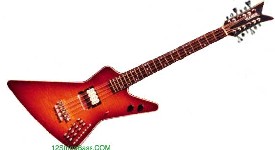
Hamer Quad Standard 12-string bass, courtesy (12stringbass.com [archived]).
- Reportedly used on Quadrophenia Soundtrack.
- Completed 25 January, 1979. Only one ever made.
- Bound body;
- Quad pickup only, no humbucker installed in second route (a cream DiMarzio humbucker was later added in the open route);
- 21-fret rosewood set neck; custom double- and triple-dot markers.
- Sold in 1988 for £1,100.
- Serial no. 0139
- More info and pics at 12stringbass.com (archived).
-
Steinberger prototype L2 headless bass
John used this headless bass for the Don’t Let Go The Coat promotional video, which he had purchased following NAMM in 1979.

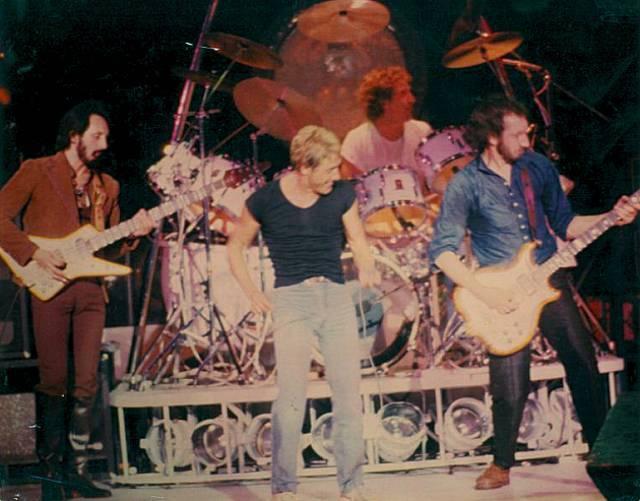

Amplification – 1976–1985
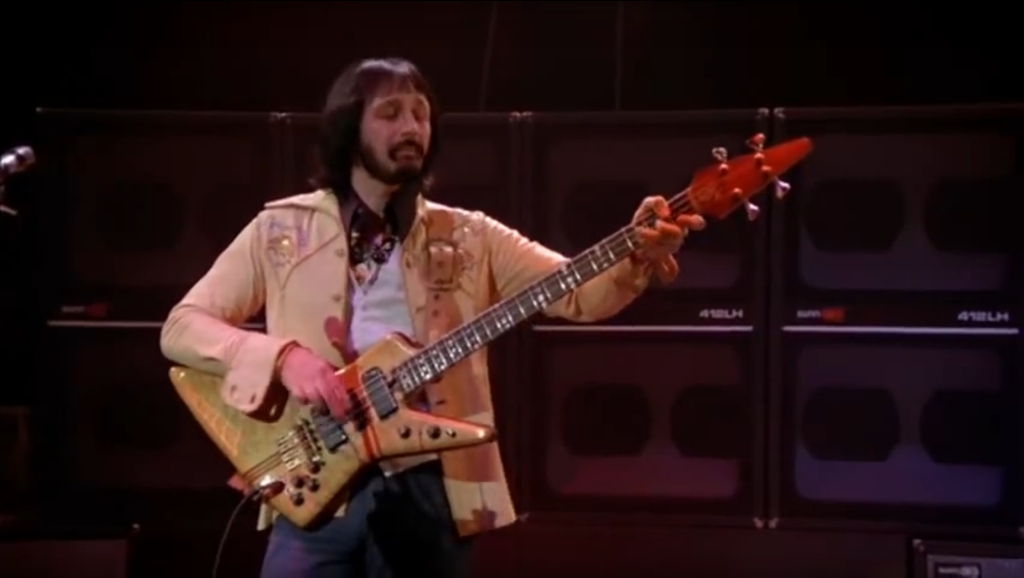
Click to view larger version. 25 May 1978, Shepperton, Sunn rig comprising four Sunn 412LH 4×12 cabs, two Sunn W 1×18 reflex bins (inner bottom) and two Sunn W 1×18 cabinets (outer bottom).
In 1976, John’s amplifier rig was built into a custom Gelf rack by Kenny Flegg, and switched from Alembic preamps to Stramp 4120 stereo preamps. John had three of these rigs built, plus an additional studio-only rig. These were used from May 1976 — with first use at Parc des Expositions in Colmar, France, 22 May, 1976 — through 1982 (and 1985, for Live Aid). The speaker stacks remained the same as 1975 (until 1977).
1976
- Custom Gelf amp rack
- Customized Alembic IN-1 or IN-2 input module/splitter with electronic crossover, feeding mids/highs to one preamp, lows to another.
- Two German-made Stramp 4120 stereo preamps, which split their outputs to one power amp each.
- Four Sunn Coliseum Slave 320-watt power amps (two for low frequencies, one for mids, one for highs/full-range).
- At least three of these Gelf racks built by Kenny Flegg of Gelf.
- Speaker stacks:
- Two Sunn 4×12 cabs (outside top)
- Two Sunn 312 3×12 cabs (inside top)
- Two Sunn W 1×18 reflex bins (inside bottom), with 18″ Cerwin-Vega speakers
- Two Sunn 1×18 cabinets (silver-grille), with 18″ Cerwin-Vega speakers (outside bottom)
1977–1979
For the Kilburn and Shepperton gigs in 1977 and 1978, John replaced the 4×12 and 3×12 cabs with four Sunn 412LH 4×12 cabs, using this setup until late 1979.
- Custom Gelf amp rack, as above
- Speaker stacks:
- Four Sunn 412LH 4×12 cabs (top)
- Two Sunn W 1×18 reflex bins (bottom), with 18″ Cerwin-Vega speakers
- Two Sunn 1×18 cabinets (silver-grille), with 18″ Cerwin-Vega speakers
1979
John also experimented with replacing the Sunn 1×18 cabinets, adding an additional Sunn W 1×18 bin.
- Custom Gelf amp rack, as above
- Three or four speaker stacks:
- Sunn 412LH 4×12 cabs (on top)
- Sunn W 1×18 reflex bins (on bottom)
1979
Around November 1979, John replaced the Sunn W 1×18 bins with Mega 1×18 cabs with Gauss drivers.
- Custom Gelf amp rack, as above
- Speaker stacks:
- Sunn 412LH 4×12 cabs (on top)
- Three or four Mega 1×18 cabs (bottom), with Gauss drivers
1979–1982/1985
By December 1979, John replaced the Sunn 412LH 4×12 cabs with Sunn 412L 4×12 cabs. He remained with this setup through the 1982 Farewell Tour (and again for Live Aid in 1985).
- Custom Gelf amp rack, as above
- Speaker stacks:
- Three Sunn 412L 4×12 cabs (top)
- Three or four Mega 1×18 cabs (bottom), with Gauss drivers
- Miked with Sennheiser 421 microphones
1982 (N.E.C. Birmingham only)
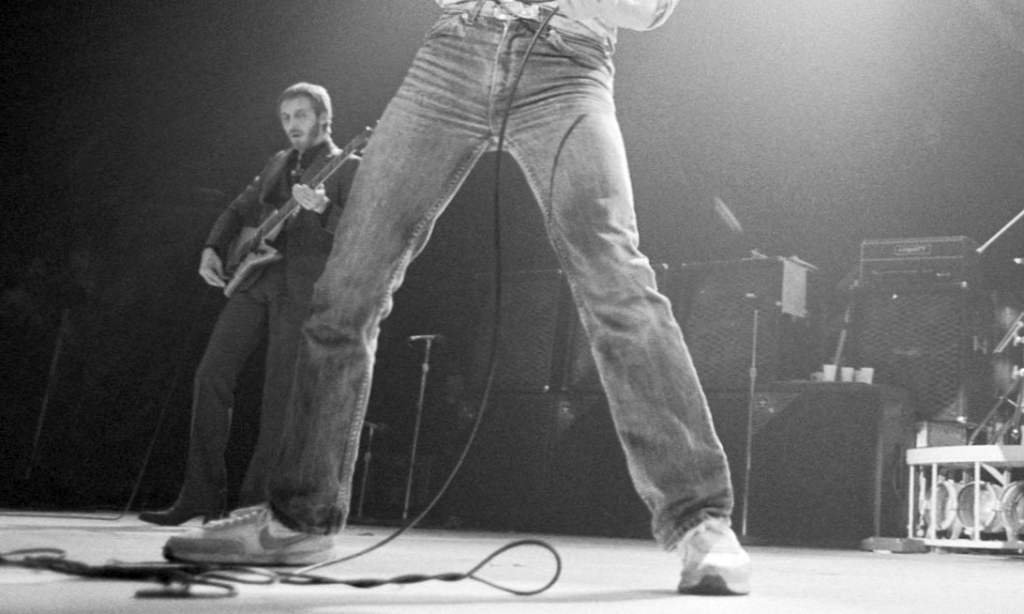
Click to view larger version. 10 or 11 Sept. 1982, N.E.C., Birmingham, three Mesa-Boogie 4×12 cabs (top) in place of the Sunn 412L 4×12 cabs, with four Mega 1×18 cabs (bottom). Roger’s CP103 and Mesa-Boogie 4×12 visible at right.
For the 10 and 11 Sept. 1982 warmup gigs at N.E.C. in Birmingham, John used Mesa-Boogie 4×12 cabs on top, with the Mega 1×18 cabs, in place of the Sunn 412L cabs, a move John had alluded to in a December 1981 interview in Musician magazine. While Roger and Pete used Mesa-Boogie 4×12 cabs for the remainder of the 1982 Farewell Tour, this was John’s only stage use of Mesa-Boogie.
- Custom Gelf amp rack, as above
- Speaker stacks:
- Three Mesa-Boogie 4×12 cabs (top)
- Four Mega 1×18 cabs (bottom), with Gauss drivers
Stramp 4120 stereo preamp features
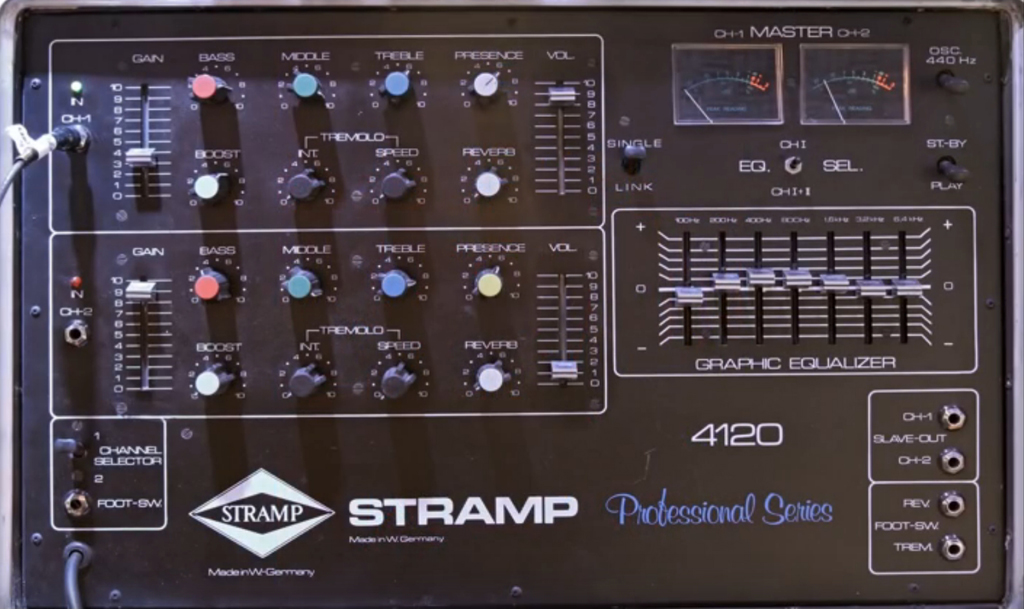
Click to view larger version. Generic Stramp 4120 preamp.
- Each channel featured:
- Gain fader, bass, middle treble presence controls; boost, tremolo int, tremolo speed, reverb; volume fader; selectable (Ch. 1 or 1+2) seven-band graphic EQ; single/link toggle, standby toggle; Osc. 440Hz toggle.
- Inputs/outputs
- Ch. 1 input jack/Ch. 2 input jack; channel selector; foot-sw; Slave-Out (Ch. 1/2); Foot-Sw. (Rev/Trem)
Selected quotes
All quotes and references are copyright their original owners and are included for reference only.
From May 1977 Guitar Player
I’ve started using the Alembic where the extra treble and the facility to get up high means that I can take more solos. I’ve finally fulfilled my role in the Who. You see, I wasn’t really playing what I wanted to play. I was using a Thunderbird bass which was very difficult to get any top from. To do this I had to run one amp into the back of another and they were so loud that I could only play with that sound for maybe two songs. With the Alembic I can play like it all the way through, varying the volumes.
Actually, I’ve had two major changes. Before I had the Thunderbird I used to use an extremely trebly sound and play lead figures, and I was OK with a Precision bass. Then we started playing stadiums and huge places that held up to 70000 people and the sound just didn’t carry — it sounded like a little click at the back of the audience. So I changed the whole equipment and the basses to the Thunderbird. In a way it was an advance for me because I’ve been in a rut ever since Tommy which was the last album where I used a Precision. I’d work out a series of lines that flowed into each other with the twang of the trebly sound and I’d find myself drifting into that every night, unless it was a bit of free form. So from there my whole style changed for about five years until recently when I’ve had another change onto the Alembics — the best change I ever did.
From the August 1989 Guitar Player
Although [John] was happy with the bright, clear tone of the Alembics, and assortment of inconveniences ultimately forced him to move away from the instruments after more than a decade. “Unfortunately, the basses were very sensitive to the climate changes on our tour schedules, and I’d spend as long as a half-hour before every gig making adjustments. Also, I grew tired of the bloody 5-pin Cannon jack and transformer box I had to use with them. What finally put me off was when we did Live Aid. Right before we were to play, my main bass went dead because I’d accidentally crossed some wires while changing the battery. I ran for the backup bass but couldn’t tune it because there were no transformers backstage. At that point we were introduced, and I barely managed to get back onstage in time to start ‘My Generation.’ If you listen closely to the video, you can hear me tuning the D string as we go. I just about got it in tune in time for the bass solo. I sold the main bass to the Hard Rock Cafe — that was its punishment.”
From May 15, 2002, Guitar Center interview
I eventually changed to using Sunn 300-watt Coliseum Amps powering four 18″ PA bins plus additional 12″ cabinets (up to sixteen 12″ cabinets at one point).
From the November 1977 Guitar Player (read an excerpt of the article):
John Entwistle’s amps are the responsibility of Bill Harrison, who stands to the rear of the bass cabinets when the Who are onstage. Each of the two signals of John’s stereo output is sent to its own Stramp 4120 stereo preamp, where they are again divided and relayed to one of four Sunn Coliseum slave amps. The Stramps are turned all the way up, the Sunns set at about 5 or 6. The current speaker array includes a pair of Sunn W bins, each with an 18″ Vega speaker; two standard Sunn enclosures, each with a Vega 18; two Sunn 4×12s; and two Sunn 3×12s. Entwistle describes his goal: “Mainly the sound qualities that I am looking for in this particular amping system center around the fact that I like separation between low and high notes. I can have four different sounds going on at once, with the equalization of the preamps and four amp heads. Just flicking two switches on the preamps allows me to select which sound I want at any given point.”
Unlike the vast majority of bassists, John has his strings (Rotosounds) changed before every concert in order to attain maximum crispness. The task is another of Alan Rogan’s responsibilities. Entwistle says, “You don’t get that initial twang if you use the strings again. You can always turn up your treble control to get it like the day before, but then you end up getting a lot of whistle.” Entwistle’s action is probably the lowest of any modern electric bass player. As John laughs, “I like my strings on the *other* side of the frets.”
The Who’s bassist has a huge collection of vintage instruments, though all of his road basses are currently Alembics. His newest ones are a matched set of three, constructed to be as identical as possible. About two years ago, while one of the “Fenderbirds” was being repaired, John happened to pick up a stock Alembic for a rehearsal. He liked it so much that he ordered several — unmodified except for their extremely low actions. Alembic president Rick Turner recalls, “John then inquired as to the possibility of our doing some Explorer copies. I kind of resisted, because I’m not usually into doing copies of stuff, but then I said — what the hell; might be interesting — so we went ahead.”
The Explorer-shaped Alembics have necks and bodies of birdseye maple and walnut. The seven-piece laminate necks are long-scale. Each instrument has two master volume controls with a selector switch so that John can preset two levels and then switch back and forth. The electronics are otherwise stock Alembic circuitry: two pickups that are medium impedance and gain-adjustable, internal preamp, and a dummy pickup for hum cancellation; the tone controls are active low-pass filters. The instrument attaches to the cable through a 5-pin connector and may be sent to an Alembic IN-2 input module that distributes the signal to any of various components — PA, amp, recording console, etc. Turner adds that the Alembic recently sent John another bass, a new model with a medium scale graphite neck, and an ebony body with a Bigsby vibrato tailpiece.
Post from 2009 by former Stramp employee Michael Wagener on John’s Stramp 4120 preamps:
Yes, I built this particular one. Stramp was a very small company, only four people total, so whatever left the building I had my hands on it.
A funny story about the delivery of eight 4120 tops to the Who: we made a special version of the 4120 preamp section for John Entwistle. They were built in to a “lectern” kind of setup with 3200W in poweramps in the bottom.
John bought eight of them, because they had four major rehearsal studios around the world and he didn’t like to set up, so each studio got two of them (one for spare). That kept us in bread for a few month back then. There were two preamps in each top and you could blend between them with a standard $50 volume pedal. When we delivered the amps to the London rehearsal space, we forgot to bring the volume pedal. John said it was no problem, they would send a Roadie to buy one. The next day I asked about the roadie with the volume pedal, and they said that he should be on the next flight, because they buy at Manny’s in New York. Now THAT is loyalty to a dealer.
You can use it for bass or guitar. It’s very clean and won’t distort without a pedal, but it has tons of clean punch. And it has that nine-band graphic EQ (in 1975!).
From December 1981 Musician interview with John Entwistle:
Amp — Two Stramp stero pre-amps, Sunn Coliseum power amps, driving three Sunn 18″ cabinets and three 4 X 12″ cabinets. This set-up is still a bit too loud, so I’m thinking of switching to two Mesa Boogie stacks instead. In the studio I use a Music Man HD-130 head and a 2 X 12″ cabinet for the clean sound, and a Mesa Boogie with an extension cabinet for the distortion and the treble.
Effects — Occasionally I’ll use a Boss Chorus.
Amplification
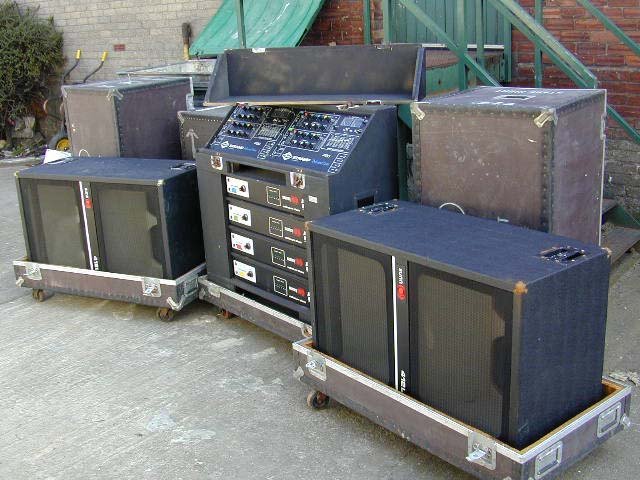
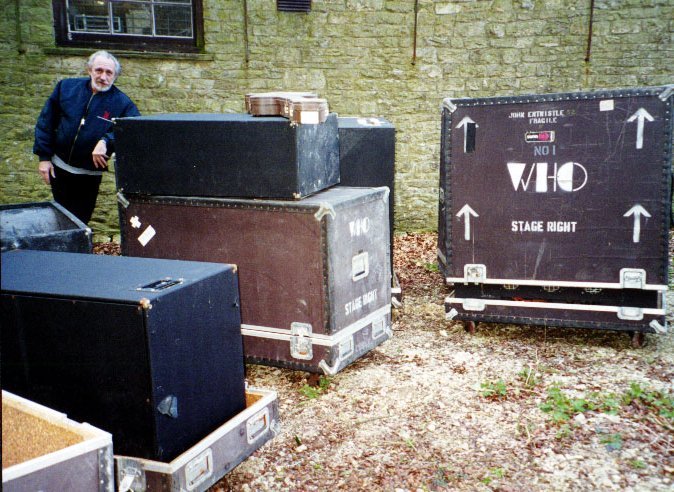
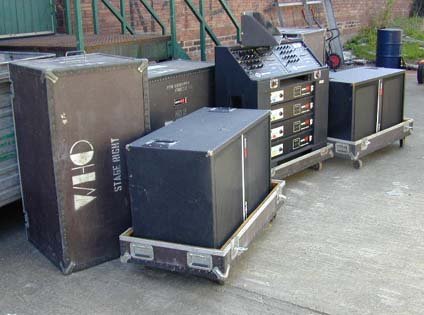
John’s custom amp rack, with two Stramp 4120 preamps and four Sunn Coliseum Slave power amps (input module/splitter slot is empty). Cabinets are Sunn 412LH 4×12s. Courtesy rockstarsguitars.com.
Gallery of John’s custom amp rack and speaker cabinets. All images courtesy and copyright rockstarsguitars.com.

Sunn 312 cabinet, courtesy rockstarsguitars.com.
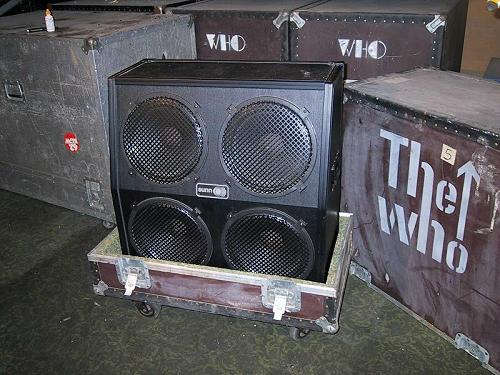
Sunn 412 cabinet, courtesy rockstarsguitars.com.
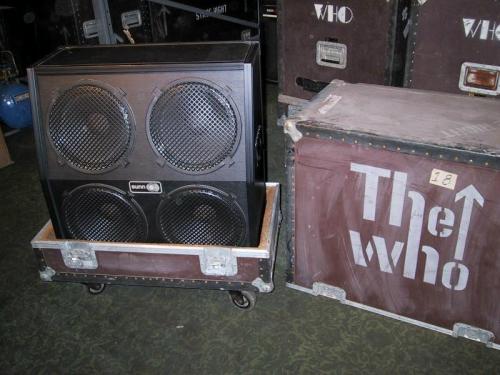
Sunn 412 cabinet, courtesy rockstarsguitars.com.
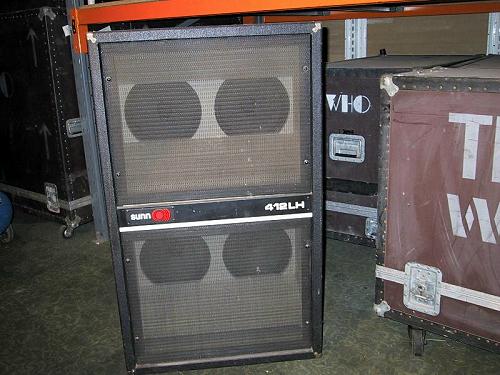
Sunn 412LH cabinet, courtesy rockstarsguitars.com.
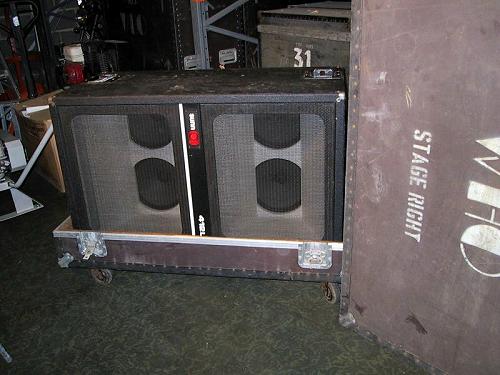
Sunn 412LH cabinet, courtesy rockstarsguitars.com.
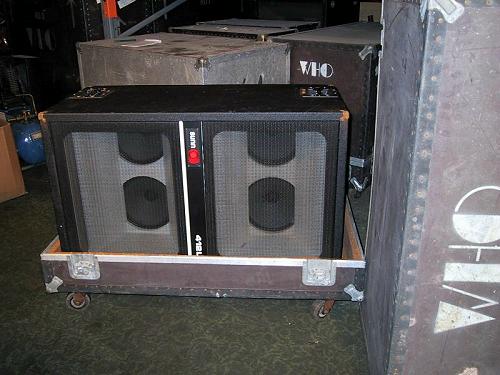
Sunn 412LH cabinet, courtesy rockstarsguitars.com.
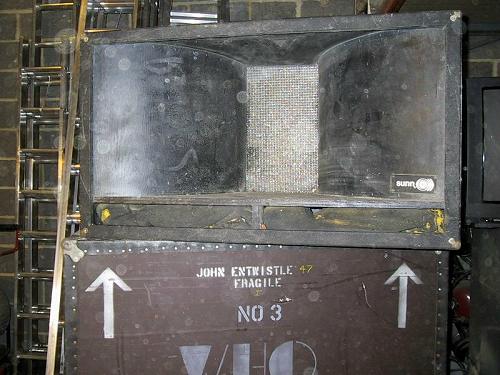
Sunn Bass bin, courtesy rockstarsguitars.com.
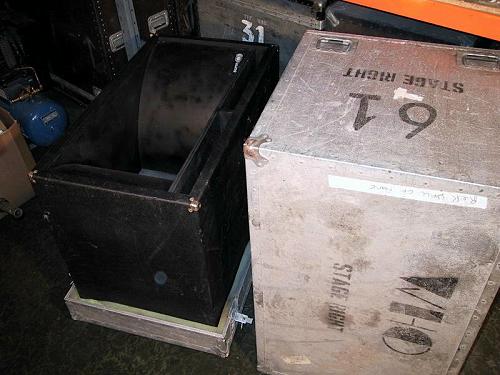
Sunn Bass bin, courtesy rockstarsguitars.com.
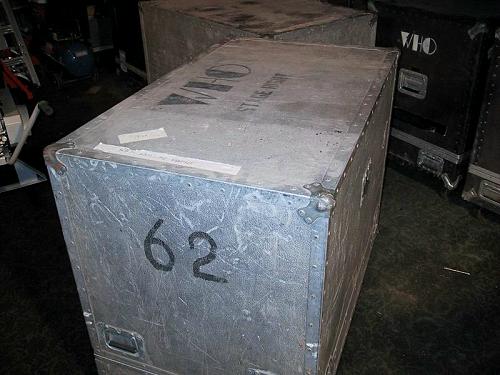
Sunn Bass bin road case, courtesy rockstarsguitars.com.
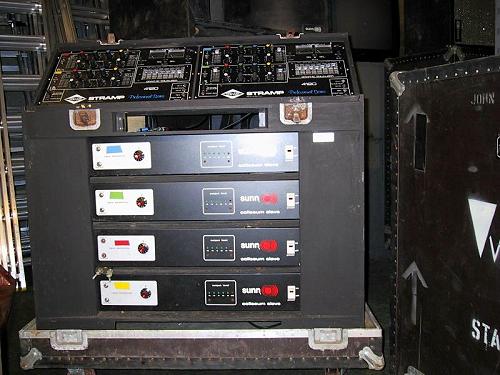
Sunn Gelf amp rig #1, courtesy rockstarsguitars.com.
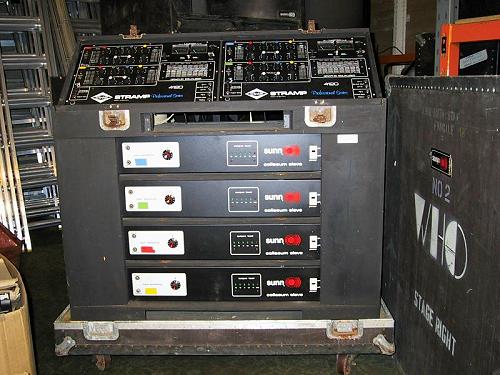
Sunn Gelf amp rig #2, courtesy rockstarsguitars.com.
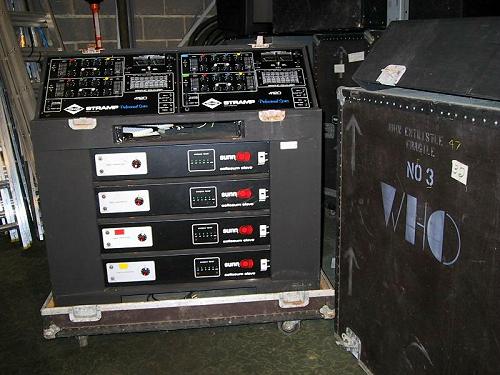
Sunn Gelf amp rig #3, courtesy rockstarsguitars.com.
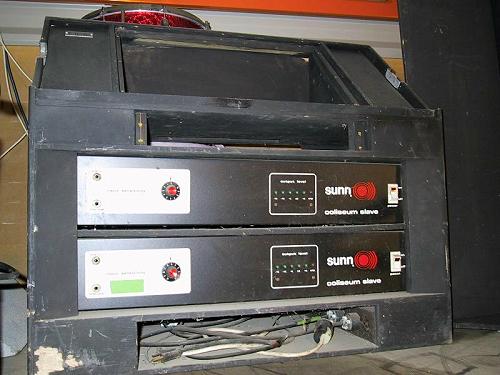
Sunn Gelf recording amp rig, courtesy rockstarsguitars.com.
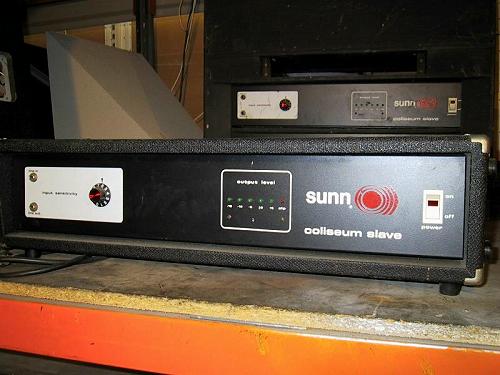
Sunn Coliseum Slave, courtesy rockstarsguitars.com.
Sunn Coliseum Slave, courtesy rockstarsguitars.com.
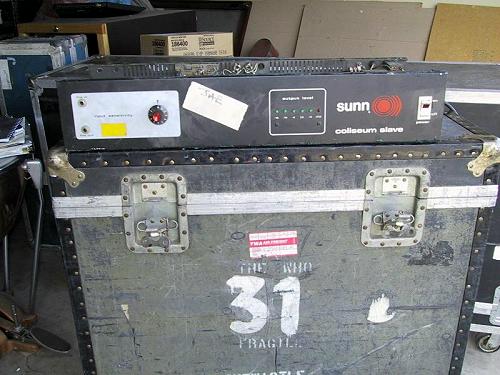
Sunn Coliseum Slave spare, courtesy rockstarsguitars.com.
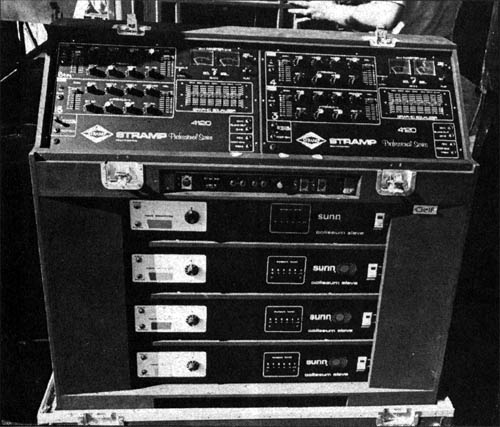
Ca. 1976, the Gelf custom amp rack by Kenny Flegg, with two Stramp 4120 preamps, Alembic IN-2 input module, and four Sunn Coliseum Slave 300-watt power amps.
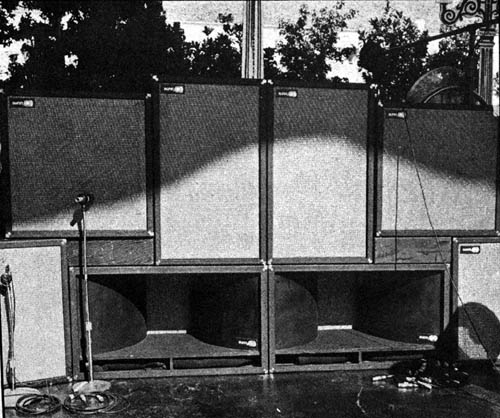
Ca. 1976, Sunn speaker cabinet setup, with two Sunn 412L 4×12 cabs (outside top); two Sunn 312 3×12 cabs (inside top); two Sunn W 1×18 reflex bins (inside bottom), with 18″ Vega speakers; two Sunn 1×18 cabinets (silver-grille), with 18″ Vega speakers (outside bottom).
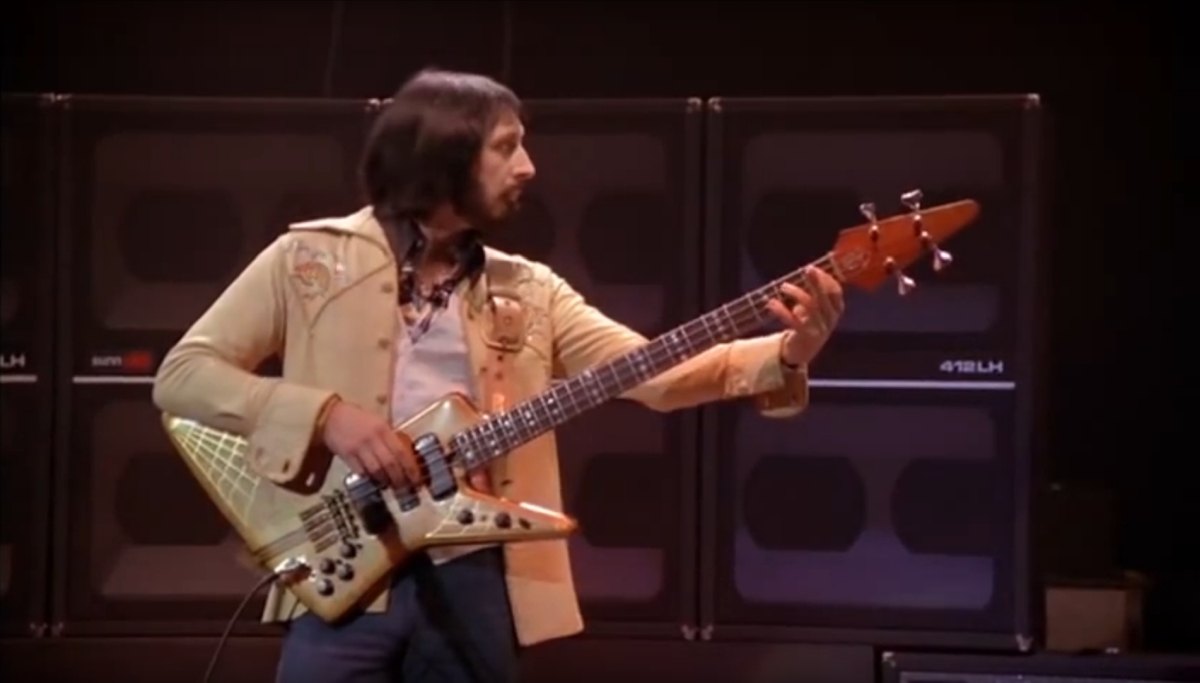
Click to view larger version. 25 May 1978, Shepperton, Sunn rig comprising four Sunn 412LH 4×12 cabs, two Sunn W 1×18 reflex bins (inner bottom) and two Sunn W 1×18 cabinets (outer bottom).
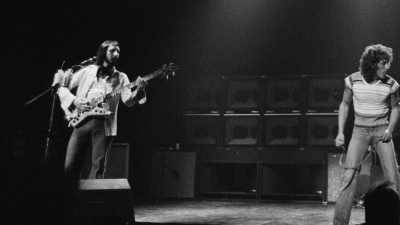
25 May 1978, Shepperton, Sunn rig comprising four Sunn 412LH 4×12 cabs, two Sunn W 1×18 reflex bins (inner bottom) and two Sunn W 1×18 cabinets (outer bottom).
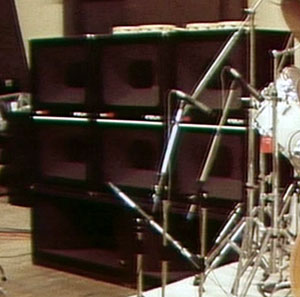
Ca. April 1979, rehearsals, Sunn rig comprising three Sunn 412LH 4×12 cabs and two Sunn W 1×18 reflex bins.
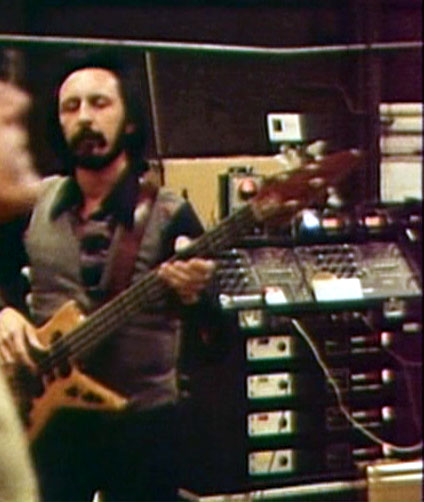
Click to view larger version. Ca. April 1979, rehearsals, custom amp rack, with two Stramp 4120 stereo preamps, Alembic IN-2 input module/splitter, and four Sunn Coliseum Slave power amps.
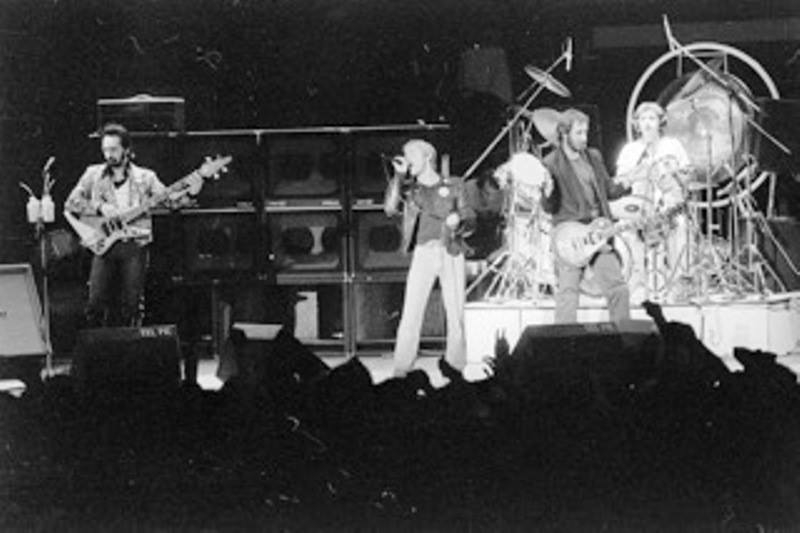
Click to view larger version. 12 May 1979, Frejus, France, Sunn 412LH 4×12 and Sunn W 1×18 bins, with Hiwatt CP103 at far (stage) right end for guitar monitoring.
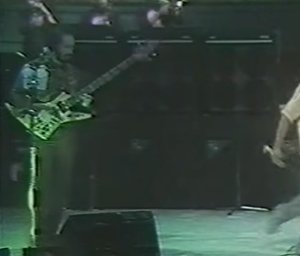
8 Dec. 1979, Chicago, with Sunn 412L 4×12 and Mega 1×18 cabinets.
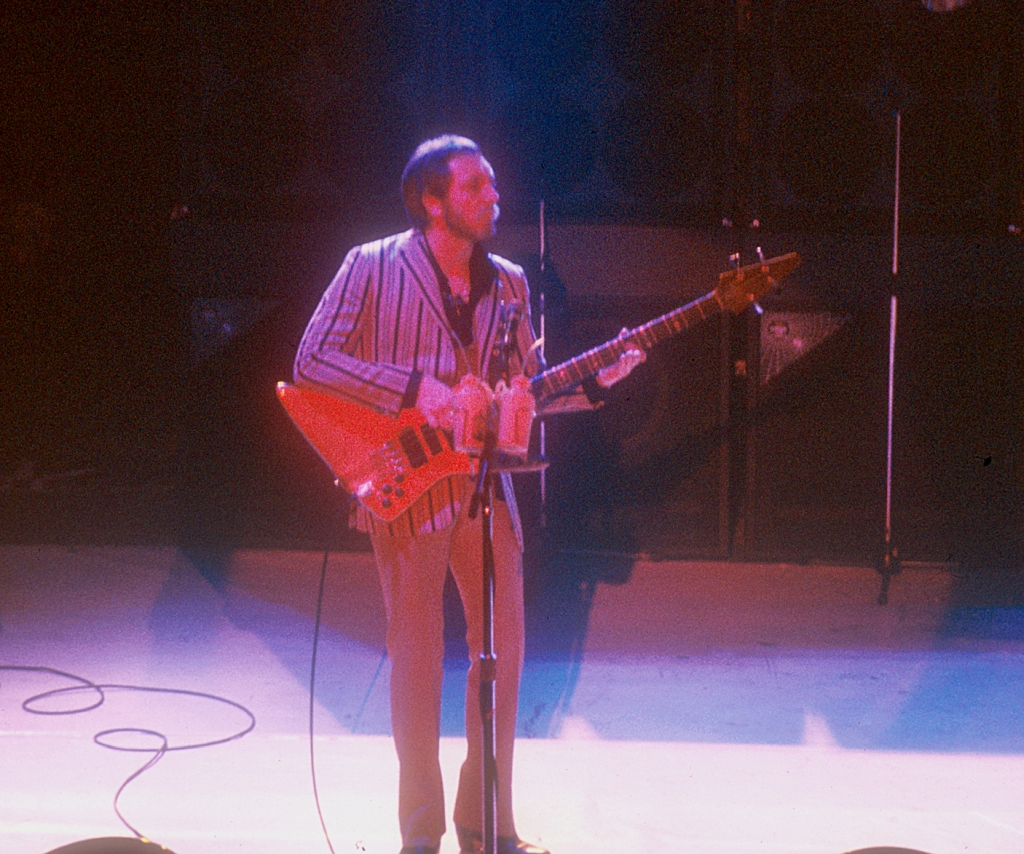
Click to view larger version. Ca. March 1981, Manchester Apollo, Sunn 412L 4×12 and Mega 1×18 cabinets.
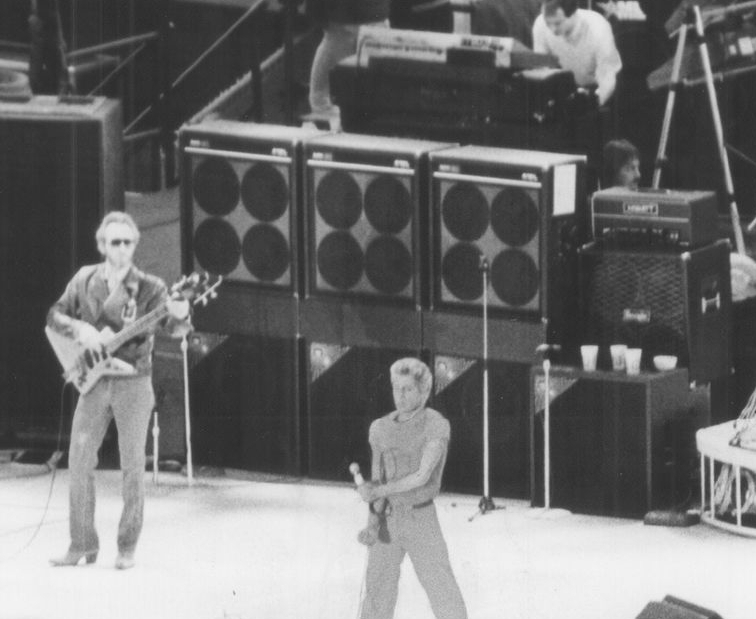
Click to view larger version. Ca. 1982, Toronto, Sunn rig, with three Sunn 412L 4×12 and Mega 1×18 cabinets. Roger’s Hiwatt CP103 “The Ox” and Mesa-Boogie 4×12 visible at right.
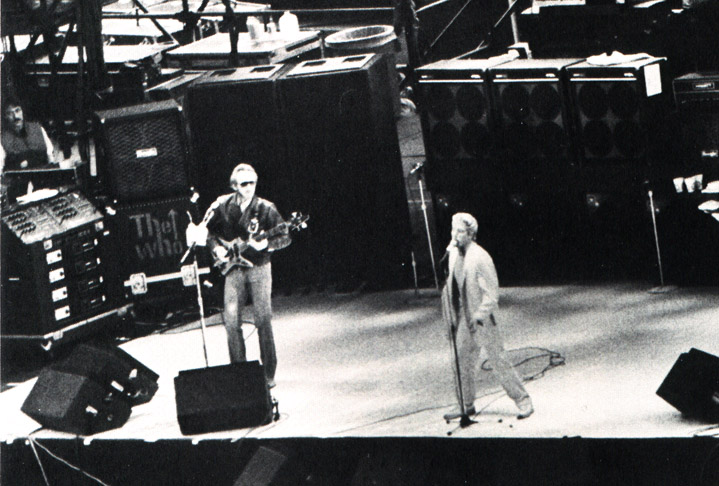
Click to view larger version. Ca. 1982, Sunn rig, with Gelf rack visible at stage right.
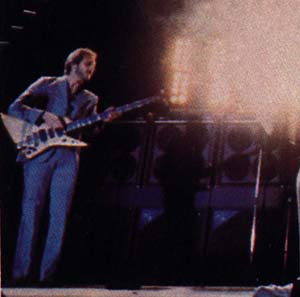
Ca. 1982, Sunn 412L 4×12 and Mega 1×18 cabinets.
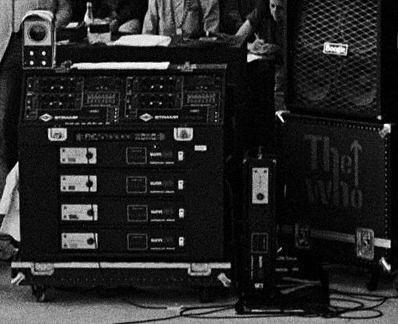
25 Sept. 1982, Gelf custom amp rack, with two Stramp 4120 stereo preamps, Alembic IN-2 input module/splitter, and four Sunn Coliseum Slave power amps, with one as spare. Topped by Conn Strobotuner. Mesa-Boogie 4×12 for guitar monitoring at right.
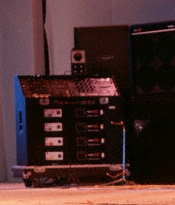
13 July 1985, Live Aid, Gelf custom amp rack, with two Stramp 4120 stereo preamps, Alembic input module/splitter, and four Sunn Coliseum Slave power amps. Topped by Conn Strobotuner.
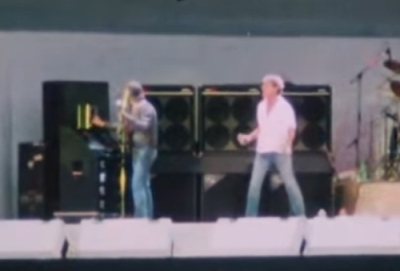
13 July 1985, Live Aid, last use of the Sunn 412L 4×12 and Mega 1×18 rig.
Alembic Explorer
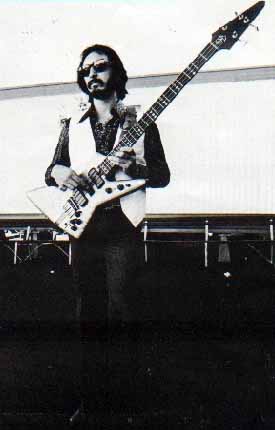
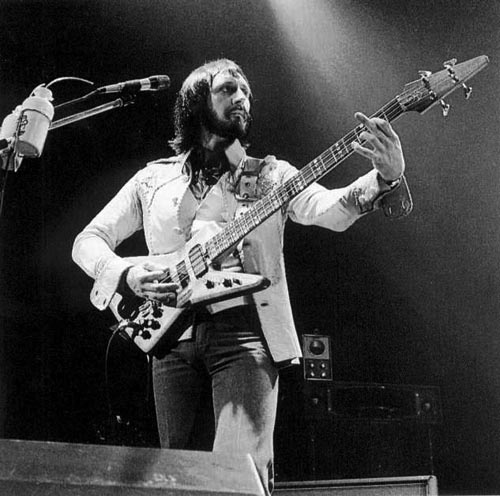
Ca. 1976, with Alembic Explorer.
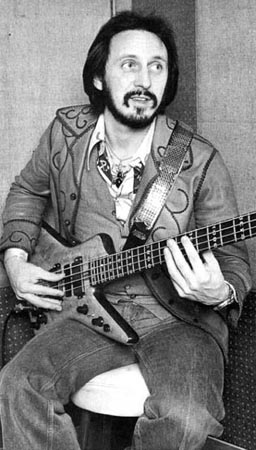
In the studio with Alembic Explorer.
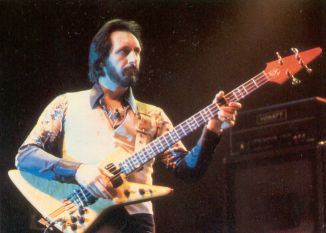
Ca. 1979, with Alembic Explorer.
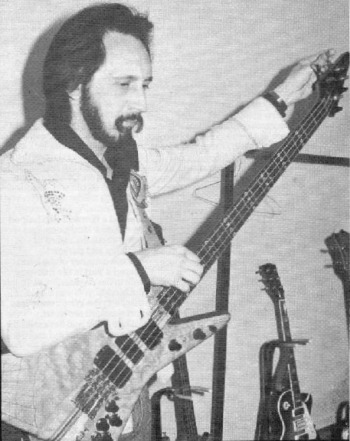
Ca. 1979, backstage, with Alembic Explorer.
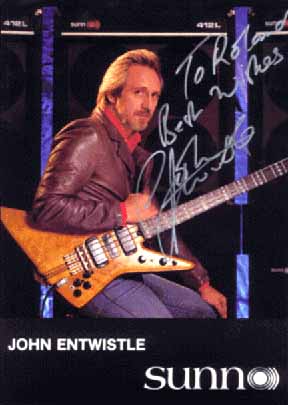
Click image to view larger version. Sunn ad, courtesy thewho.org.
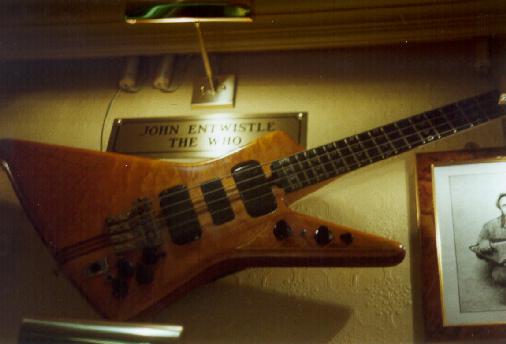
John’s Alembic bass in its original display at the Hard Rock Café in Berlin. Courtesy Martin Forsbom.
Alembic Explorer on display at Hard Rock Café, Berlin
Photos courtesy Colin Baker.
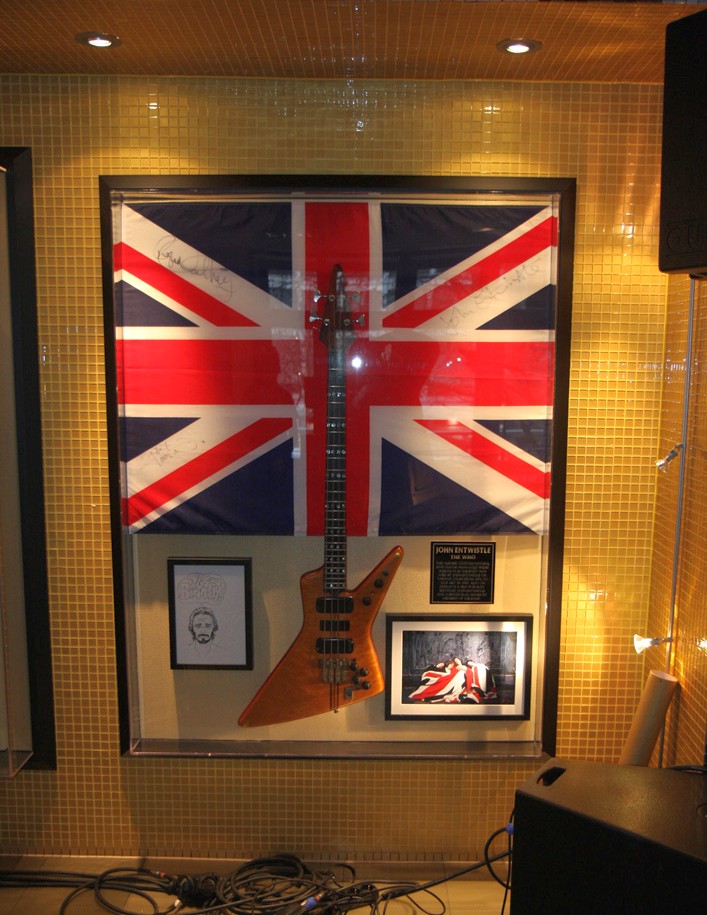
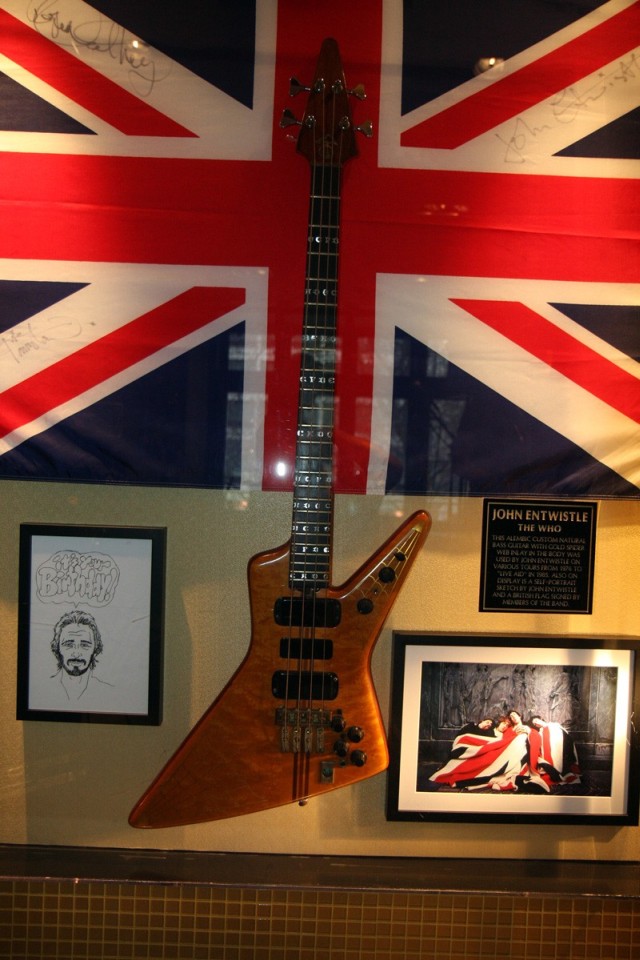
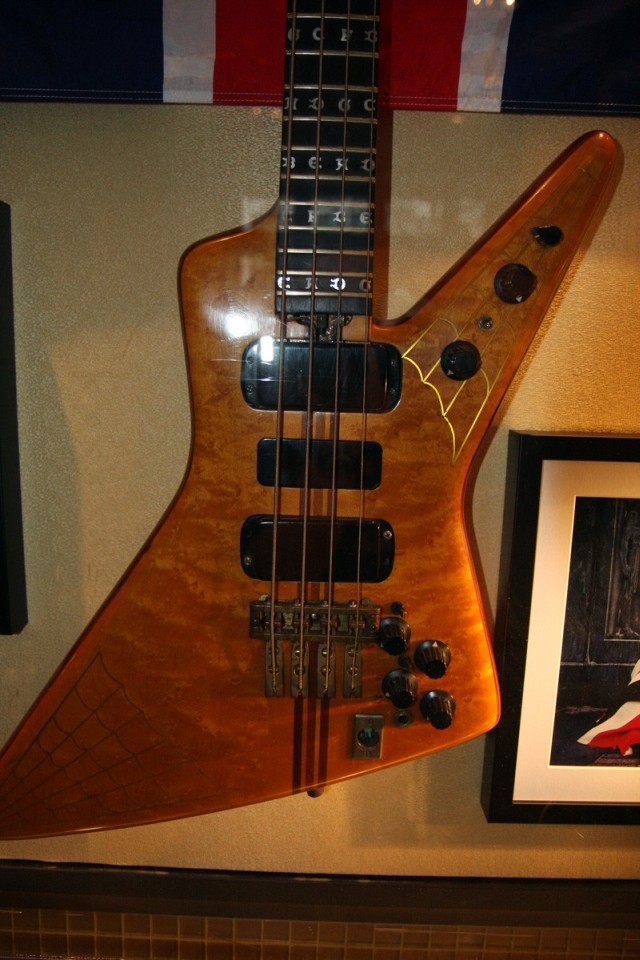
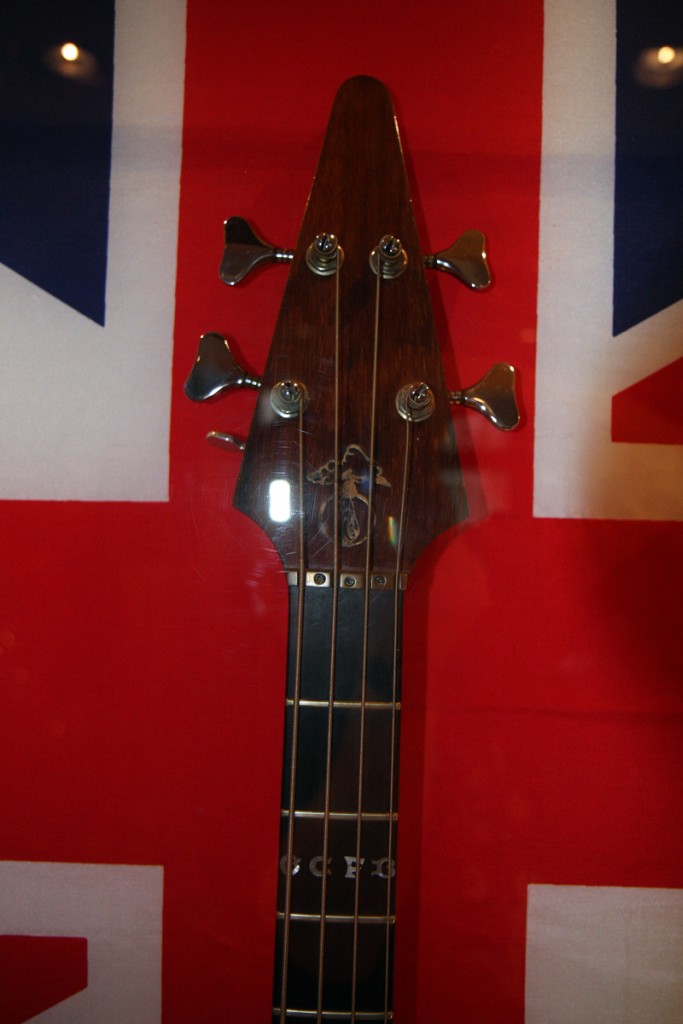
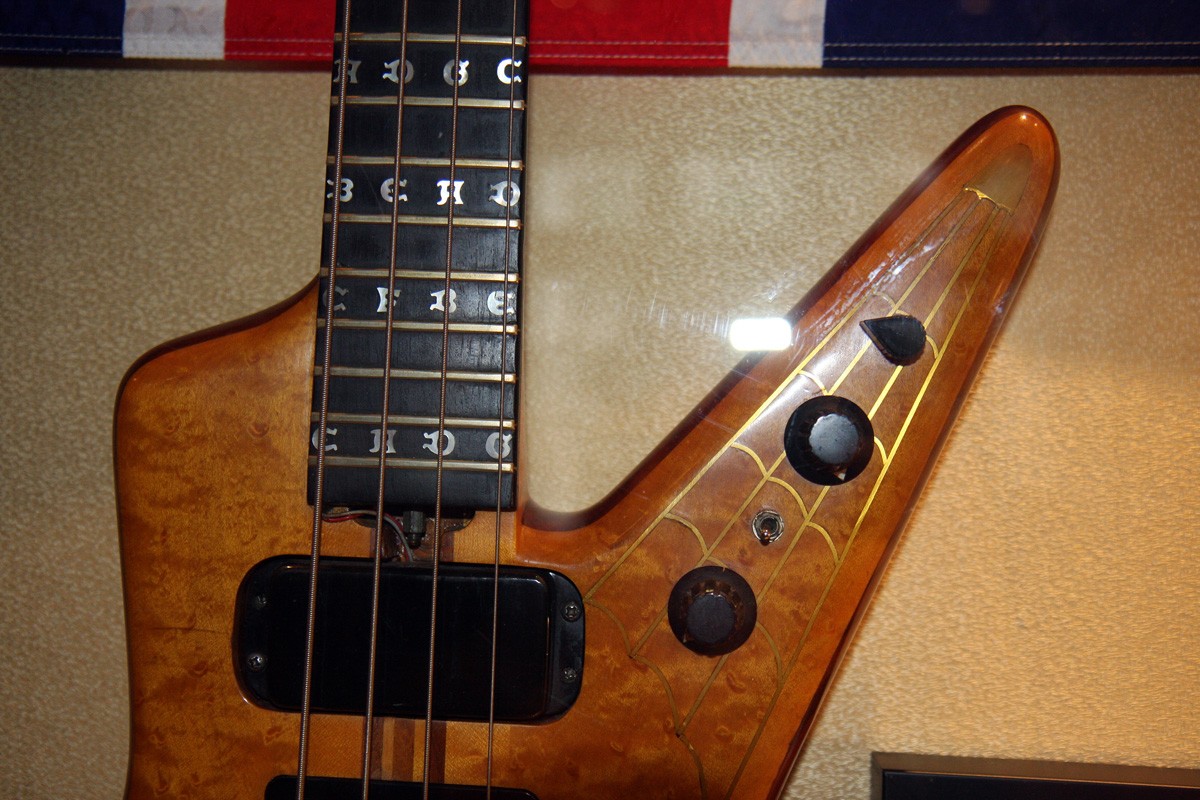

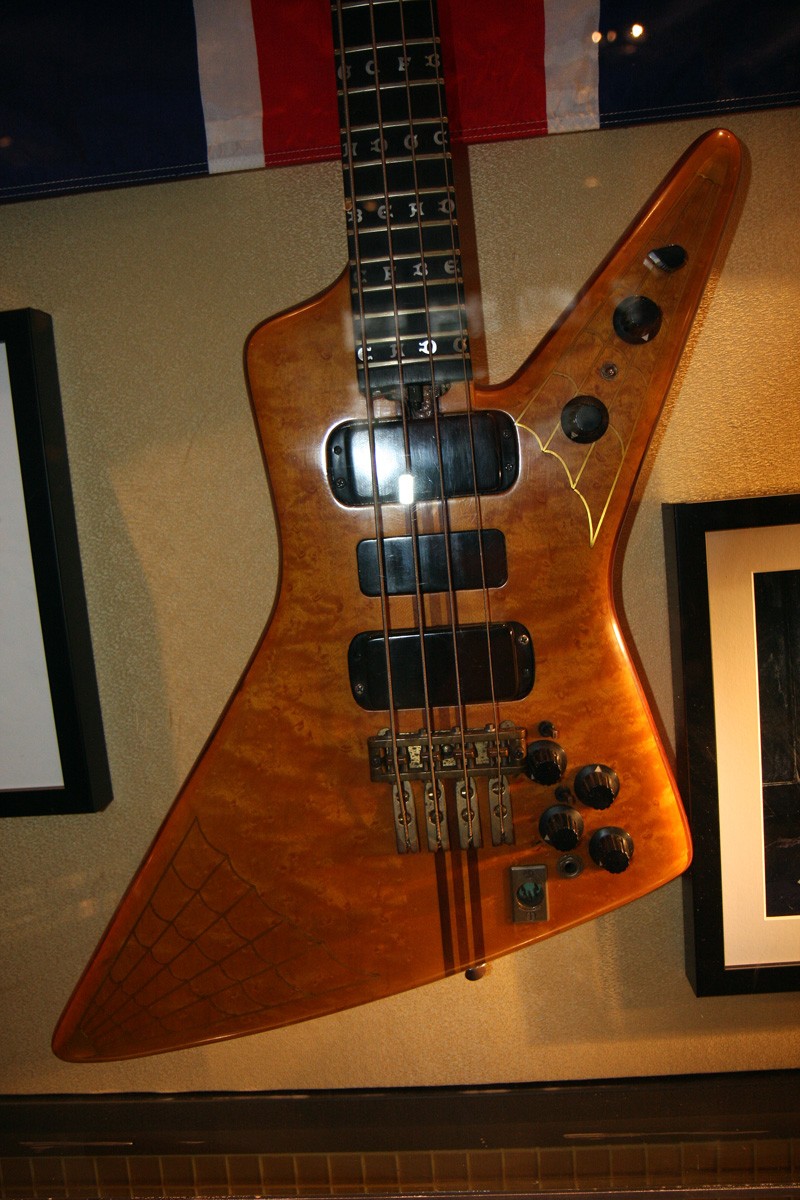
Click images to view larger versions. Courtesy Colin Baker.
Alembic Explorer on display at the Hard Rock Vault in Orlando, Florida, 2004
Photos courtesy Michael Mullins.
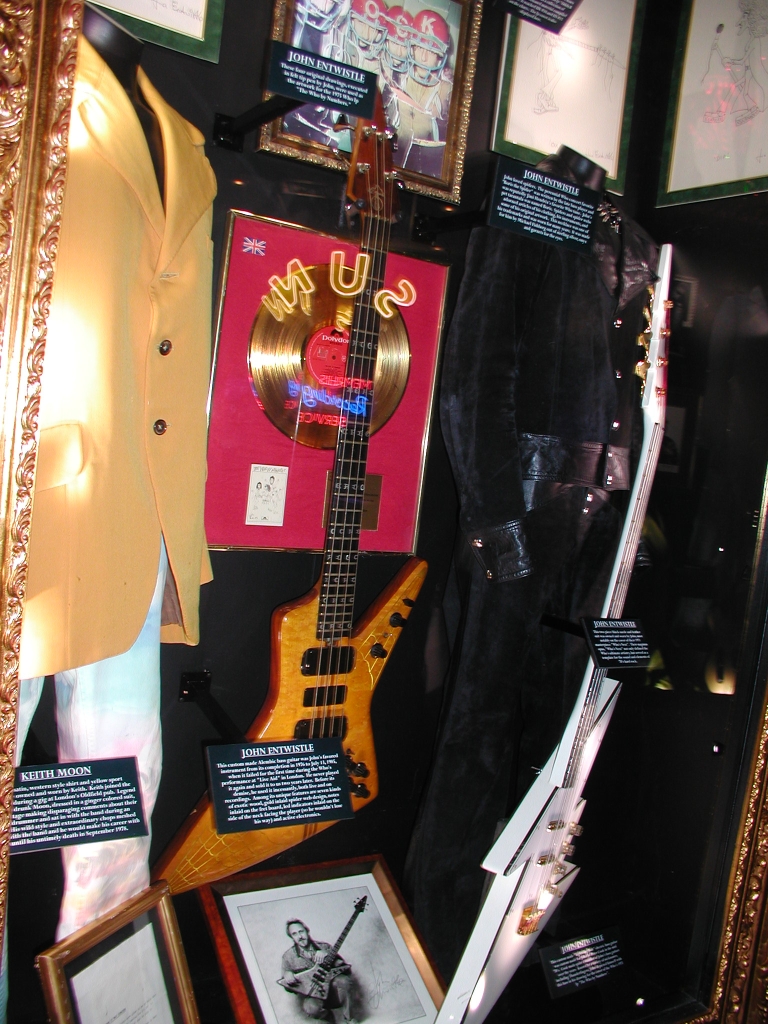
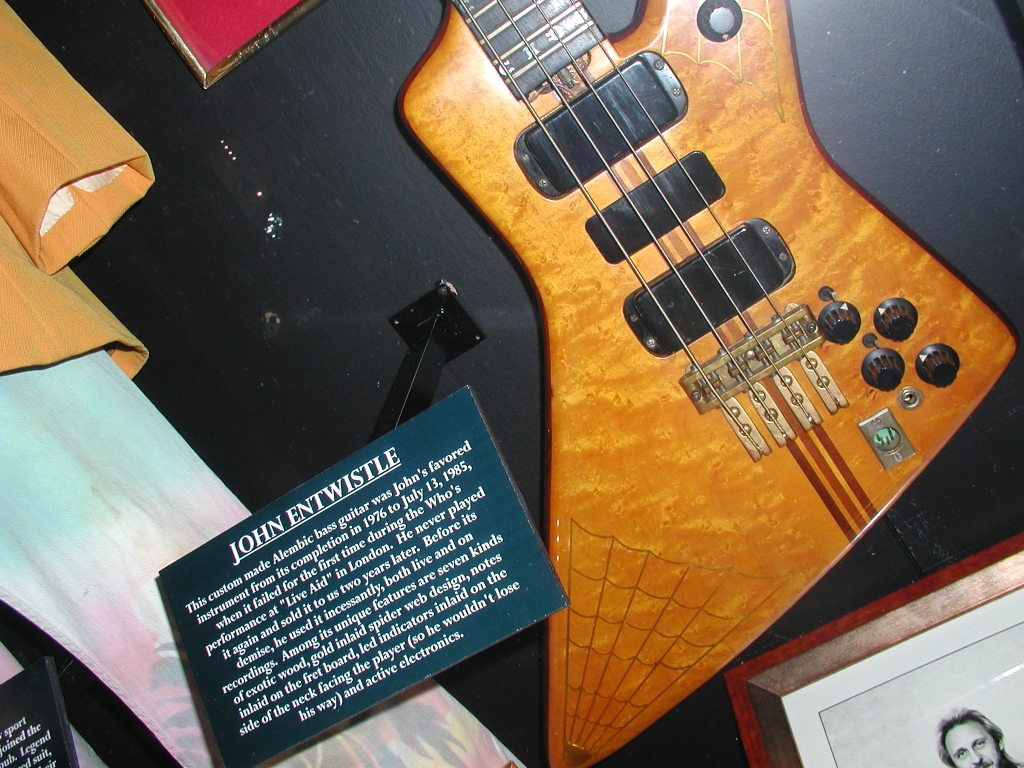

Click images to view larger versions. Courtesy Michael Mullins.
Auction Profiles
All auction information, including quotes and references are copyright their original owners and are included for reference only. Whotabs makes no claim that these auctions represent authentic Who-used items.
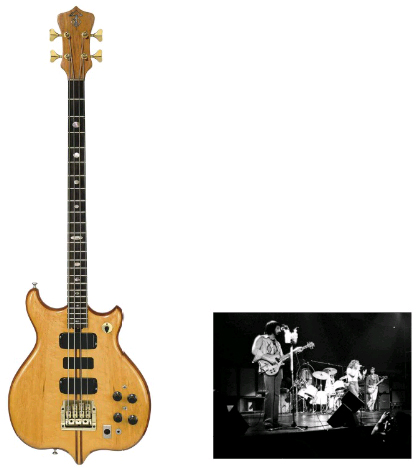
News (June 2012): Christie’s to auction Alembic as part of its Popular Culture: Rock & Roll Memorabilia sale, to be held on 12 June 2012. The instrument is currently owned by Brad Rodgers of whocollection.com.
The Who/John Entwistle
A 1976 Alembic Bass guitar; serial number 76-A046, in natural finish, neck through body constriction [sic], curved maple top, mahogany body cores, maple and walnut laminate neck, ebony twenty six fret fingerboard with oval abalone inlays and LED side markers, headstock with walnut facing and silver Alembic logo, two pickups, four rotary controls, one selector switch, two mini-toggle switches (one broken), jack and cannon connector sockets, gold plated Schaller tremolo bridge/tailpiece with four adjustable saddles; and an original blue rectangular hard shell case with red plush lining — owned and played by John Entwistle on stage with The Who; accompanied by a black and white image of Entwistle playing the instrument on stage at the Winterland, San Francisco, 28 March, 1976.
Estimate:
£10,000–£15,000 (US$15,440–$23,160)
Realised:
£10,000 (US$15,460)
Provenance:
Ex-lot 63 Rock ‘n’ Roll Memorabilia 1956–1984 – The Property of John Entwistle, Sotheby’s, London, 7th April, 1988
From the collection of Brad and Diana Rodgers of www.whocollection.com
Exhibited:
This guitar was exhibited at the Rock & Roll Hall of Fame, Cleveland, Ohio from 1998–2007
Lot notes:
According to the original lot description the LED side markers on the guitar were at the request of Entwistle as an essential tool when the stage was entirely blacked out during The Who’s concerts in 1975 and 1976.
Christie’s would like to thank Rick Turner for his assistance with this lot.
See lot details at christies.com
News (28 April 2010): Christie’s to auction Peter Cook custom “Flame” bass, as part of its Popular Culture: Rock and Pop Memorabilia sale, to be held on 24 June 2010. The instrument is currently owned by Brad Rodgers of whocollection.com.
Rock Stars Guitars for sale at Christie’s
Four iconic guitars feature from Brad Rodgers at www.whocollection.com — the largest single-owner collection of The Who memorabilia to ever appear at auction — two previously owned by Pete Townshend, and two by John Entwistle [...] The most striking example is the Paul [sic] Cook custom-made bass guitar, of flame design (estimate: £15,000–20,000). Owned by John Entwistle, and played by him during the Top of the Pops The Who performance circa 1976.
See christies.com
Realised: £30,000 ($44,880)
Resources and Information
Contributors
Thanks to those who have made this page possible:
- Paul Winkler (pw_lists@slinkp.com)
- Brad Rodgers (whocollection.com)
- Jesse Pollack (quarryman88@yahoo.com)
Additional Information:
- Brad Rodgers at whocollection.com
- Rock Stars Guitars, rockstarsguitars.com
- Sotheby’s May 2003 auction: sothebys.com
- Dr. Tube’s Schematics: drtube.com/guitamp.htm
- Unofficial Sunn Equipment: sunn.ampage.org/site/museum/ (archived)
- Includes “museum,” schematics and history.
- The Sunn Shack: richbriere.com/The_Sunn_Shack.htm (archived)
- Bass Culture, by John Entwistle; forewords by Roger Daltrey and Rick Nielsen. Published 2004 by Sanctuary Publishing
- Alembic F-2B preamp: alembic.com/prod/f2b.html
- 2011 interview with John Entwistle’s luthier/guitar maker Peter Cook posted on flatericbassandguitar.blogspot.com
- Conn Strobotuner: Conn ST-11 Strobotuner
Manufacturer’s Sites
- Alembic: alembic.com
- Rotosound Strings: rotosound.com
- Sunn Amplification: sunnamps.com
- Boss Timeline: Boss Chorus Ensemble CE-1
- Stramp