Keith Moon’s Drumkits: Borrowed/Hired Kits
Whether due to missed transport, previous night’s abuse or other inexplicable reason, Keith occasionally borrowed another group’s drumkit, solemnly promising to return it intact. This page highlights some of the known borrowed kits.
1963 – Beachcombers and The Strangers
Keith apparently borrowed some pieces for these early photo sessions.
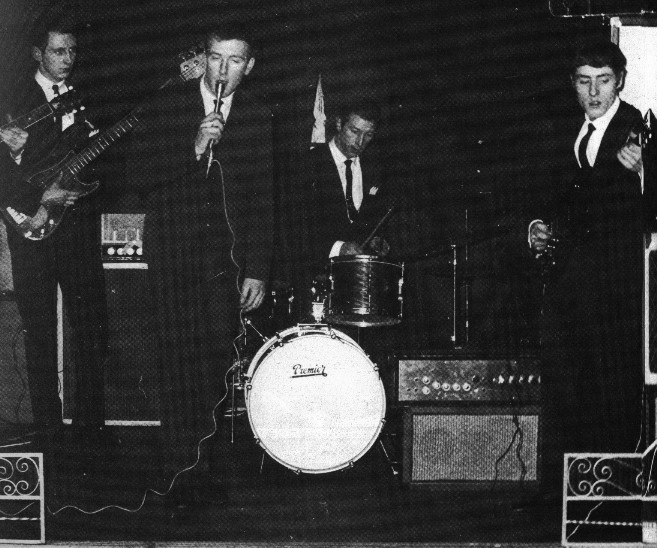
With the Strangers, a Premier snare:
- Likely the “Hi-Fi” model.
- 5.5″ × 14″
- Either Silver Sparkle or Gold Sparkle finish.
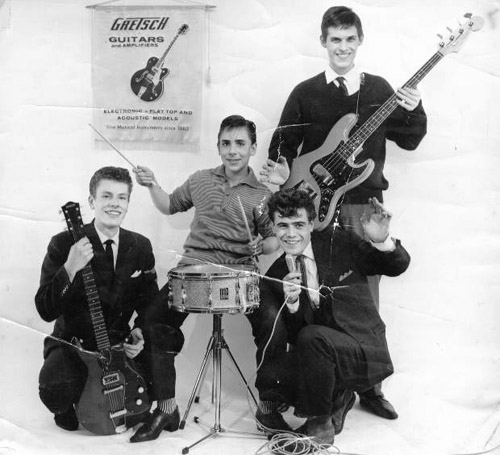
Click to view larger version. Keith with his first band, the Strangers. He has a Premier snare.
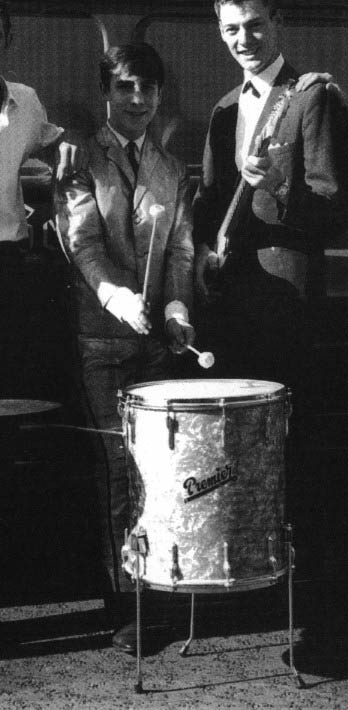
Click to view larger version. Early photo session with the Beachcombers, with Premier 16″×18″ White Marine Pearl floor tom.
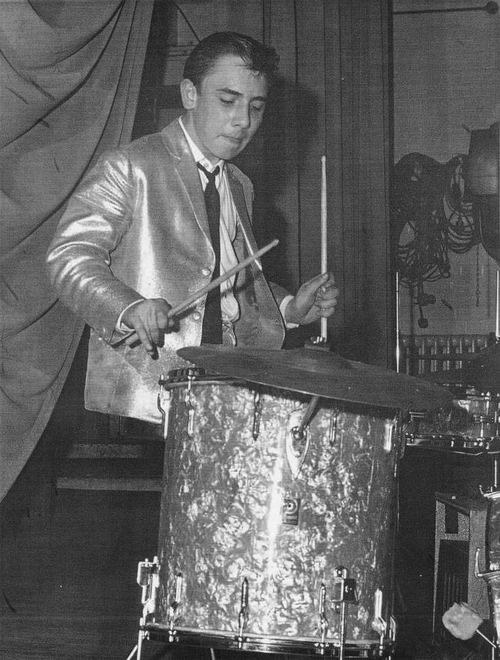
Click to view larger version. Early photo session with the Beachcombers, with Premier 16″×18″ White Marine Pearl floor tom.
1964 – English Rogers kit (photo session)
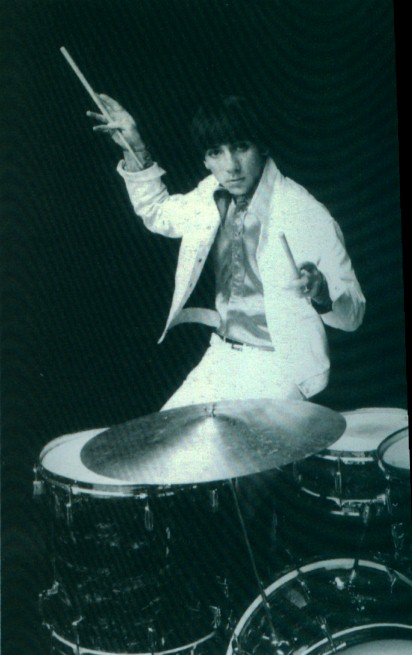
Click to view larger version. English Rogers drumkit.
Just after Moon joined the Who, he posed with an English Rogers drumkit for a photo session.
Rogers kit:
- 8×12 rack tom
- 16×16 floor tom
- 14×20 bass drum
Finish is probably BlackBlue Diamond Pearl.
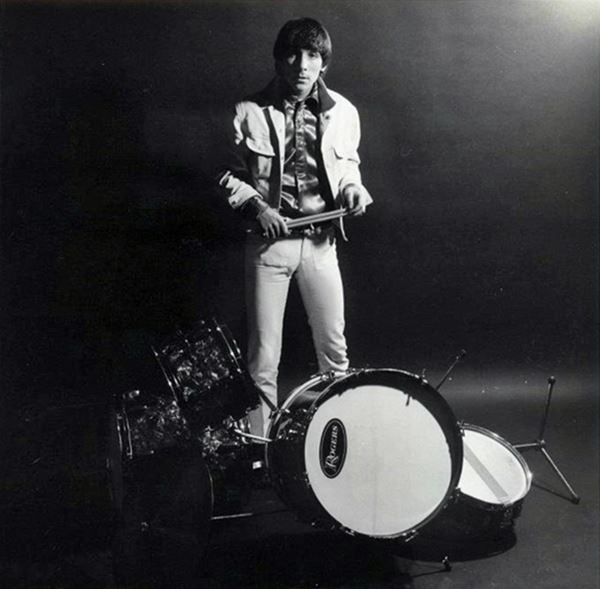
Click to view larger version. 1964 photo session, with spilled English Rogers kit. (Photo: SoundCityChris)
1965 – Premier kit
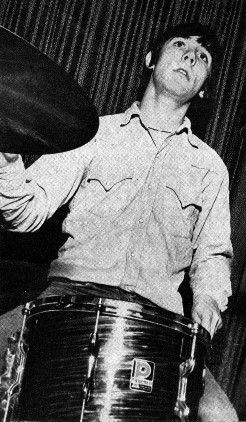
From February 1966 Beat Instrumental, a photo of Keith playing a striped Premier kit ca. 1965.
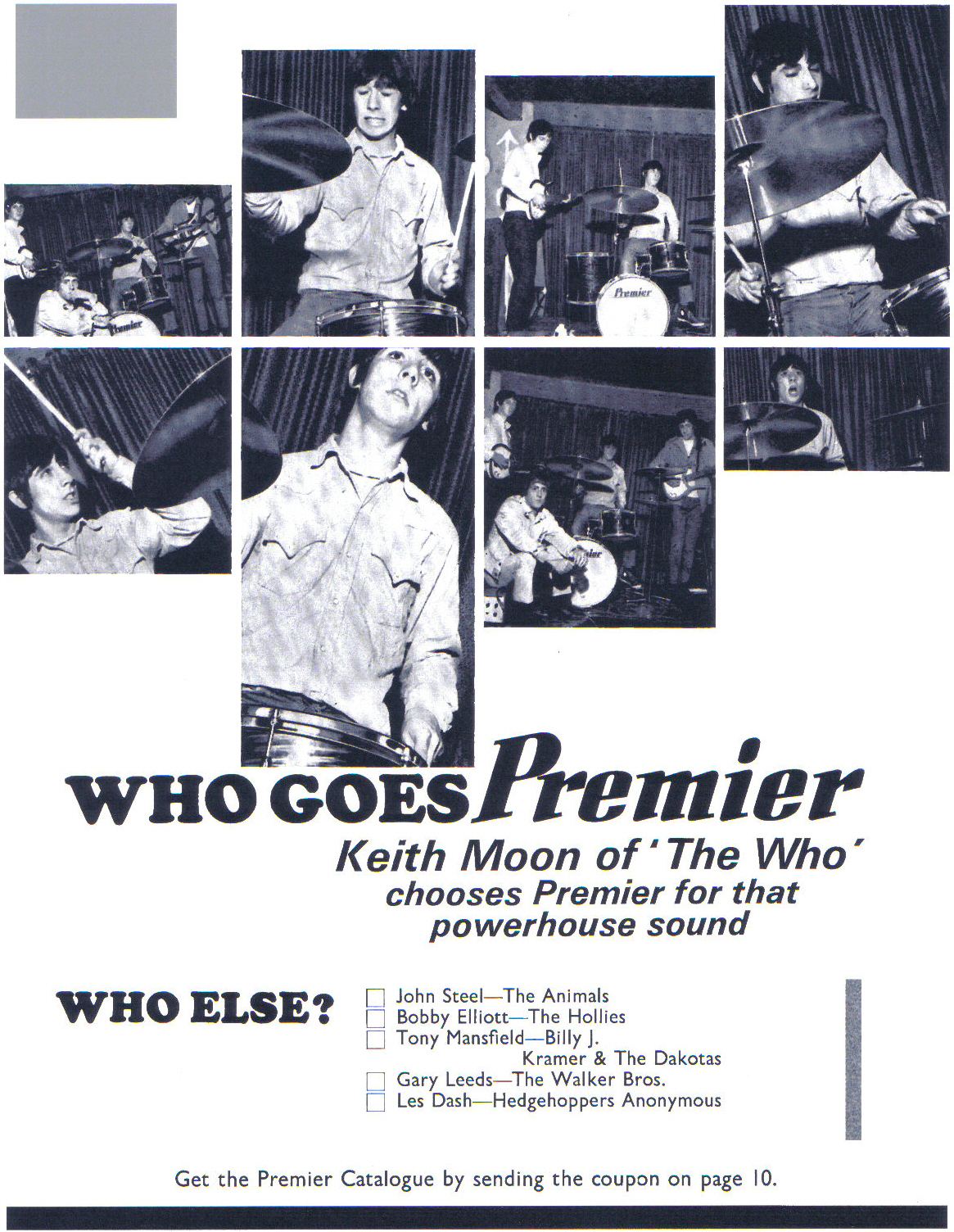
Click to view larger version. Premier ad – “Who Goes Premier” ad, from March 1966.
Revised: The kit pictured here, is likely borrowed from Premier for this photo shoot. A new Premier ad from March 1966 shows Keith with this striped Premier kit. The pictures look to be a photo shoot, given the types of the shots. The purpose is likely for this ad and nothing more. Keith’s red glitter Premier kit might not have been finished for the photo shoot.
The kit Keith used in this photo is a Premier kit with the same finish as the Premier kit that Doug Sandom (the original Detours drummer) owned (though the stripes on the finish go the opposite way on the two drumkits).
The picture of Keith is from the February 1966 “Beat Instrumental” magazine, though photo was likely taken in 1965. From what is known, Keith didn’t own a kit with this finish.
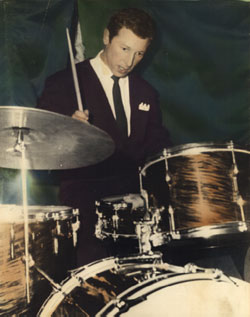
Doug Sandom of the Detours playing his Premier kit, which he would end up lending to The Who for a month after they kicked him out of the group.
Click to view larger version. Doug Sandom playing his Premier kit with the Detours. From left to right, John on bass, Colin Dawson on vocal, Sandom on drums, Roger on lead guitar, playing an Epiphone.
January 1965 – Trixon kit, Ready Steady Go!
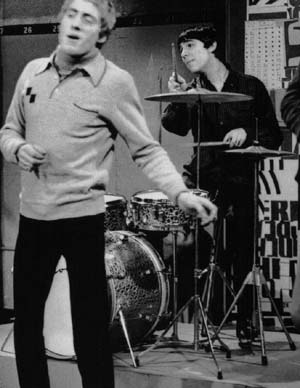
Keith playing Trixon kit on Ready Steady Go!, 29 Jan. 1965.
Keith used a Trixon kit once on Ready Steady Go!, 29 Jan. 1965. (See trixondrums.de for more on Trixon drums.)
- Brand: Trixon
- Model: Luxus 0/200
- Finish: Blue Croco
- One 13″ mounted tom
- One 16″ floor tom
- One 20″ bass drum
- One 14″ × 5″ snare
- Hi-hat
- Crash
- Ride
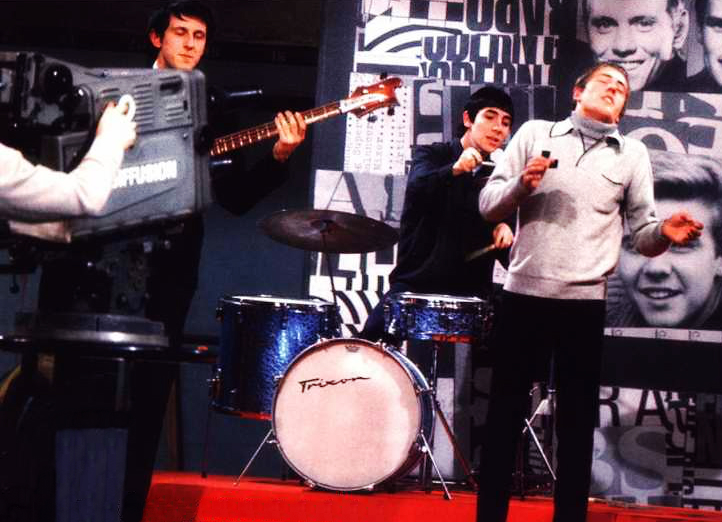
Click to view larger version. On Ready Steady Go!, 29 Jan. 1965.
Mid-1965 – White Marine Pearl English Rogers kit, Top of the Pops
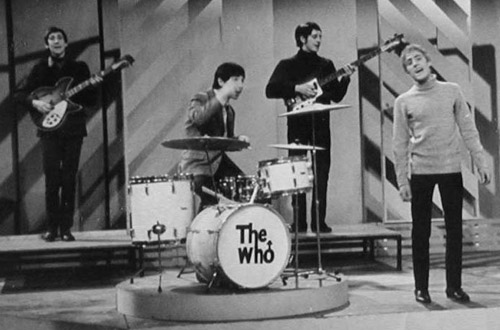
- English Rogers were Rogers drums made under licence in the UK by Boosey & Hawkes in Edgware, North London, between 1961 and 1967–8.
- This particular kit was rented repeatedly in the early 1960s by the BBC for broadcasts of Top of the Pops from their Manchester studios from well-known local music shop Johnny Roadhouse.
- Specs:
- Snare is a chrome. Could be either his favourite type of Ludwig 400 series Supraphonic or his next favourite, the Premier 2000 series. Both are chromed alloy.
- Rack tom is 12″ × 8″
- Bass drum is 20″×14″
- Floor tom size is 16″×16″
- 18″ or 16″ ride or crash
- 20″ or 22″ ride cymbal attached
- Premier flush base stand, etc.
- The tom holder is the famous Rogers Swiv-o-matic type.
This kit was owned by Stu Valentine from 1987 to 1991.
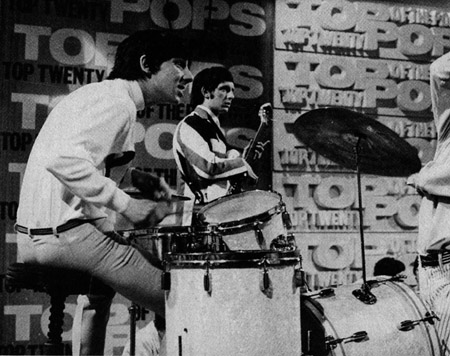
On Top of the Pops, 10 June 1965.
Stu Valentine:
“In 1987, I started Manchester University and had left my usual drums back at a friend’s in my home town but I wanted a cheap knockabout kit. I was walking past Johnny Roadhouse one day and in the front of the upstairs window was a three-piece shell pack WMP English Rogers kit. I asked how much it was and it was, £75, so I said, great, I’ll have it. The boss’s son John Jr. (who now runs the shop in his own right) asked me how I was getting it home and in fact offered to give me a lift home with it. We got chatting and I ended up getting a job at the shop and worked there for three years or so before moving to London in 1991.
In that time I got chatting to John Sr. on a number of occasions about the shop and stories of old and he happened to mention that they hired out a lot of stuff to the BBC for TOTP and other shows, and that that kit I’d bought was the old hire kit. At the time I didn’t put two and two together and it’s only in the past 10 years or so since seeing pics on the internet of Keith playing those drums that I realised what it was that I’d owned.
Without realising its back story, I sold the kit because I needed money when I arrived in London. So, if you came to a slightly musty cellar in Shepherds Bush in 1991 to buy a WMP English Rogers drum set you’d seen advertised in loot, you own little piece of musical history!”
19 June 1965 – Premier kit, Uxbridge Blues and Folk Festival
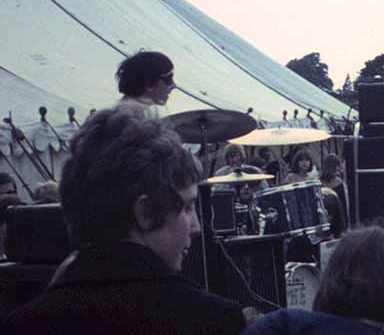
19 June 1965, at the Uxbridge Blues and Folk Festival. Courtesy SoundCityChris.
19 June 1965, The Who appeared at the Uxbridge Blues and Folk Festival. Keith is using what appears to be a blue-finished Premier four-piece kit of unknown origin.
6 Aug. 1965 – Premier kit, Ready Steady Go!
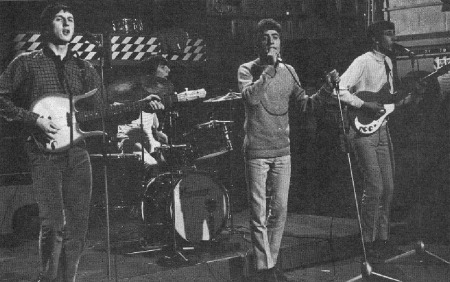
6 Aug. 1965, The Who appeared on Ready Steady Go! at Wembley Studios in London using borrowed gear as their regular gear was already in Richmond for the 5th National Jazz & Blues Festival gig that night.
On 6 Aug. 1965, The Who appeared on Ready Steady Go! at Wembley Studios in London using borrowed gear, as their regular gear was already in Richmond for the 5th National Jazz & Blues Festival gig that night. Keith is using unknown Premier four-piece kit of unknown origin.
September 1965 – Lee Kings kit
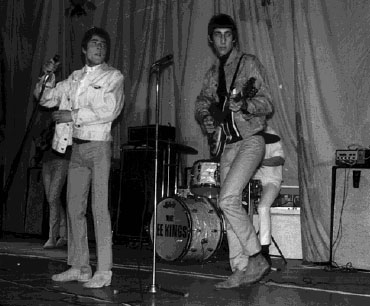
25 Sept. 1965, Keith playing the Lee Kings drumkit.
On 25 Sept. 1965, The Who played in Elsinore (Helsingör), Denmark, at 9 p.m., then rushed 20 miles to play a midnight show in the capital Copenhagen at “KB Hallen.”
According to The Who in Denmark & Norway & Finland, the Swedish band The Lee Kings’ drummer Lasse Sandgren lent his kit to Keith because the Who’s equipment had been sent directly from England to Copenhagen.
“The Who’s equipment were sent directly from England to Copenhagen, so Keith asked me if he could use my drums. I had put weights on my bass-drum pedal, to get more “swung”, and that made the pedal more stiff, something Keith was uncomfortable with. I had to remove the weights before he used it.”
Just two weeks after, the two drummers met again, this time in Gothenburg, Sweden. Also this time Keith borrowed Lasse’s drums. Lasse Sandgren later sold his kit and bought a brand new Slingerland kit.
October 1965 – Mascots kit
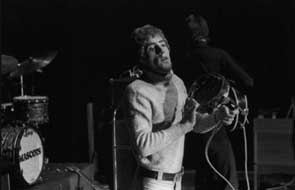
Moon with Mascots’ kit, Stockholm, Sweden, 10 Oct. 1965.
Keith borrowed the support act’s — the Mascots — drumkit because all of the equipment was sent to the venue they played later that day.
From the Concert File for 10 Oct., Johanneshovs Isstadion, Stockholm, Sweden:
They appeared in Stockholm at 2:00 pm and went on to Gothenburg for two evening shows. Due to a flight mix-up, The Who’s equipment had been shipped directly to Gothenburg for the later show. The gig went ahead with equipment borrowed from the supporting acts The Overlanders, The Mascots and The Moonjacks.
December 1965 – Dave Clark Five Red Sparkle English Rogers kit, Ready Steady Go!
On 31 Dec. 1965, The Who appear on the popular TV show Ready Steady Go! in a special called “The New Year Starts Here.”
Keith uses a Red Sparkle English Rogers drumkit borrowed from The Dave Clark Five during rehearsals. According to the book, Anyway Anyhow Anywhere, Keith’s drumkit arrived for the actual broadcast, although photos of the broadcast show the same kit now fitted with a “The Who” logo on the bass drum skin. Why change drumskin to one with a Who logo, for a rehearsal?
For more information about this kit, including its current whereabouts, see Dave Clark’s English Rogers drumkit site.
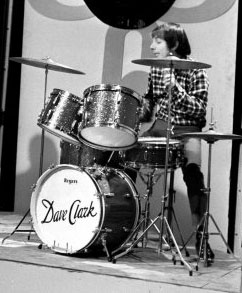
31 Dec. 1965, rehearsals for Ready Steady Go!, with Keith playing on Dave Clark Five double-tom Rogers kit.
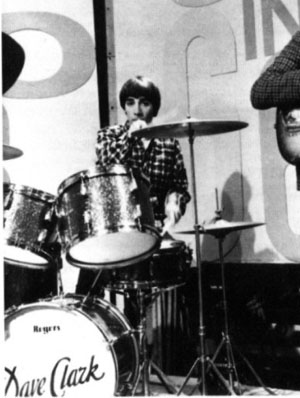
31 Dec. 1965, rehearsals for Ready Steady Go!, with Keith playing on Dave Clark Five double-tom Rogers kit.
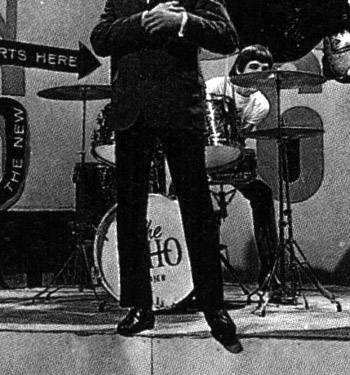
31 Dec. 1965, broadcast for Ready Steady Go!, with Keith playing on same drumkit fitted with “The Who” logo on bass drum skin.
March 1966 – white Premier kit, Top of the Pops
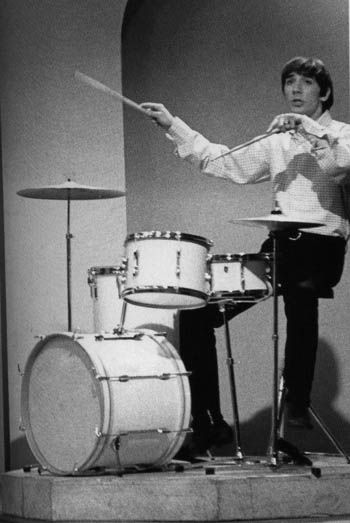
The Who performed Substitute on Top of the Pops, in March 1966, and Keith is seen with a white Premier kit.
- Wood shell snare
- Probably 12″ tom tom
- The bass looks like it could be 20″
- The floor tom could be a 16″ (pre-International) × 20″
- Possibly a 16″ crash cymbal or an 18″ ride cymbal and 14″ hi-hats
- The hardware is the early “flush base” type cymbal stands, which Keith used right up until the chrome kit from ’68.
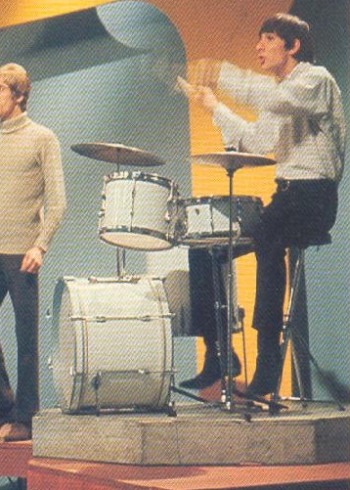
On Top of the Pops, in March 1966. Photo courtesy Chris.
Premier kit (unknown)
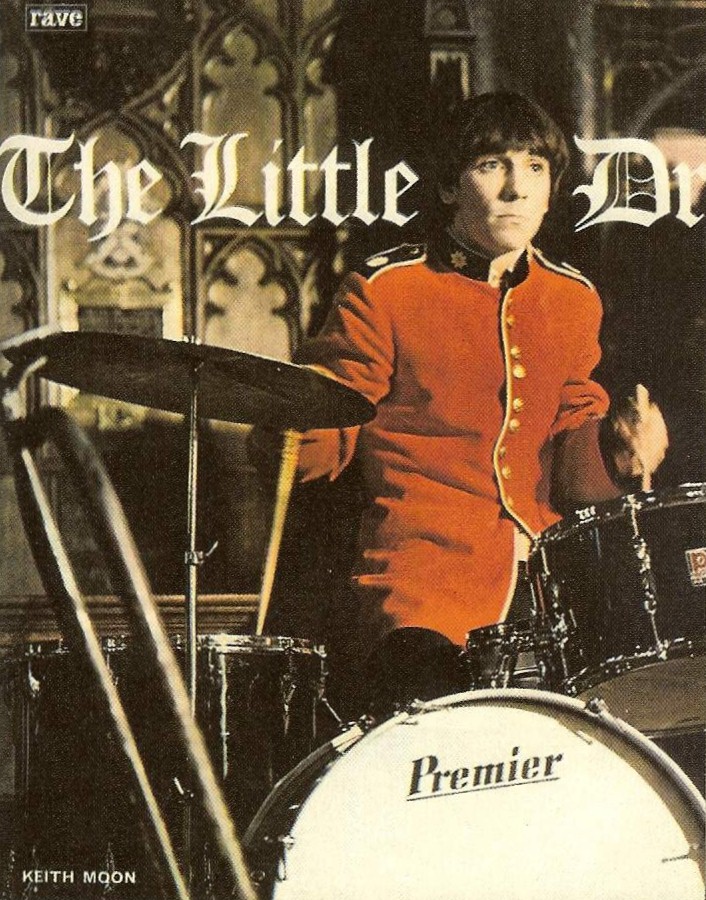
Click to view larger version. Borrowed Premier kit in Rave magazine, December 1966.
Mid-1960s Premier kit used in what looks to be a photo shoot. Photo published in Rave magazine in December 1966. The snare drum is a Ludwig 400.
October 1966 – Tages kit
The Who taped I’m A Boy, Substitute and My Generation for the Danish TV show “Klar I Studiet” on 20 Oct. 1966 in Denmark using gear borrowed from a group called Tages.
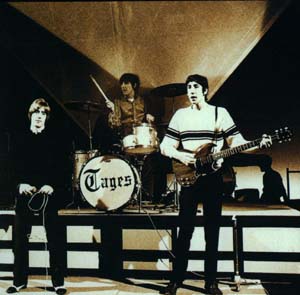
Moon with Tages’ drumkit, Denmark, 20 Oct. 1966. (Pete is using a borrowed pre-1966 Gibson SG Special.
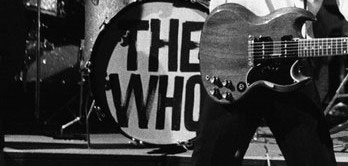
Keith had a “WHO” logo bassdrum skin fitted for the actual performance. Notice that it is simply painted on the skin.
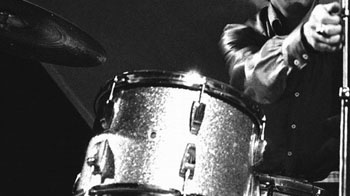
Closeup of borrowed Tages kit.
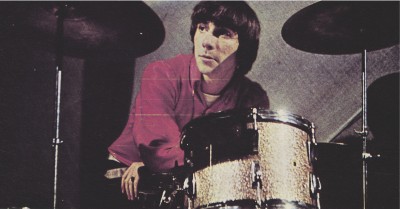
Colour photo of borrowed Tages kit.
14 June 1967 – Slingerland kit
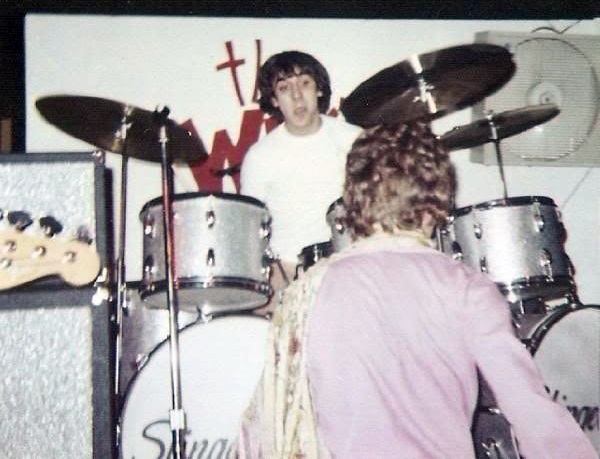
14 June 1967, Ann Arbor, Michigan, Keith with silver sparkle kit. (Photo: SoundCityChris)
14 June 1967, Ann Arbor, Michigan
This appears to be the same Slingerland drumkit played at Monterey Pop Festival, but with non-Rogers tom mounts.
18 June 1967 – ‘Monterey Pop’ Slingerland kit
Rented kit for the Monterey Pop Festival and prior shows. For the first 1967 U.S. tours, The Who did not bring their own gear to save on freight.
Note: Diagram is missing third mounted tom and third floor tom.
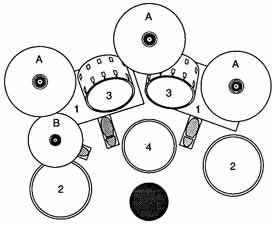
Drums:
Slingerland, with tom mounts apparently changed to Rogers Swiv-O-Matics.
- Two 22″ bass drums
- Three 16″ floor toms
- Three 13″ mounted toms
- 14″ × 5½″ Ludwig snare drum
Cymbals:
Manufacturer unknown
- crash/ride (sizes unknown)
- hi-hats (sizes unknown)
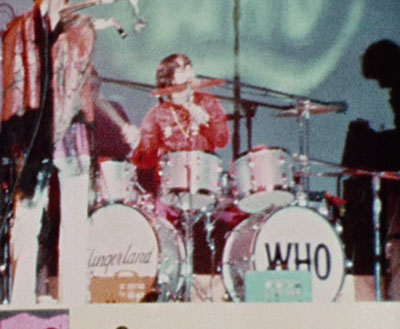
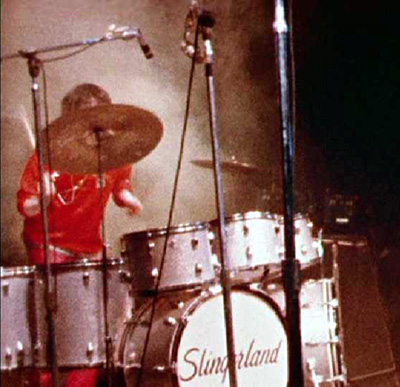
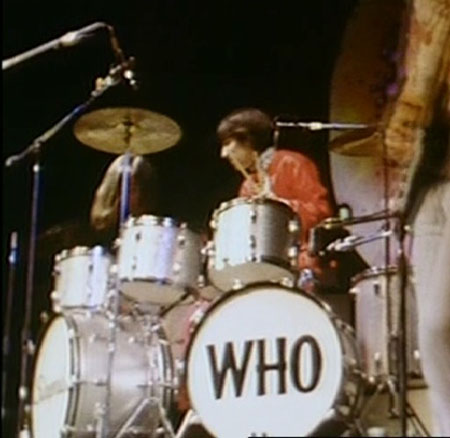
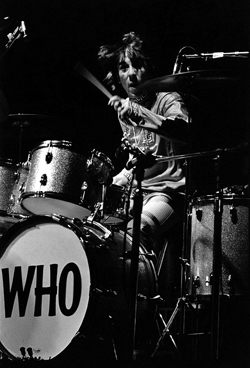
Monterey Pop Festival, 18 June 1967, showing Premier “Everplay” logo on kick drum skin behind anchor. (h/t Craig L.)
1968–69 – Premier kit (studio only)
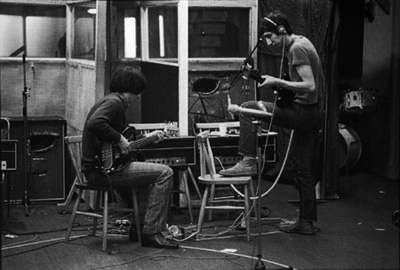
Ca. February–March 1969, recording sessions for Tommy. White Marine Pearl Premier kit is visible at right.
For some IBC Studios dates for the recording of Tommy, Keith used a borrowed White Marine Pearl Premier kit. (He also used his Champagne Silver Premier kit for these recordings.) This kit was possibly borrowed from Who roadie Tony Haslam.
September 19, 1968: IBC Studios, Anyway Anyhow Anywhere references that, “Having exhausted Premier’s tolerance, Keith used a new double kit belonging to roadie Tony Haslam.”
Specs
Finish:
White Marine Pearl
Sizes (Depth x head size)
- Bass drum:
- 14″ × 22″
- Rack tom:
- 8″ × 14″
- Floor tom:
- 16″ × 16″
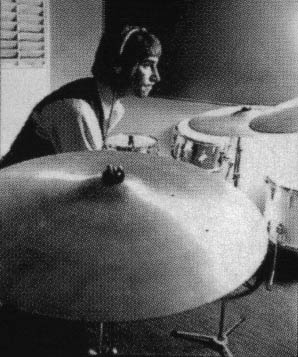
Keith during the recording of Tommy, with a combination of White Marine Pearl and Champagne Silver Premier drums.
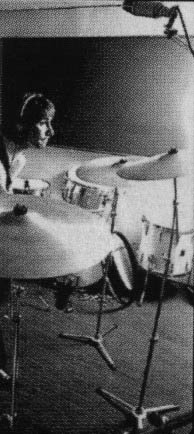
Keith during the recording of Tommy, with a combination of White Marine Pearl and Champagne Silver Premier drums.
30 Aug. 1969 – Isle of Wight
Not a borrowed kit per se, but a lent kit, with Marsha Hunt, who were the act on before The Who, having borrowed Keith’s kit, along with the rest of the stage setup.
Per UK Rock Festivals, according to the guitar player, Ged Peck, the band were forced to use The Who’s gear for this gig.
For more information, see UK Rock Festivals: Marsha Hunt.
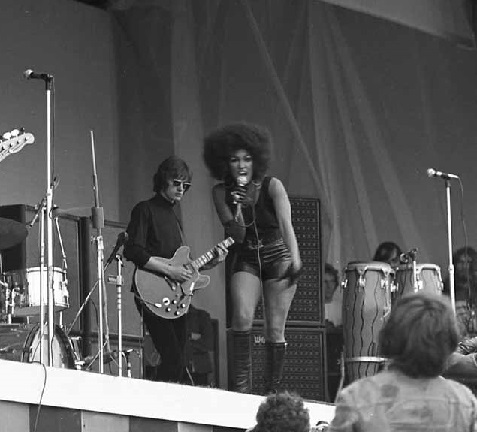
30 Aug. 1969, Marsha Hunt using The Who’s gear at the Isle of Wight. (photo courtesy SoundCityChris)
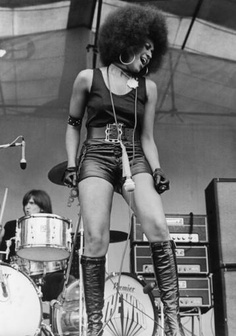
30 Aug. 1969, Marsha Hunt using The Who’s gear at the Isle of Wight. (photo courtesy SoundCityChris)
1971 – Ludwig kit (studio only)
Likely a hired or studio kit, used in the March 1971 Record Plant studio sessions, New York.
This is likely a ’60s Ludwig kit in Champagne Sparkle, based on the lug design and the tom mounting hardware. Note that there are only two tom toms.
Both rack toms appear to be 13×9s. The bass drums are probably 22×14s, and the two floor toms may be 16×16s.
On the snare drum (pictured below), material (possibly cotton) is taped to the edge of the drumhead. This is done to reduce a buzzing sound that often can occur from when playing a snare drum, especially around other instruments.
In the right photo, below, a Premier Everplay Plus drumhead can be seen on the tom in the foreground. The other tom has a Remo head.
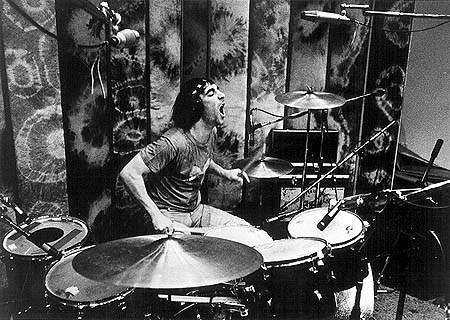
Ca. March 1971, in the studio, Record Plant, New York, with Ludwig kit.
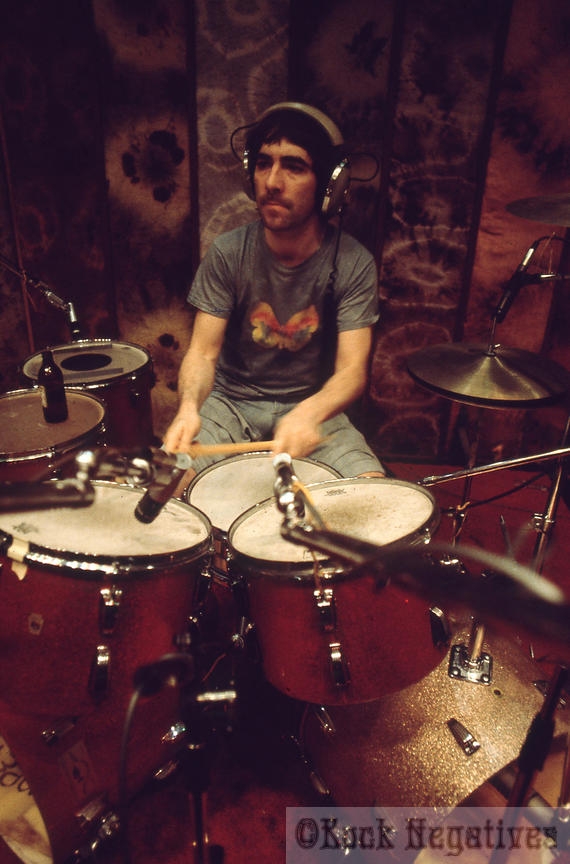
Click to view larger version. In the studio, ca. March 1971, with Ludwig kit. The distinctive Remo crown logo can clearly be seen.
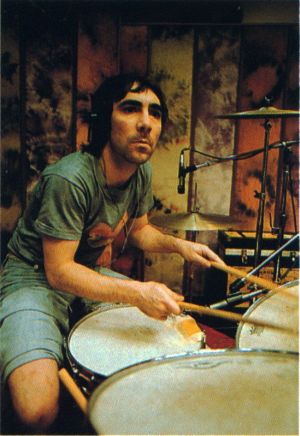
In the studio, ca. March 1971, Record Plant, New York, with Ludwig kit, with snare drum muffling visible below microphone. A Premier Everplay Plus drumhead can be seen on the tom in the foreground, with tom at left a Remo head, with its distinctive crown logo. (See closeup at right.)
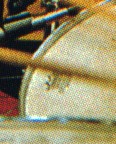
Same photo as left, closeup of the the distinctive Remo crown logo.
15 December 1971 – Seattle
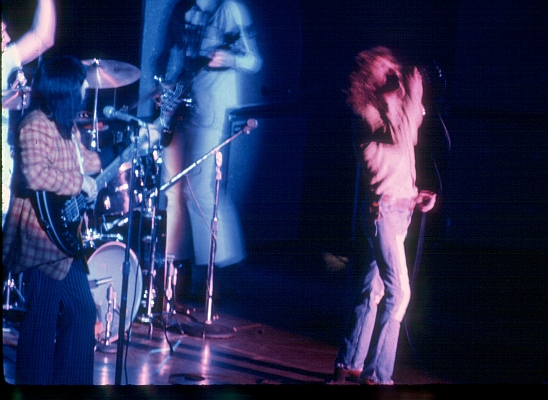
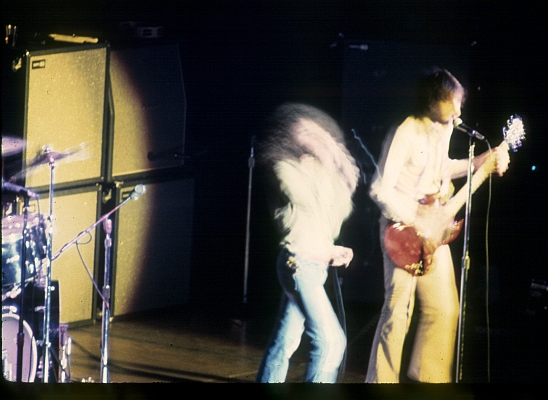
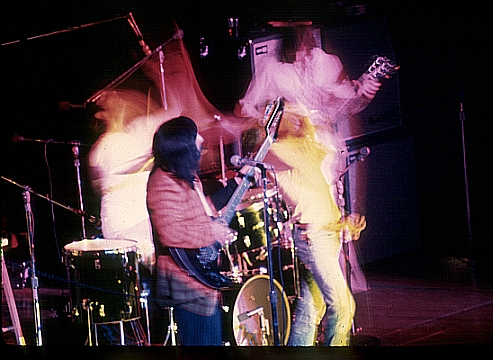
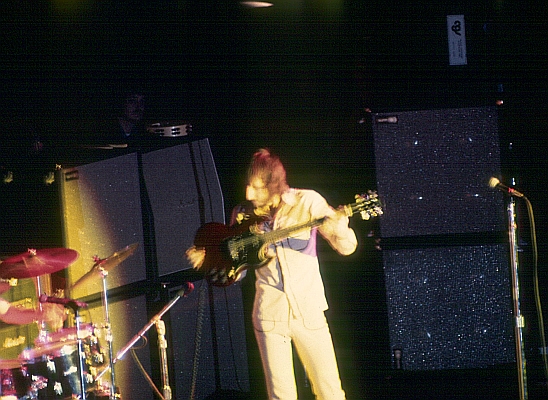
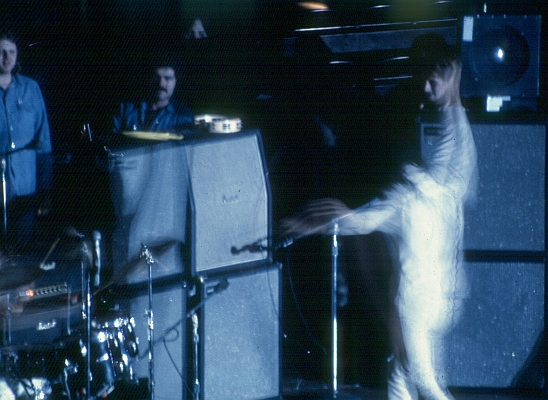
For a show at the Seattle Center Coliseum in Seattle, Wash., on 15 December 1971, Keith used a kit apparently borrowed from the supporting act, as one of the Who’s equipment trucks had crashed en route from San Francisco. Pete also used gear borrowed from the opening act.
In the photos below, Keith appears to be using a two-bass-drum Rogers kit, with two rack toms and one floor tom.
The Who at the Seattle Center Coliseum, 15 Dec., 1971
Photos copyright and courtesy of Jeff Gledhill. Please respect the owner of these photos and do not reuse them for public or private use.
1974 – Vistalites
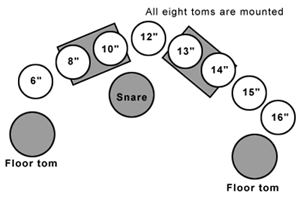
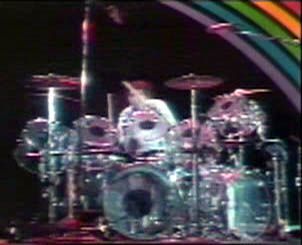
8 Oct. 1974, the Midnight Special drum solo clip with Vistalites drumkit.
In 1974, Keith used another transparent drumkit (as he’d previously used a Zickos transparent kit in 1970–1971). This time it was from Ludwig, who launched their own line of acrylic drums called Vistalites. This kit comprised:
- Two 24″×14″ bass drums
- Two 18″×16″ floor toms
- Eight mounted tom toms: 6″, 8″, 10″, 12″, 13″, 14″, 15″, 16″
- Custom-built drumrack
Keith used this drumkit performing on the U.S. TV show “Wide World In Concert: Midnight Special” on ABC on 8 Oct. 1974. As a gimmick, he put goldfish in the floor tom to his left.
Video clip of Midnight Special can be found at vistalites.com/legends/moon.htm.
For more information on Vistalites drums, see vistalites.com.
1974 – Ludwig “Son of Dracula” kit
Clip from Son of Dracula featuring Keith on the Ludwig kit for “Jump Into The Fire.”
Via YouTube.
Keith used a Ludwig kit of unknown origin in the movie Son of Dracula in 1974.
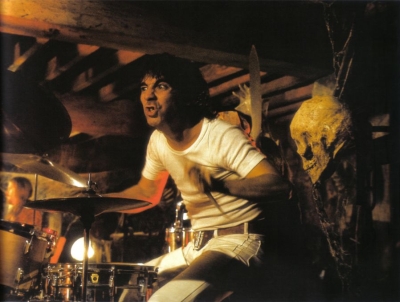
Keith in the film Son of Dracula.
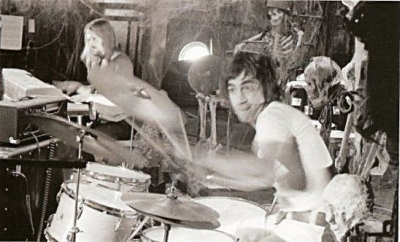
Keith in the film Son of Dracula.
1974 – Premier “Stardust” kit
Information and kit photos courtesy Rock Stars Guitars.
Keith in the film Stardust.
A mid-’60s blue/black pearl finish Premier kit used by Keith Moon in the movie Stardust as J.D. Clover, drummer with “The Stray Cats.”
All heads and stands are original. It is in the same condition as it was in 1974, apart from the faded Stray Cats logo (and a layer of dust). The logo has been removed and reattached, presumably when it was used on Keith’s double gold kit later in the movie, along with another identical Stray Cats logo. There has been a logo attached to the beater head of this drum too, which is also white, presumably this “other” logo. Keith used his own cymbals for the shoot.
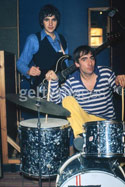
Keith in the film Stardust.
This kit was obtained from the production company after the shoot, and has remained in private hands until purchased by Rock Stars Guitars recently.
Specification
- 20″ bass drum
- 16″ floor tom
- 12″ tom
- 14″ snare
This kit is available for sale through Rock Stars Guitars.

Click to view larger version. “Stardust” Premier kit, courtesy Rock Stars Guitars.
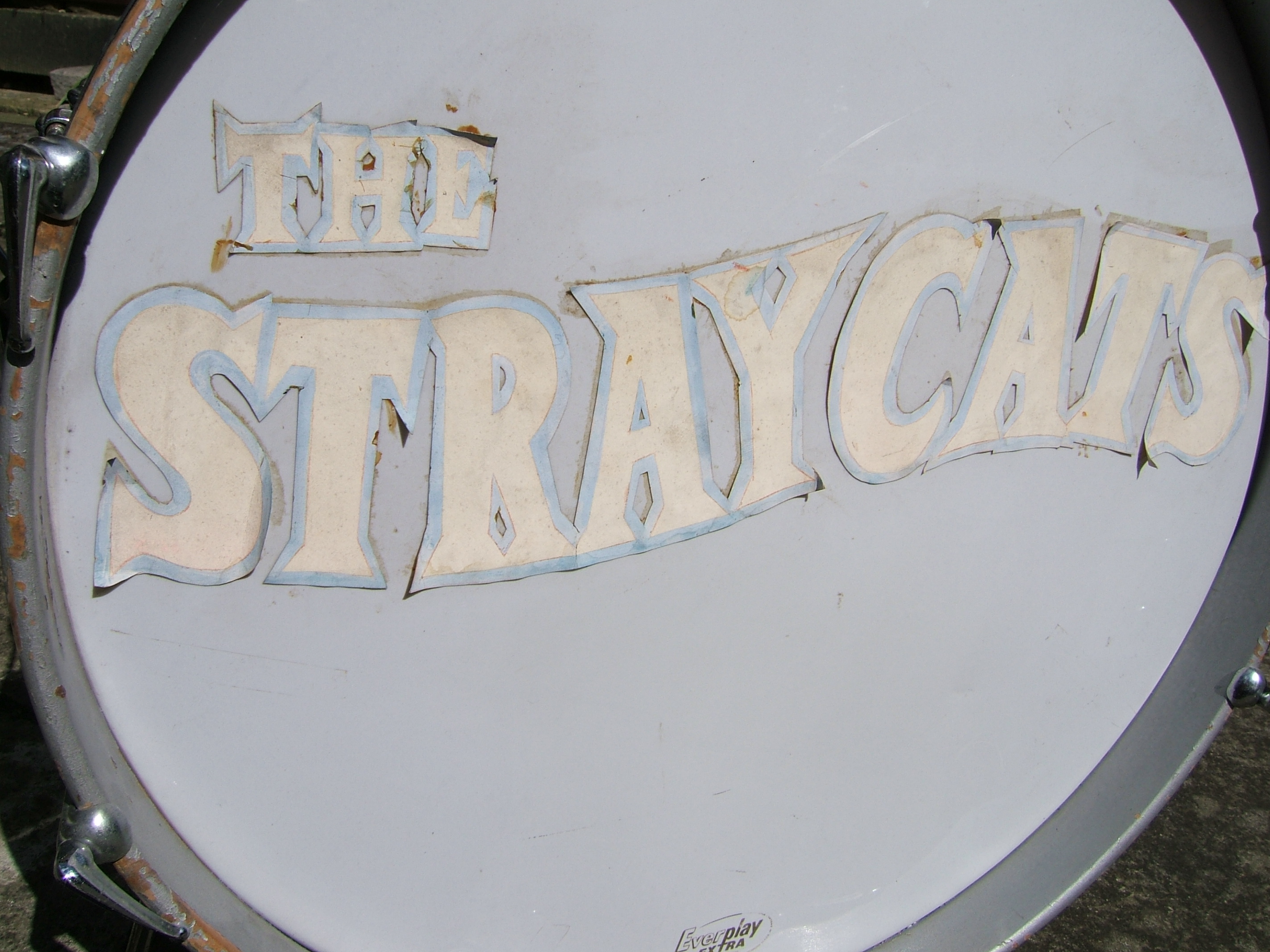
Click to view larger version. “Stardust” bass drum “Stray Cats” logo, courtesy Rock Stars Guitars.
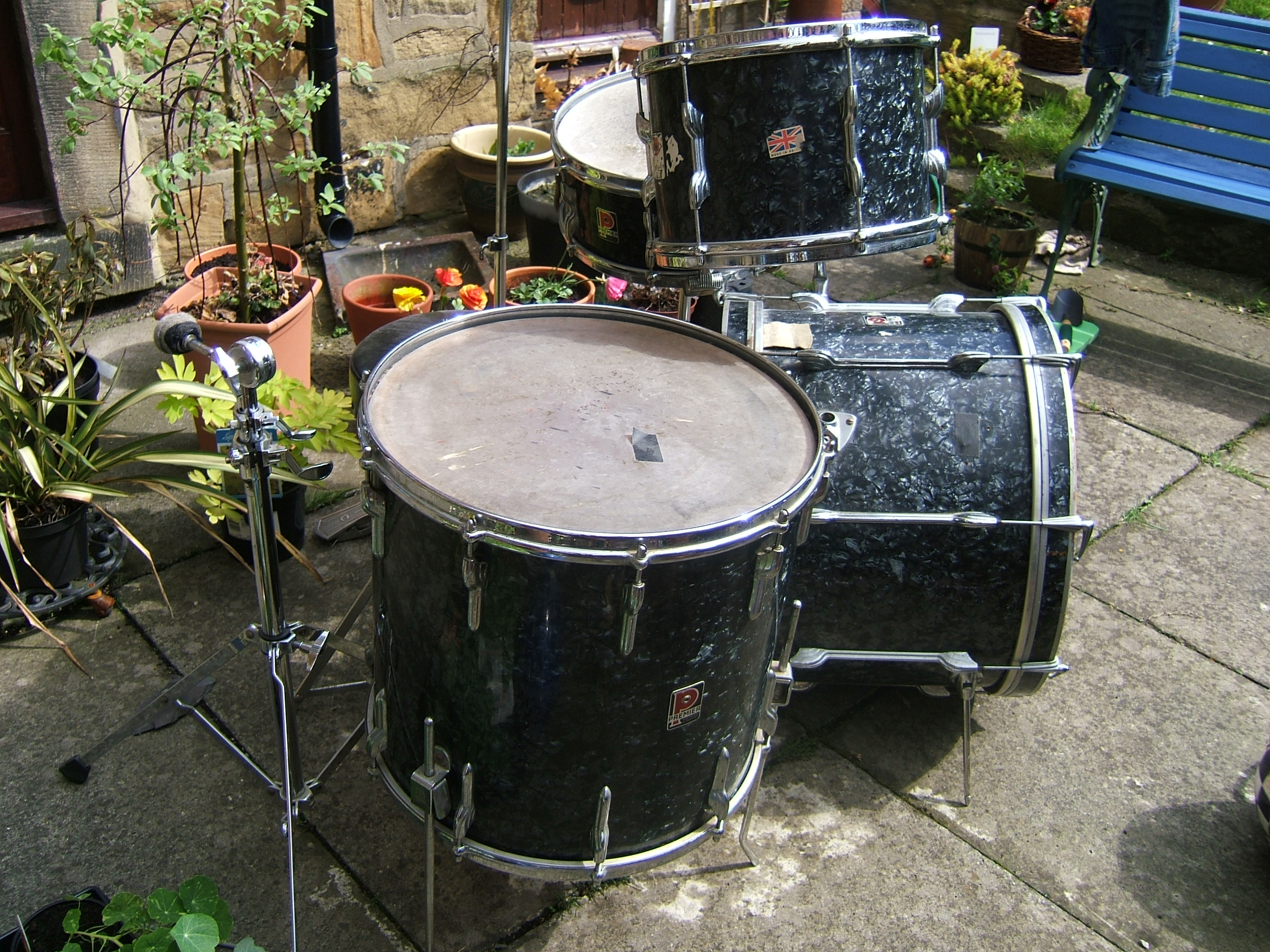
Click to view larger version. “Stardust” Premier kit, courtesy Rock Stars Guitars.
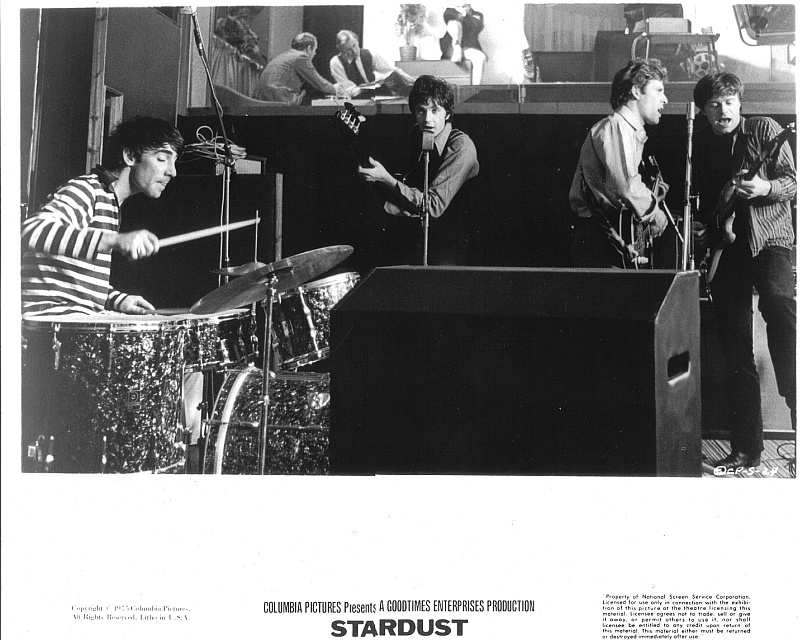
Click to view larger version. “Stardust” promotional photo, courtesy Martin Forsbom.
1974 – Ludwig “Roy Harper Valentine’s Day” kit
Keith played a Ludwig kit that appears to be configured similarly to the Premier gold-colored kit, on 14 Feb. 1974, the Rainbow Theatre, London, as The Intergalactic Elephant Band for Roy Harper’s Valentines’ Day concert.
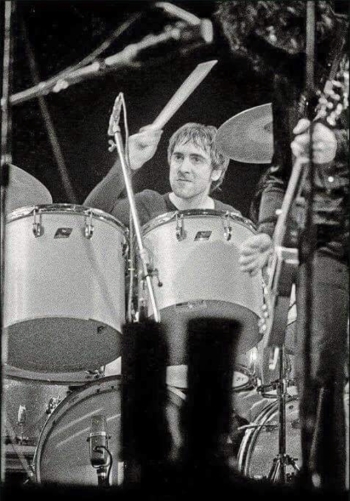
Keith played a Ludwig kit that appears to be configured similarly to the Premier gold-colored kit, on 14 Feb. 1974, the Rainbow Theatre, London, as The Intergalactic Elephant Band for Roy Harper’s Valentines’ Day concert. (courtesy Trevor K.)
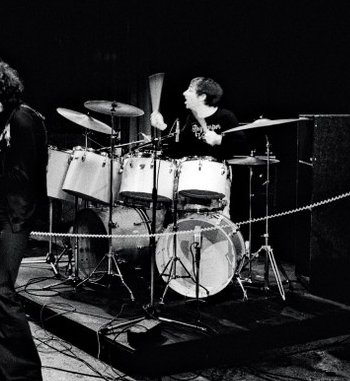
Keith played a Ludwig kit that appears to be configured similarly to the Premier gold-colored kit, on 14 Feb. 1974, the Rainbow Theatre, London, as The Intergalactic Elephant Band for Roy Harper’s Valentines’ Day concert. (courtesy Trevor K.)
Resources and Information
Contributors:
Many thanks to the following, who have made this page possible:
- Martin Forsbom (forsbom@gmail.com)
- Brad Rodgers at whocollection.com.
- Huw Owens (huw.owens@ntlworld.com)
- Trevor Penn
- Paul Wells (spiraling.net)
- Rock Stars Guitars
- Trevor K.
Additional information:
- Brad Rodgers at whocollection.com.
- David Brewis at Rock Stars Guitars, for pictures of Moon’s drumsticks, timbales, claves and drumheads.
- Tam Rankin at vintprem.moonfruit.com for information on vintage Premier drums.
Bibliography:
- Drums & Drumming magazine, October/November 1989.
- Modern Drummer, September 2003.
- Moon, the Life and Death of a Rock Legend, by Tony Fletcher. 1999.
Manufacturers’ sites
- Premier Drums: premier-percussion.com
- Ludwig Drums: ludwig-drums.com
- Paiste Cymbals: paiste.com
- Zildjian Cymbals: zildjian.com
- Slingerland Drums: slingerland.com (now owned by Gibson)
- Vistalites Drums: vistalites.com
- Zickos Drums: zickosdrums.com